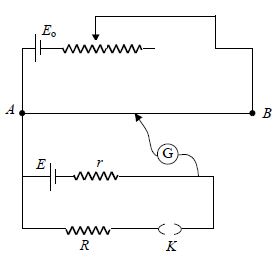
The given figure represents an arrangement of potentiometer for the calculation of internal resistance $(r)$ of the unknown battery $(E)$. The balance length is $70.0\, cm$ with the key opened and $60.0\,cm$ with the key closed. $R$ is $132.40 \Omega $. The internal resistance $(r)$ of the unknown cell will be.......$\Omega$ (Given $E_o > E$) :-
Medium
Download our app for free and get started
Internal resistance $r=\frac{R\left[l-l^{\prime}\right]}{l^{\prime}}$
where $l=$ balanced length with key open.
$l^{\prime}=$ balanced length with key $K$ closed
$\therefore r=\frac{132.40[70-60]}{60}=\frac{132.40 \times 10}{60}$
$=21.06\, \Omega \approx 22.1\, \Omega$

Download our appand get started for free
Experience the future of education. Simply download our apps or reach out to us for more information. Let's shape the future of learning together!No signup needed.*
Similar Questions
- 1In a meter bridge experiment the balance point in obtained if the gaps are closed by $2\,\Omega$ and $3\,\Omega$. A shunt of $x\,\Omega$ is added to $3\,\Omega$ resistor to shift the balancing point by $22.5\,cm$. The value of $X$ is $................$View Solution
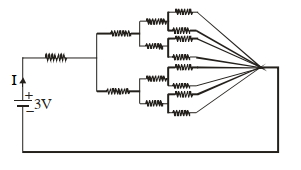
- 2All resistances in figure are $1\,\Omega$ each. The value of current ' $I$ ' is $\frac{a}{5}\,A$. The value of $a$ isView Solution
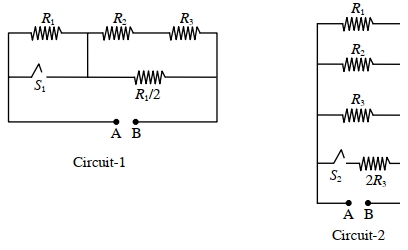
- 3In Circuit-$1$ and Circuit- $2$ shown in the figures, $R_1=1 \Omega, R_2=2 \Omega$ and $R_3=3 \Omega$. $P_1$ and $P_2$ are the power dissipations in Circuit-$1$ and Circuit-$2$ when the switches $S_1$ and $S_2$ are in open conditions, respectively. $Q_1$ and $Q_2$ are the power dissipations in Circuit-$1$ and Circuit-$2$ when the switches $S_1$ and $S_2$ are in closed conditions, respectively.View Solution
Which of the following statement($s$) is(are) correct?
$(A)$ When a voltage source of $6 V$ is connected across $A$ and $B$ in both circuits, $P_1$
$(B)$ When a constant current source of $2 Amp$ is connected across $A$ and $B$ in both circuits, $P_1>P_2$.
$(C)$ When a voltage source of $6 V$ is connected across $A$ and $B$ in Circuit-$1$, $Q_1>P_1$.
$(D)$ When a constant current source of $2 Amp$ is connected across $A$ and $B$ in both circuits, $Q_2$
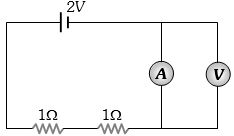
- 4In the circuit shown, $A$ and $V$ are ideal ammeter and voltmeter respectively. Reading of the voltmeter will be ............... $V$View Solution
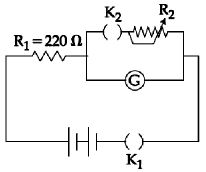
- 5The galvanometer deflection, when key $K_1$ is closed but $K_2$ is open, equals $\theta_0$ (see figure). On closing $K_2$ also and adjusting $R_2$ to $5\,\Omega $ , the deflection in galvanometer becomes $\frac{{\theta _0}}{5}$. The resistance of the galvanometer is, then, given by [Neglect the internal resistance of battery]: .................. $\Omega$View Solution
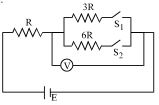
- 6In the circuit shown in figure reading of voltmeter is $V_1$ when only $S_1$ is closed, reading of voltmeter is $V_2$ when only $S_2$ is closed. The reading of voltmeter is $V_3$ when both $S_1$ and $S_2$ are closed thenView Solution
- 7View SolutionWhat is immaterial for an electric fuse wire
- 8In a potentiometer, the null point is received at $7^{th}$ wire. If now we have to change the null point at $9^{th}$ wire, what should we do ?View Solution
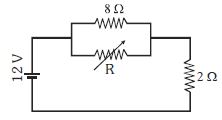
- 9The value of the resistance $R$ in figure is adjusted such that power dissipated in the $2\,\Omega $ resistor is maximum. Then the power dissipated in the $2\,\Omega $ will be ................ $W$View Solution
- 10It takes $12$ minutes to boil $1$ litre of water in an electric kettle. Due to some defect it becomes necessary to remove $20 \%$ turns of heating coil of the kettle. After repair, how much time will it take to boil $1$ litre of water.View Solution