MCQ
This question has Statement-I and Statement-2. Of the four ch.oices given after the Statements, choose the one that best describes the two Statetnents.

Statement $-1$ : A capillary is dipped in a liquid and liquid rises to a height $h$ in it. As the temperature of the liquid is raised, the height $h$ increases (if the density of the liquid and the angle of contact remain the same).

Statement $-2$ : Surface tension of a liquid decreases with the rise in its temperature.

  • A
    Statement $- 1$ is true, Statement $-2$ is true; Statement $-2$ is not the correct explanation for Statemer $- 1$
  • Statement $-1$ is false, Statement $-2$ is true
  • C
    Statement $- 1$ is true, Statement $-2$ is false
  • D
    Statement $- 1$ is true, Statement $-2$ is true; Statement $-2$ is the correct explanation for Statement $- 1$
Answer

Correct option: B.
Statement $-1$ is false, Statement $-2$ is true
b
Surface tension of a liquid decreases with the rise in temperture. At the boiling point of liquid, surface tension is zero.

$Capillary\,rise\,h = \frac{{2T\cos \theta }}{{rdg}}$

As surface tension $T$ decreases with rise in temperature hence capillary rise also decreases.

Need a full question paper?

Generate a complete, print-ready paper with questions like this in minutes — across 16+ boards, with answer keys.

Start Generating Free

Similar questions

In an experiment to find acceleration due to gravity $(g)$ using simple pendulum, time period of $0.5\,s$ is measured from time of $100$ oscillation with a watch of $1\;s$ resolution. If measured value of length is $10\; cm$ known to $1\; mm$ accuracy. The accuracy in the determination of $g$ is found to be $x \%$. The value of $x$ is
Consider the two statements related to circular motion in usual notations

$A$. In uniform circular motion $\vec{\omega}, \vec{v}$ and $\vec{a}$ are always mutually perpendicular

$B$. In non-uniform circular motion, $\vec{\omega}, \vec{v}$ and $\vec{a}$ are always mutually perpendicular

A thin uniform rod of mass $M$ and length $ L$ is rotating about a perpendicular axis passing through its centre with a constant angular velocity $\omega$. Two objects each of mass $\frac{ M }{3}$ are attached gently to the two ends of the rod. The rod will now rotate with an angular velocity of
A particle executes $S.H.M.,$ the graph of velocity as a function of displacement is :-
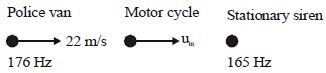
A police van, moving at $22\, m/s$ , chases a motor-cyclist. The police man sounds horn at $176\, Hz$ , while both of them move towards a stationary siren of frequency $165\, Hz$ as shown in the figure. If the motor-cyclist does not observe any beats, his speed must be .... $m/s$ (take the speed of sound $= 330\, m/s$ )
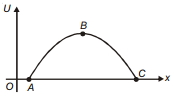
The variation of potential energy $U$ of a body moving along $x$-axis varies with its position $(x)$ as shown in figure  The body is in equilibrium state at
A soap film of surface tension $3 \times {10^{ - 2}}\,N{m^{ - 1}}$ formed in rectangular frame, can support a straw. The length of the film is $10\, cm$. Mass of the straw the film can support is ........ $gm$
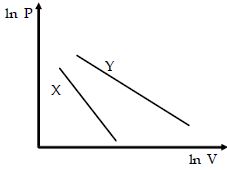
For two different gases $X$ and $Y,$ having degrees of freedom $f_1$ and $f_2$ and molar heat capacities at constant volume $C_{v_1}$ and $C_{v_2}$ respectively, for adiabatic process , the $\ln P$ versus $\ln V$ graph is plotted as shown :-
A particle of mass $m$ is moving with speed $2\, v$ collides with a mass $2\,m$ moving with speed $v$ in the same direction. After collision, the first mass is stopped completely while the second one splits into two particles each of mass $m$, which move at angle $45^o$ with respect to the original direction. The speed of each of the moving particle will be
If opened door of a refrigerator in working condition kept in an insulated room: