MCQ 11 Mark
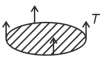
A thin flat circular disc of radius $4.5 \mathrm{~cm}$ is placed gently over the surface of water. If surface tension of water is $0.07 \mathrm{~N} \mathrm{~m}^{-1}$, then the excess force required to take it away from the surface is
- A
$198 \mathrm{~N}$
- B
$1.98 \mathrm{mN}$
- C
$99 \mathrm{~N}$
- ✓
$19.8 \mathrm{mN}$
AnswerCorrect option: D. $19.8 \mathrm{mN}$
d
$\text { Excess force }=T \times 2 \pi R$
$=\frac{7}{100} \times 2 \times 3.14 \times \frac{4.5}{100}$
$=197.82 \times 10^{-4}$
$=19.8 \times 10^{-3} \mathrm{~N}$
$=19.8 \mathrm{mN}$
View full question & answer→MCQ 21 Mark
The amount of energy required to form a soap bubble of radius $2\,cm$ from a soap solution is nearly $..........\,\times 10^{-4}\,J$: (surface tension of soap solution $=0.03\,N\,m ^{-1}$ )
- A
$50.1$
- B
$30.16$
- C
$5.06$
- ✓
$3.01$
AnswerCorrect option: D. $3.01$
d
$E =2 T \left(4 \pi R ^3\right)$
$=2(0.03)(4)(3.14)\left(2 \times 10^{-2}\right)^2$
$=3.01 \times 10^{-4}\,J$
View full question & answer→MCQ 31 Mark
If a soap bubble expands, the pressure inside the bubble:
- A
- B
- C
is equal to the atmospheric pressure
- ✓
Answerd
$P=P_{0}+\frac{4 T}{R}$
$\Rightarrow R$ increases and $P$ decreases
View full question & answer→MCQ 41 Mark
A capillary tube of radius $r$ is immersed in water and water rises in it to a helght $h$. The mass of the water in the capillary is $5\,g.$ Another capillary tube of radlus $2\, r$ is immersed in water. The mass of water that will rise in this tube is $........\;g$
- A
$20.0$
- B
$2.5$
- C
$5.0$
- ✓
$10.0$
AnswerCorrect option: D. $10.0$
d
$h=\frac{2 T \cos \theta}{r \rho g}$
Mass of water in the firsr tube,
$m=\pi r^{2} h \rho=\pi r^{2} \times\left(\frac{2 T \cos \theta}{r \rho g}\right) \times \rho$
$=\frac{2 \pi r T \cos \theta}{g}$
$m \propto r$
$\frac{ m _{2}}{ m _{1}}=\frac{ r _{2}}{ r _{1}}$
$\frac{ m _{2}}{5}=\frac{2 r }{ r }$
$m _{2}=10 g$
View full question & answer→MCQ 51 Mark
A liquid does not wet the solid surface if angle of contact is
AnswerCorrect option: D. greater than $90^{\circ}$
d
If angle of contact is greater than $90^{\circ},$ then liquid will not wet the wall of container.
View full question & answer→MCQ 61 Mark
A soap bubble, having radius of $1\; \mathrm{mm}$, is blown from a detergent solution having a surface tension of $2.5 \times 10^{-2}\; N / m$. The pressure inside the bubble equals at a point $Z_{0}$ below the free surface of water in a container. Taking $g=10\; \mathrm{m} / \mathrm{s}^{2}$ density of water $=10^{3} \;\mathrm{kg} / \mathrm{m}^{3},$ the value of $\mathrm{Z}_{0}$ is......$cm$
Answerc
$P=P_{0}+\rho g Z_{0}\ldots(i)$
Also, $\mathrm{P}=\mathrm{P}_{0}+\frac{4 \mathrm{T}}{\mathrm{R}}\ldots$ (ii)
From $(i) \;and\; (ii)$
$\rho g Z_{0}=\frac{4 \mathrm{T}}{\mathrm{R}}$
$\mathrm{z}_{0}=\frac{4 \mathrm{T}}{\mathrm{pgR}}$
$=\frac{4 \times 2.5 \times 10^{-2}}{10^{3} \times 10 \times 10^{-3}}=10^{-2} \mathrm{m}=1 \;\mathrm{cm}$
View full question & answer→MCQ 71 Mark
A rectangular film of liquid is extended from $(4 \,\,cm \times 2\, cm)$ to $(5\,\, cm \times 4\, cm).$ If the work done is $3 \times 10^{-4}\, J,$ the value of the surface tension of the liquid is ............ $Nm^{-1}$
- A
$0.2$
- B
$8.0$
- C
$0.250$
- ✓
$0.125$
AnswerCorrect option: D. $0.125$
d
$work\,done = Surface\,tension\,of\,film \times $
$Change\,in\,area\,of\,the\,film$
$or,\,\,W = T \times \Delta A$
$Here,{A_1} = 4\,cm \times 2\,cm = 8\,c{m^2}$
${A_2} = 5\,cm \times 4\,cm = 20\,c{m^2}$
$\Delta A = 2\,\left( {{A_2} - {A_1}} \right) = 24\,c{m^2} = 24 \times {10^{ - 4}}{m^2}$
$W = 3 \times {10^{ - 4}}J,T = ?$
$\therefore \,\,T = \frac{W}{{\Delta A}} = \frac{{3 \times {{10}^{ - 4}}}}{{24 \times {{10}^{ - 4}}}} = \frac{1}{8} = 0.125\,N\,{m^{ - 1}}$
View full question & answer→MCQ 81 Mark
Three liquids of densities $\rho _1,\rho _2$ and $\rho _3$ (with $\rho _1 > \rho _2 > \rho_3),$ having the same value of surface tension $T,$ rise to the same height in three identical capillaries. The angles of contact $\theta_1 \,,\theta_2$ and $\theta_3$ obey
- A
$\frac{\pi }{2} < {\theta _1} < {\theta _2} < {\theta _3} < \pi \;$
- B
$\;\pi > {\theta _1} > {\theta _2} > {\theta _3} > \frac{\pi }{2}$
- C
$\;\frac{\pi }{2} > {\theta _1} > {\theta _2} > {\theta _3} > 0$
- ✓
$\;0 \le {\theta _1} < {\theta _2} < {\theta _3} < \frac{\pi }{2}$
AnswerCorrect option: D. $\;0 \le {\theta _1} < {\theta _2} < {\theta _3} < \frac{\pi }{2}$
d
$Capillary\,rise,\,h = \frac{{2T\cos \theta }}{{r\rho g}}$
$For\,given\,value\,of\,T\,and\,r,h \propto \frac{{\cos \theta }}{\rho }$
$Also,{h_1} = {h_2} = {h_3}\,\,or\,\,\frac{{\cos {\theta _1}}}{{{\rho _1}}} = \frac{{\cos {\theta _2}}}{{{\rho _2}}} = \frac{{\cos {\theta _3}}}{{{\rho _3}}}$
$Since\,{\rho _1} > {\rho _2} > {\rho _{3'}}\,so\,\cos {\theta _1} > \cos {\theta _2} > \cos {\theta _3}$
$For\,0 \le \theta < \frac{\pi }{2},{\theta _1} < {\theta _2} < {\theta _3}$
$Hence,\,0 \le {\theta _1} < {\theta _2} < {\theta _3} < \frac{\pi }{2}$
View full question & answer→MCQ 91 Mark
Excess pressure of one soap bubble is four times more than the other. Then the ratio of volume of first bubble to another one is
- ✓
$1:64$
- B
$1 : 4$
- C
$64:1$
- D
$1 : 2$
AnswerCorrect option: A. $1:64$
a
(a) $\Delta P = \frac{{4T}}{r}\; \Rightarrow \frac{{\Delta {P_1}}}{{\Delta {P_2}}} = 4$
$\therefore \;\frac{{{r_2}}}{{{r_1}}} = 4$ and $\frac{{{V_1}}}{{{V_2}}} = {\left( {\frac{{{r_1}}}{{{r_2}}}} \right)^3} = \frac{1}{{64}}$
View full question & answer→MCQ 101 Mark
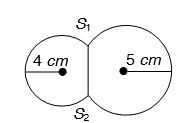
Two soap bubbles of radii ${r_1}$ and ${r_2}$ equal to $4 \,cm $ and $5 \,cm $ are touching each other over a common surface ${S_1}{S_2}$ (shown in figure). Its radius will be ....... $cm$
Answerb
(b) $r = \frac{{{r_1}{r_2}}}{{{r_1} - {r_2}}} = \frac{{5 \times 4}}{{5 - 4}} = 20\;cm$
View full question & answer→MCQ 111 Mark
The pressure inside a small air bubble of radius $0.1\, mm$ situated just below the surface of water will be equal to [Take surface tension of water $70 \times {10^{ - 3}}N{m^{ - 1}}$ and atmospheric pressure = $1.013 \times {10^5}N{m^{ - 2}}$]
- A
$2.054 \times {10^3}\,Pa$
- B
$1.027 \times {10^3}\,Pa$
- ✓
$1.027 \times {10^5}\,Pa$
- D
$2.054 \times {10^5}\,Pa$
AnswerCorrect option: C. $1.027 \times {10^5}\,Pa$
c
(c) Excess pressure inside the air bubble $ = \frac{{2T}}{r}$
$ \Rightarrow {P_{in}} - {P_{out}} = \frac{{2T}}{r} = \frac{{2 \times 70 \times {{10}^{ - 3}}}}{{0.1 \times {{10}^{ - 3}}}} = 1400\,Pa$
$⇒$ ${P_{in}} = 1400 + 1.013 \times {10^5}$$ = 0.014 \times {10^5} + 1.013 \times {10^5} = 1.027 \times {10^5}\,Pa$
View full question & answer→MCQ 121 Mark
A square frame of side $L$ is dipped in a liquid. On taking out, a membrane is formed. If the surface tension of the liquid is $T$, the force acting on the frame will be
- A
$2\, TL$
- B
$4 \,TL$
- ✓
$8 \,TL$
- D
$10\, TL$
AnswerCorrect option: C. $8 \,TL$
c
(c) Force on each side $ = 2\,TL$ (due to two surfaces)
$\therefore $ Force on the frame = $ 4(2\,TL) = 8\,TL$
View full question & answer→MCQ 131 Mark
Force necessary to pull a circular plate of $5\, cm$ radius from water surface for which surface tension is $75\, dynes/cm,$ is
- A
$30\,dyne$
- B
$60 \,dynes$
- C
$750 \,dynes$
- ✓
$750 \,\pi \,dynes$
AnswerCorrect option: D. $750 \,\pi \,dynes$
d
(d) The total length of the circular plate on which the force will act $ = 2\pi R$
Force to pull $ = 2\pi RT = 2 \times \pi \times 5 \times 75 = 750\pi \, dynes$
View full question & answer→MCQ 141 Mark
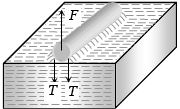
The maximum force, in addition to the weight required to pull a wire of $ 5.0\, cm$ long from the surface of water at temperature $20^\circ C$, is $728 $ dynes. The surface tension of water is
- A
$7.28 \,N/cm$
- B
$7.28 \,dyne/cm$
- ✓
$72.8\, dyne/cm$
- D
$7.28×10^2\, dyne/cm$
AnswerCorrect option: C. $72.8\, dyne/cm$
c
(c) $T = \frac{F}{{2l}} = \frac{{728}}{{2 \times 5}}$
$T = 72.8\;dyne/cm$
View full question & answer→MCQ 151 Mark
A $10\, cm$ long wire is placed horizontally on the surface of water and is gently pulled up with a force of $2 ×10^{-2}\,N$ to keep the wire in equilibrium. The surface tension, in $Nm^{-1}$, of water is
- ✓
$0.1$
- B
$0.2$
- C
$0.001$
- D
$0.002$
Answera
(a) $T = \frac{F}{{2l}} = \frac{{2 \times {{10}^{ - 2}}}}{{2 \times 10 \times {{10}^{ - 2}}}} = 0.1\;N/m$
View full question & answer→MCQ 161 Mark
The force required to separate two glass plates of area ${10^{ - 2}}{m^2}$ with a film of water $0.05\, mm$ thick between them, is ...... $N$ (Surface tension of water is $70 \times {10^{ - 3}}\,N/m$)
Answera
(a) Force required to separate the plates
$F = \frac{{2TA}}{t} = \frac{{2 \times 70 \times {{10}^{ - 3}} \times {{10}^{ - 2}}}}{{0.05 \times {{10}^{ - 3}}}} = 28N$
View full question & answer→MCQ 171 Mark
Energy needed in breaking a drop of radius $R$ into $n$ drops of radii $ r$ is given by
AnswerCorrect option: A. $4\pi T(n{r^2} - {R^2})$
a
(a) Energy needed = Increment in surface energy
= (surface energy of $n$ small drops) -(surface energy of
one big drop)
$ = n4\pi {r^2}T - 4\pi {R^2}T = 4\pi T(n{r^2} - {R^2})$
View full question & answer→MCQ 181 Mark
A drop of liquid of diameter $2.8\, mm$ breaks up into $125$ identical drops. The change in energy is nearly ........ $erg$ (S.T. of liquid = $75\, dynes/cm$)
Answerd
(d) $E = 4\pi {R^2}T({n^{1/3}} - 1)$
= $4 \times 3.14 \times {(1.4 \times {10^{ - 1}})^2} \times 75({125^{1/3}} - 1)$$ = 74\;erg$
View full question & answer→MCQ 191 Mark
Radius of a soap bubble is $'r'$, surface tension of soap solution is $T$. Then without increasing the temperature, how much energy will be needed to double its radius
- A
$4\pi {r^2}T$
- B
$2\pi {r^2}T$
- C
$12\pi {r^2}T$
- ✓
$24\pi {r^2}T$
AnswerCorrect option: D. $24\pi {r^2}T$
d
(d) $W = 8\pi T(R_2^2 - R_1^2) = 8\pi T[{(2r)^2} - {(r)^2}] = 24\pi {r^2}T$
View full question & answer→MCQ 201 Mark
A spherical liquid drop of radius $R$ is divided into eight equal droplets. If surface tension is $T$, then the work done in this process will be
- A
2$\pi {R^2}T$
- B
3$\pi {R^2}T$
- ✓
4$\pi {R^2}T$
- D
2$\pi R{T^2}$
AnswerCorrect option: C. 4$\pi {R^2}T$
c
(c)$W = 4\pi {R^2}T({r^{1/3}} - 1) = 4\pi {R^2}T({8^{1/3}} - 1) = 4\pi {R^2}T$
View full question & answer→MCQ 211 Mark
The amount of work done in blowing a soap bubble such that its diameter increases from $d$ to $D$ is ($T=$ surface tension of the solution)
- A
$4\pi ({D^2} - {d^2})T$
- B
$8\pi ({D^2} - {d^2})T$
- C
$\pi ({D^2} - {d^2})T$
- ✓
$2\pi ({D^2} - {d^2})T$
AnswerCorrect option: D. $2\pi ({D^2} - {d^2})T$
d
(d)$W = T \times 8\pi (r_2^2 - r_1^2) = T \times 8\pi \left( {\frac{{{D^2}}}{4} - \frac{{{d^2}}}{4}} \right)$
$ = 2\pi ({D^2} - {d^2})T$
View full question & answer→MCQ 221 Mark
If $T$ is the surface tension of soap solution, the amount of work done in blowing a soap bubble from a diameter $D$ to $2D$ is
- A
$2\pi {D^2}T$
- B
$4\pi {D^2}T$
- ✓
$6\pi {D^2}T$
- D
$8\pi {D^2}T$
AnswerCorrect option: C. $6\pi {D^2}T$
c
(c) Work done to increase the diameter of bubble from $d$ to $D$
$W = 2\pi ({D^2} - {d^2})T = 2\pi [{(2D)^2} - {(D)^2}]\;T = 6\pi {D^2}T$
View full question & answer→MCQ 231 Mark
If work $W$ is done in blowing a bubble of radius $R$ from a soap solution, then the work done in blowing a bubble of radius $2R$ from the same solution is
- A
$W/2$
- B
$2W$
- ✓
$4W$
- D
$2\frac{1}{3}W$
Answerc
(c) $W = 8\pi {R^2}T$
$W \propto {R^2}$ ($T$ is constant)
If radius becomes double then work done will become four times.
View full question & answer→MCQ 241 Mark
A spherical drop of oil of radius $1\, cm$ is broken into $1000$ droplets of equal radii. If the surface tension of oil is $50$ dynes/cm, the work done is
- A
$18\pi $ ergs
- B
$180\pi $ ergs
- ✓
$1800\pi $ ergs
- D
$8000\pi $ ergs
AnswerCorrect option: C. $1800\pi $ ergs
c
(c) $W = 4\pi {R^2}T({n^{1/3}} - 1)$$ = 4\pi \times 1 \times 50({10^{3/3}} - 1)$ = $1800\pi \;erg$
View full question & answer→MCQ 251 Mark
The work done in blowing a soap bubble of radius $r$ of the solution of surface tension $T$ will be
- ✓
$8\pi {r^2}T$
- B
$2\pi {r^2}T$
- C
$4\pi {r^2}T$
- D
$\frac{4}{3}\pi {r^2}T$
AnswerCorrect option: A. $8\pi {r^2}T$
a
(a) work done $=T . T . \times$ area of soap bubble
$=T \times\left(4 \pi r^{2}\right) \times 2=8 \pi T r^{2}$
View full question & answer→MCQ 261 Mark
The surface tension of a soap solution is $2 \times {10^{ - 2}}N/m.$ To blow a bubble of radius $1 \,cm,$ the work done is
- A
$4\pi \times {10^{ - 6}}J$
- B
$8\pi \times {10^{ - 6}}J$
- C
$12\pi \times {10^{ - 6}}J$
- ✓
$16\pi \times {10^{ - 6}}J$
AnswerCorrect option: D. $16\pi \times {10^{ - 6}}J$
d
(d)$W = 8\pi {R^2}T = 8 \times \pi \times {({10^{ - 2}})^2} \times 2 \times {10^{ - 2}}$$ = 16\pi \times {10^{ - 6}}J$
View full question & answer→MCQ 271 Mark
A mercury drop of $1\, cm$ radius is broken into ${10^6}$ small drops. The energy used will be (surface tension of mercury is $35 \times {10^{ - 3}}N/cm)$
- ✓
$4.4 \times {10^{ - 3}}\,J$
- B
$2.2 \times {10^{ - 4}}\,J$
- C
$8.8 \times {10^{ - 4}}\,J$
- D
${10^4}\,J$
AnswerCorrect option: A. $4.4 \times {10^{ - 3}}\,J$
a
(a) $E = 4\pi {R^2}T({n^{1/3}} - 1)$
$ = 4 \times 3.14 \times {10^{ - 4}} \times 35 \times {10^{ - 1}}({10^{6/3}} - 1)$ $ = 4.4 \times {10^{ - 3}}\,J$
View full question & answer→MCQ 281 Mark
Surface tension of a soap solution is $1.9 \times {10^{ - 2}}N/m$. Work done in blowing a bubble of $2.0\, cm$ diameter will be
- A
$7.6 \times {10^{ - 6}}\pi $ joule
- ✓
$15.2 \times {10^{ - 6}}\pi $ joule
- C
$1.9 \times {10^{ - 6}}\pi $ joule
- D
$1 \times {10^{ - 4}}$ joule
AnswerCorrect option: B. $15.2 \times {10^{ - 6}}\pi $ joule
b
(b) $W = 8\pi {R^2}T = 8\pi \times {(1 \times {10^{ - 2}})^2} \times 1.9 \times {10^{ - 2}}$=$15.2 \times {10^{ - 6}}\pi\, J$
View full question & answer→MCQ 291 Mark
What is ratio of surface energy of $1$ small drop and $1$ large drop, if $1000$ small drops combined to form $1$ large drop
- A
$100:1$
- B
$1000 : 1$
- C
$10:1$
- ✓
$1 : 100$
AnswerCorrect option: D. $1 : 100$
d
(d) Volume of liquid remain same i.e. volume of $1000$ small drops will be equal to volume of one big drop
$n\frac{4}{3}\pi {r^3} = \frac{4}{3}\pi {R^3}$ $⇒$ $1000{r^3} = {R^3}$ $⇒$ $R = 10r$
$\therefore \frac{r}{R} = \frac{1}{{10}}$
$\frac{{{\rm{surface \,energy \,of \,one\, small\, drop}}}}{{{\rm{surface\, energy \,of\, one \,big\, drop}}}} = \frac{{4\pi {r^2}T}}{{4\pi {R^2}T}} = \frac{1}{{100}}$
View full question & answer→MCQ 301 Mark
A liquid drop of diameter $D$ breaks upto into $27$ small drops of equal size. If the surface tension of the liquid is $\sigma$, then change in surface energy is
- A
$\pi {D^2}\sigma $
- ✓
$2\pi {D^2}\sigma $
- C
$3\pi {D^2}\sigma $
- D
$4\pi {D^2}\sigma $
AnswerCorrect option: B. $2\pi {D^2}\sigma $
b
(b) Work done = $4\pi {R^2}T({n^{1/3}} - 1)$$ = 4\pi {\left( {\frac{D}{2}} \right)^2}\sigma ({n^{1/3}} - 1)$
$ = \pi {D^2}\sigma ({27^{1/3}} - 1)$$ = 2\pi {D^2}\sigma $
View full question & answer→MCQ 311 Mark
One thousand small water drops of equal radii combine to form a big drop. The ratio of final surface energy to the total initial surface energy is
- A
$1000:1$
- B
$1 : 1000$
- C
$10:1$
- ✓
$1:10$
AnswerCorrect option: D. $1:10$
d
(d) As volume remain constant therefore $R = {n^{1/3}}r$
$\frac{{{\rm{surface\, energy\, of\, one \,big \,drop}}}}{{{\rm{surface \,energy \,of \,}}n{\rm{ drop}}}} = \frac{{4\pi {R^2}T}}{{n \times 4\pi {r^2}T}}$
$\frac{{{R^2}}}{{n{r^2}}} = \frac{{{n^{2/3}}{r^2}}}{{n{r^2}}}$ = $\frac{1}{{{n^{1/3}}}} = \frac{1}{{{{(1000)}^{1/3}}}} = \frac{1}{{10}}$
View full question & answer→MCQ 321 Mark
If $\sigma$ be the surface tension, the work done in breaking a big drop of radius R in n drops of equal radius is
- A
$R{n^{2/3}}\sigma $
- B
$({n^{2/3}} - 1)R\sigma $
- C
$({n^{1/3}} - 1)R\sigma $
- ✓
$4\pi {R^2}({n^{1/3}} - 1)\sigma $
AnswerCorrect option: D. $4\pi {R^2}({n^{1/3}} - 1)\sigma $
d
(d) Volume will be conserved
$\frac{4}{3} \pi R^{3}=n \frac{4}{3} \pi r^{3}$
$r=n^{-1 / 3} R$
workdone $=$ $final energy - initial energy$
$=\left[n 4 \pi n^{-2 / 3} R^{2}-4 \pi R^{2}\right] \sigma$
$=4 \pi R^{2}\left(n^{1 / 3}-1\right) \sigma$
View full question & answer→MCQ 331 Mark
A big drop of radius $R$ is formed by $1000 $ small droplets of water, then the radius of small drop is
- A
$R/2$
- B
$R/5$
- C
$R/6$
- ✓
$R/10$
AnswerCorrect option: D. $R/10$
d
(d) $\frac{4}{3}\pi {R^3} = 1000 \times \frac{4}{3}\pi {r^3}$ (As volume remains constant)
${R^3} = 1000{r^3}$ $⇒$ $R = 10r \Rightarrow r = \frac{R}{{10}}$
View full question & answer→MCQ 341 Mark
When ${10^6}$small drops coalesce to make a new larger drop then the drop
Answerc
(c)Because energy is liberated
View full question & answer→MCQ 351 Mark
$8000$ identical water drops are combined to form a big drop. Then the ratio of the final surface energy to the initial surface energy of all the drops together is
- A
$1:10$
- B
$1:15$
- ✓
$1:20$
- D
$1:25$
AnswerCorrect option: C. $1:20$
c
(c) As volume remains constant ${R^3} = 8000{r^3}$
$\therefore R = 20r$
$\frac{{{\rm{Surface \,energy\, of \,one \,big \,drop}}}}{{{\rm{Surface \,energy \,of \,8000 \,small\, drop}}}} = \frac{{4\pi {R^2}T}}{{8000\;4\pi {r^2}T}}$
$ = \frac{{{R^2}}}{{8000{r^2}}} = \frac{{{{\left( {20r} \right)}^2}}}{{8000{r^2}}} = \frac{1}{{20}}$
View full question & answer→MCQ 361 Mark
$8$ mercury drops coalesce to form one mercury drop, the energy changes by a factor of
Answerc
(c) As volume remains constant therefore $R = {n^{1/3}}r$
$\frac{{{\rm{Energy\, of \,big \,drop}}}}{{{\rm{Energy \,of\, small\, drop}}}} = \frac{{4\pi {R^2}T}}{{4\pi {r^2}T}} = \frac{{{R^2}}}{{{r^2}}}$$ = {(8)^{2/3}} = 4$
View full question & answer→MCQ 371 Mark
A film of water is formed between two straight parallel wires of length $10\,cm$ each separated by $0.5\, cm$. If their separation is increased by $1\, mm$ while still maintaining their parallelism, how much work will have to be done (Surface tension of water = $7.2 \times {10^{ - 2}}\,N/m)$
- A
$7.22 \times {10^{ - 6}}\,Joule$
- ✓
$1.44 \times {10^{ - 5}}\,Joule$
- C
$2.88 \times {10^{ - 5}}\,Joule$
- D
$5.76 \times {10^{ - 5}}\,Joule$
AnswerCorrect option: B. $1.44 \times {10^{ - 5}}\,Joule$
b
(b) Increment in area of soap film = ${A_2} - {A_1}$
$ = 2 \times [(10 \times 0.6) - (10 \times 0.5)] \times {10^{ - 4}} = 2 \times {10^{ - 4}}{m^2}$
Work done = $T \times \Delta A$
$ = 7.2 \times {10^{ - 2}} \times 2 \times {10^{ - 4}} = 1.44 \times {10^{ - 5}}J$
View full question & answer→MCQ 381 Mark
A drop of mercury of radius $2\, mm$ is split into $8$ identical droplets. Find the increase in surface energy ....... $\mu J$. (Surface tension of mercury is $0.465\;J/{m^2}$)
- ✓
$23.4$
- B
$18.5$
- C
$26.8$
- D
$16.8$
AnswerCorrect option: A. $23.4$
a
(a) Increase in surface energy or work done in splitting a big drop $ = 4\pi {R^2}T({n^{1/3}} - 1)$
$ \Rightarrow W = 4\pi \times {(2 \times {10^{ - 3}})^2} \times 0.465({8^{1/3}} - 1) = 23.4\;\mu \,J$
View full question & answer→MCQ 391 Mark
If two soap bubbles of equal radii $r$ coalesce then the radius of curvature of interface between two bubbles will be
Answerc
(c) $r = \frac{{{r_1}{r_2}}}{{{r_2} - {r_1}}} = \infty \;\sin ce\;{r_1} = {r_2}$
View full question & answer→MCQ 401 Mark
A liquid is coming out from a vertical tube. The relation between the weight of the drop $W$, surface tension of the liquid $T$ and radius of the tube $r$ is given by, if the angle of contact is zero
AnswerCorrect option: B. $W = 2\pi rT$
b
(b) The weight of liquid drop is equal to surface tension force.
Therefore, $W=S . T=2 \pi r . T$
View full question & answer→MCQ 411 Mark
Energy required to form a soap bubble of diameter $20 \,cm$ will be (Surface tension for soap solution is $30$ dynes/cm)
- A
$12000\, \pi$ ergs
- B
$1200 \,\pi$ ergs
- C
$2400 \,\pi$ ergs
- ✓
$24000\,\pi$ ergs
AnswerCorrect option: D. $24000\,\pi$ ergs
d
(d) $E = 8\pi {r^2}T = 8\pi {(10)^2} \times 30 = 24000\;\pi \;erg$
View full question & answer→MCQ 421 Mark
If the work done in blowing a bubble of volume $V$ is $W$, then the work done in blowing the bubble of volume $2V$ from the same soap solution will be
- A
$W/2$
- B
$\sqrt 2 $$W$
- C
$\sqrt[3]{2}$ $W$
- ✓
$\sqrt[3]{4}$$W$
AnswerCorrect option: D. $\sqrt[3]{4}$$W$
d
(d) Work done to form a soap bubble
$W = 8\pi {R^2}T$(As $V \propto {R^3}$ $\therefore R \propto {V^{1/3}}$)
$\therefore W \propto {V^{2/3}}$
$\frac{{{W_2}}}{{{W_1}}} = {\left( {\frac{{{V_2}}}{{{V_1}}}} \right)^{2/3}} = {(2)^{2/3}}$==> ${W_2} = {(4)^{1/3}}W$
View full question & answer→MCQ 431 Mark
Surface tension of soap solution is $ 2 ×10^{-2} N/m$. The work done in producing a soap bubble of radius $2 \,cm$ is
- ✓
$64\pi \times {10^{ - 6}}J$
- B
$32\pi \times {10^{ - 6}}J$
- C
$16\pi \times {10^{ - 6}}J$
- D
$8\pi \times {10^{ - 6}}J$
AnswerCorrect option: A. $64\pi \times {10^{ - 6}}J$
a
(a) $W = 8\pi {R^2}T$$ = 8 \times \pi \times {(2 \times {10^{ - 2}})^2} \times 2 \times {10^{ - 2}}$$ = 64\pi \times {10^{ - 6}}J$
View full question & answer→MCQ 441 Mark
A soap bubble of radius $R$ is blown. After heating the solution a second bubble of radius $2R$ is blown. The work required to blow the second bubble in comparison to that required for the first bubble is
- A
- B
Slightly less than double
- ✓
Slightly less than four times
- D
Slightly more than four times
AnswerCorrect option: C. Slightly less than four times
c
(c) Work done to form a bubble of radius $R$
${W_1} = 8\pi {R^2}{T_1}$
Work done to form a bubble of radius $2R$
${W_2} = 8\pi {(2R)^2}{T_2}$$ = 32\pi {R^2}{T_2}$ ?$\frac{{{W_1}}}{{{W_2}}} = \frac{{{T_1}}}{{4{T_2}}}$
If surface tension of soap solution is same then
${W_2} = 4{W_1}$
But in the problem temperature of solution is increased so its surface tension decreases.
$\therefore {W_2} < 4{W_1}$
View full question & answer→MCQ 451 Mark
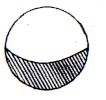
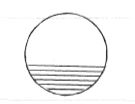
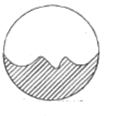
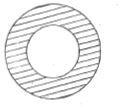
Consider a spherical body, one third of its volume is filled with a liquid which has contact angle zero with the surface of sphere. If this sphere (along with liquid) is taken to gravity free space then shape of liquid inside sphere will look like
Answerd
To minimise surface area
View full question & answer→MCQ 461 Mark
Work done in increasing the size of a soap bubble from a radius of $3\, cm$ to $5\,cm$ is (Surface tension of soap solution $= 0.03 \,Nm^{-1})$
- A
$1.92\, \pi \,mJ$
- ✓
$0.384\, \pi \,mJ$
- C
$3.84\, \pi \,mJ$
- D
$0.192\, \pi \,mJ$
AnswerCorrect option: B. $0.384\, \pi \,mJ$
b
$\mathrm{W}=8 \pi\left(\mathrm{r}_{2}^{2}-\mathrm{r}_{1}^{2}\right) \mathrm{T}=0.384 \mathrm{mJ}$
View full question & answer→MCQ 471 Mark
Assume that a drop of liquid evaporates by decrease in its surface energy, so that its temperature remains unchanged. What should be the minimum radius of the drop for this to be possible? The surface tension is $T$, density of liquid is $\rho$ and $L$ is its latent heat of vaporization.
AnswerCorrect option: D. $\frac{2T}{{\rho L}}$
d
Energy for vaporization $=$ change in surface energy $\rho\left(4 \pi r^{2} \mathrm{d} r\right) L=T(8 \pi \mathbf{r d r})$
$\Rightarrow r=\frac{2 \mathrm{T}}{\rho \mathrm{L}}$
View full question & answer→MCQ 481 Mark
The potential energy of a molecule on the surface of a liquid compared to one inside the liquid is
Answerd
When the surface area of a liquid is increased, molecules from the interior of the liquid rise to the surface. As these molecules reach the surface work is done against the cohesive force. This work is stored in the molecules in the form of potential energy. Thus, the potential energy of the molecules lying the surface is greater than that of the molecules in the interior of the liquid
View full question & answer→MCQ 491 Mark
If the excess pressure inside a soap bubble is balanced by oil column of height $2\; mm$, then the surface tension of soap solution will be ($r = 1 \,cm$ and density $d = 0.8\, gm/cc$)
- A
$3.9\, N/m$
- ✓
$3.9 ×10^{-2}\, N/m$
- C
$3.9 ×10^{-3}\, N/m$
- D
$3.9\, dyne/m$
AnswerCorrect option: B. $3.9 ×10^{-2}\, N/m$
b
(b) $\frac{{4T}}{R} = hdg$
$T = \frac{{Rhdg}}{4}$
$T = \frac{{{{10}^{ - 2}} \times 2 \times {{10}^{ - 3}} \times 0.8 \times {{10}^3} \times 9.8}}{4}$
$ = 3.9 \times {10^{ - 2}}\,N/m$
View full question & answer→MCQ 501 Mark
The excess pressure in a soap bubble is thrice that in other one. Then the ratio of their volume is
- A
$1:3$
- B
$1:9$
- C
$27:1$
- ✓
$1:27$
AnswerCorrect option: D. $1:27$
d
(d)$\Delta P \propto \frac{1}{r} \Rightarrow \frac{{{r_1}}}{{{r_2}}} = \frac{{\Delta {P_2}}}{{\Delta {P_1}}} = \frac{1}{3} \Rightarrow \frac{{{V_1}}}{{{V_2}}} = {\left( {\frac{{{r_1}}}{{{r_2}}}} \right)^3} = \frac{1}{{27}}$
View full question & answer→