Question
Three circuits, each consisting of a switch ‘S’ and two capacitors, are initially charged, as shown in the figure. After the switch has been closed, in which circuit will the charge on the left-hand capacitor (i) increase, (ii) decrease and (iii) remain same? Give reasons.

Answer

$V_L = 3?$ $V_R = 3?$ (L: Left, R: Right)
$V_L = 6?$ $V_R = 3?$  
$V_L = 2?$ $V_R= 3?$  
Reasons:
  1. No change – (potential same on both capacitors as $(V_L = V_R).$
  2. Charge on left hand capacitor will decrease $(V_L > V_R).$
  3. Charge on left hand capacitor will increase $(V_R > V_L).$

Need a full question paper?

Generate a complete, print-ready paper with questions like this in minutes — across 16+ boards, with answer keys.

Start Generating Free

Similar questions

An ideal gas $\Big(\frac{\text{C}_\text{P}}{\text{C}_\text{V}}=\gamma\Big)$ is taken through a process in which the pressure and the volume vary as $p = aV^b$. Find the value of b for which the specific heat capacity in the process is zero.
A metallic rod of length ‘l’ is rotated with a frequency v with one end hinged at the centre and the other end at the circumference of a circular metallic ring of radius r, about an axis passing through the centre and perpendicular to the plane of the rinig. A constant uniform magnetic field B parallel to the axis is present every where. Using Lorentz force, explain how emf is induced between the centre and the metallic ring and hence obtain the expression for it.

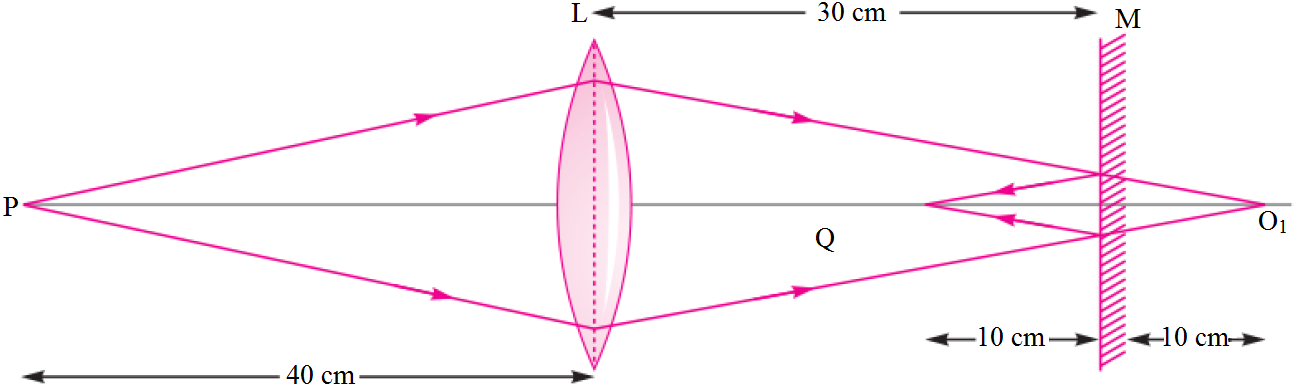
A convex lens, of focal length 20cm, has a point object placed on its principle axis at distance of 40cm from it. A plane mirror is placed 30cm behind the convex lens. Locate the position of image formed by this combination.
  1. An X-ray tube produces a continuous spectrum of radiation with its short wavelength end at 0.45 Å. What is the maximum energy of a photon in the radiation?
  2. From your answer to (a), guess what order of accelerating voltage (for electrons) is required in such a tube?
A rectangular wire loop of sides 8cm and 2cm with a small cut is moving out of a region of uniform magnetic field of magnitude 0.3T directed normal to the loop. What is the emf developed across the cut if the velocity of the loop is $1\ cms^{–1}$ in a direction normal to the:
  1. Longer side,
  2. shorter side of the loop?
For how long does the induced voltage last in each case?
  1. What characteristic property of nuclear force explains the constancy of binding energy per nucleon (BE/A) in the range of mass number 'A' lying 30
    • Show that the density of nucleus over a wide range of nuclei is constantindependent of mass numberA.
A galvanometer coil has a resistance of 15 Ω and the metre shows full scale deflection for a current of 4 mA. How will you convert the metre into an ammeter of range 0 to 6 A?
  1. State two important features of Einstein's photoelectric equation.
  2. Radiation of frequency $10^{15}\ Hz$ is incident on two photosensitive surface P and Q. There is no photoemission from surface P. Photoemission occurs from surface Q but photoelectrons have zero kinetic energy. Explain these observations and find the value of work function for surface Q.
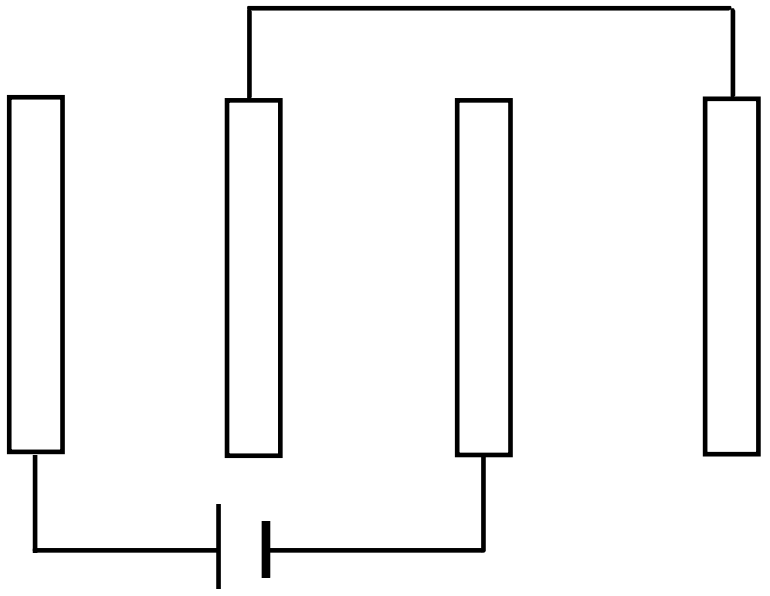
Each of the plates shown in figure has surface area $\Big(\frac{96}{\in_0}\Big)\times10^{-12}\text{Fm}$ on one side and the separation between the consecutive plates is 4.0mm. The emf of the battery connected is 10 volts. Find the magnitude of the charge supplied by the battery to each of the plates connected to it.
In single slit diffraction, explain why the maxima at $\theta=\left(n+\frac{1}{2}\right)\left(\frac{\lambda}{a}\right)$ becomes weaker and weaker as an increases. State two important differences between interference and diffraction pattern.