MCQ
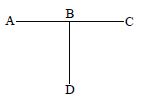
Three conducting rods of same material and cross section are shown in figure. Temperature at $A,D$ and $C$ are maintained at $20\ ^oC, 90\ ^oC$ and $0\ ^oC$. The ratio of lengths of $BD$ and $BC$ if there is no heat. Flows in $AB$ is
  • A
    $\frac{2}{7}$
  • $3.5$
  • C
    $4.5$
  • D
    $\frac{2}{9}$

Answer

Correct option: B.
$3.5$
b

Need a full question paper?

Generate a complete, print-ready paper with questions like this in minutes — across 16+ boards, with answer keys.

Start Generating Free

Similar questions

The following four wires of length $L$ and radius $r$ are made of the same material. Which of these will have the largest extension, when the same tension is applied?
From a disc of radius $R$ and mass $M,$ a circular hole of diameter $R,$ whose rim passes through the centre is cut. What is the moment of inertia of the remaining part of the disc about a perpendicular axis, passing through the centre?
The temperature of an ideal gas is kept constant as it expands. The gas does external work. During this process, the internal energy of the gas
The weight of a body at the centre of the earth is
The frequency of vibration of string is given by $\nu = \frac{p}{{2l}}{\left[ {\frac{F}{m}} \right]^{1/2}}$. Here $p$ is number of segments in the string and $l$ is the length. The dimensional formula for $m$ will be
Two cars of masses m, and my are moving in circles of radii r1 and r2, respectively. Their speeds are such that they make complete circles in the same time t. The ratio of their centripetal accelerations is:
A block of mass $50\, kg$ slides over a horizontal distance of $1\, m$. If the coefficient of friction between their surfaces is $0.2$, then work done against friction is ......... $J$
Two particles having masses $4\, g$ and $16\, g$ respectively are moving with equal kinetic energies. The ratio of the magnitudes of their linear momentum is $n : 2 .$ The value of $n$ will be ...... .
The angle between the vectors $(\hat i + \hat j)$ and $(\hat j + \hat k)$ is ....... $^o$
Two discs $A$ and $\mathrm{B}$ are mounted coaxially on a vertical axle. The discs have moments of inertia $I$ and $2 I$ respectively about the common axis. Disc $\mathrm{A}$ is imparted an initial angular velocity $2 \omega$ using the entire potential energy of a spring compressed by a distance $x_1$. Disc $B$ is imparted an angular velocity $\omega$ by a spring having the same spring constant and compressed by a distance $x_2$. Both the discs rotate in the clockwise direction.

$1.$  The ratio of $x_1 / x_2$ is

$(A)$ $2$  $(B)$ $\frac{1}{2}$  $(C)$ $\sqrt{2}$  $(D)$ $\frac{1}{\sqrt{2}}$

$2.$  When disc $\mathrm{B}$ is brought in contact with disc $\mathrm{A}$, they acquire a common angular velocity in time $\mathrm{t}$. The average frictional torque on one disc by the other during this period is

$(A)$ $\frac{2 \mathrm{I} \omega}{3 \mathrm{t}}$  $(B)$ $\frac{9 \mathrm{I} \omega}{2 \mathrm{t}}$  $(C)$ $\frac{9 \mathrm{I} \omega}{4 \mathrm{t}}$  $(D)$ $\frac{3 \mathrm{I} \omega}{2 \mathrm{t}}$

$3.$  The loss of kinetic energy during the above process is

$(A)$ $\frac{\mathrm{I} \omega^2}{2}$  $(B)$ $\frac{\mathrm{I} \omega^2}{3}$  $(C)$ $\frac{\mathrm{I} \omega^2}{4}$  $(D)$ $\frac{\mathrm{I} \omega^2}{6}$

Give the answer question $1,2$ and $3.$