Question
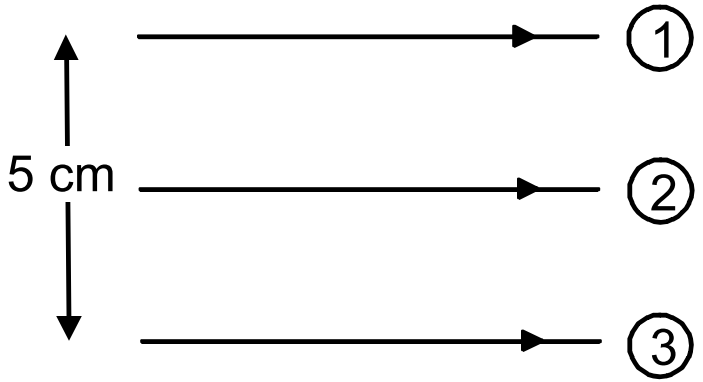
Three coplanar parallel wires, each carrying a current of 10A along the same direction, are placed with a separation 5.0cm between the consecutive ones. Find the matnitude ol the magnetic force per unit lenght acting on the wires.
Answer

i = 10A

Magnetic force due to two parallel Current Carrying wires.
$\text{F}=\frac{\mu_0\text{I}_1\text{I}_2}{2\pi\text{r}}$
So, $\overrightarrow{\text{F}}\ \text{or}\ 1=\overrightarrow{\text{F}}\ \text{or}\ 2+\overrightarrow{\text{F}}\ \text{by}\ 3$
$=\frac{\mu_0\times10\times10}{2\pi\times5\times10^{-2}}+\frac{\mu_0\times10\times10}{2\pi\times10\times10^{-2}}$
$=\frac{4\pi\times10^{-7}\times10\times10}{2\pi\times5\times10^{-2}}+=\frac{4\pi\times10^{-7}\times10\times10}{2\pi\times10\times10^{-2}}$
$=\frac{2\times10^{-3}}{5}+\frac{10^{-3}}{5}=\frac{3\times10^{-3}}{5}=6\times10^{-4}\text{N}$ towards middle wire

Need a full question paper?

Generate a complete, print-ready paper with questions like this in minutes — across 16+ boards, with answer keys.
Start Generating Free

Similar questions

A magnetic field B is confined to a region r ≤ a and points out of the paper (the z-axis), r = 0 being the centre of the circular region. A charged ring (charge = Q) of radius b, b > a and mass m lies in the x-y plane with its centre at the origin. The ring is free to rotate and is at rest. The magnetic field is brought to zero in time Δt. Find the angular velocity ω of the ring after the field vanishes.
State Soddy-Fajan’s displacement laws for radioactive transformations.
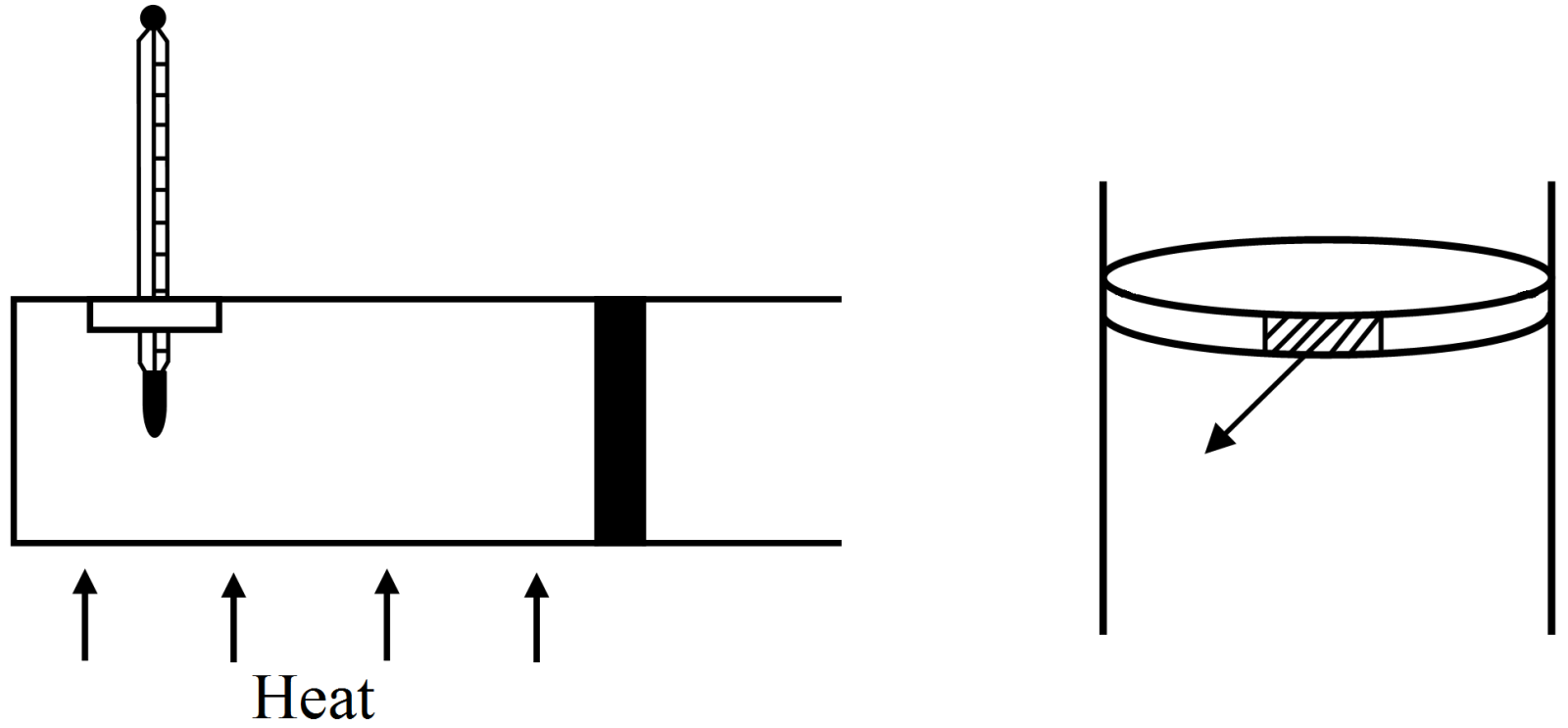
Figure. shows a cylindrical tube of radius 5cm and length 20cm. It is closed by a tight-fitting cork. The friction coefficient between the cork and the tube is 0.20. The tube contains an ideal gas at a pressure of 1 atm and a temperature of 300K. The tube is slowly heated and it is found that the cork pops out when the temperature reaches 600K Let dN denote the magnitude of the normal contact force exerted by a small length dl of the cork along the periphery (see the figure). Assuming that the temperature of the gas is uniform at any instant, calculate $\frac{\text{dN}}{\text{dl}}.$
A 50-turn circular coil of radius 2.0cm carrying a current of 5.0A is rotated in a magnetic field of strength 0.20T.
  1. What is the maximum torque that acts on the coil?
  2. In a particular position of the coil, the torque acting on it is half of this maximum. What is the angle between the magnetic field and the plane of the coil?
$Fe^+$ ions are accelerated through a potential difference of 500V and are injected normally into a homogeneous magnetic field B of strength 20.0mT. Find the radius of the circular paths followed by the isotopes with mass numbers 57 and 58. Take the mass of an ion $= A (1.6 \times 10^{-27})kg,$ where A is the mass number.
Calculate potential energy of a point charge -q placed along the axis due to a charge +Q uniformly distributed along a ring of radius R. Sketch P.E. as a function of axial distance z from the centre of the ring. Looking at graph, can you see what would happen if -q is displaced slightly from the centre of the ring (along the axis)?
Consider the situation of the previous problem. A charges of $-2.0 \times 10^{-4}C$ is moved from the point A to the point B. Find the change in electrical potential energy $U_B - U_A$ for the cases (a), (b) and (c).
An optical instrument used for angular magnification has a 25D objective and a 20D eyepiece. The tube length is 25cm when the eye is least strained.
  1. Whether it is a microscope or a telescope?
  2. What is the angular magnification produced?
An LR circuit with emf $\in$ is connected at t = 0.
  1. Find the charge Q which flows through the battery during 0 to t.
  2. Calculate the work done by the battery during this period.
  3. Find the heat developed during this period.
  4. Find the magnetic field energy stored in the circuit at time t.
  5. Verify that the results in the three parts above are consistent with energy conservation.
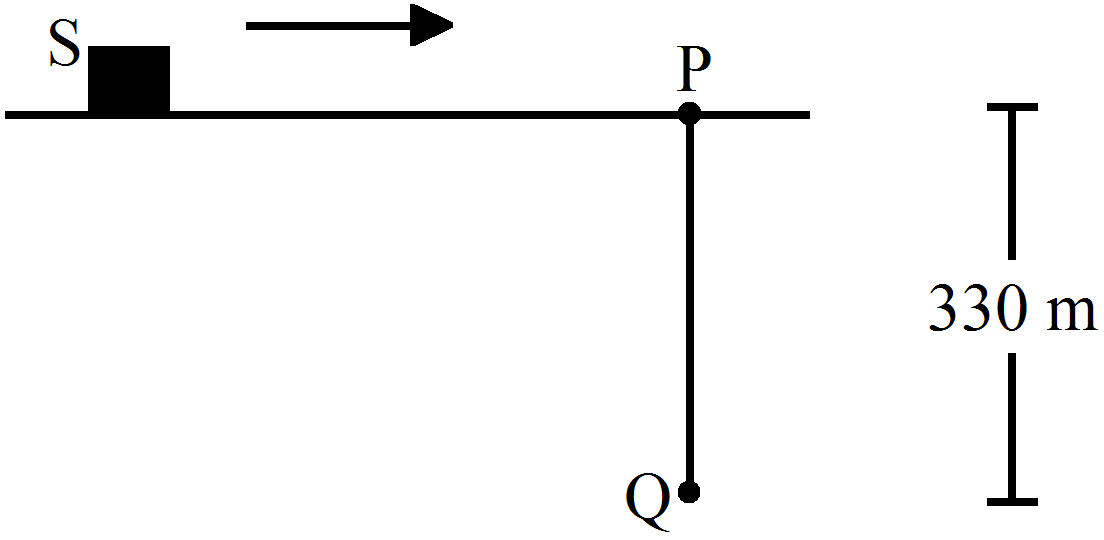
Figure, shows a source of sound moving along the X-axis at a speed of 22m/s continuously emitting a sound of frequency 2.0kHz which travels s in air at a speed of 330m/s. A listener Q stands on the Y-axis at a distance of 330 m from the origin. At t = 0, the source crosses the origin P.
  1. When does the sound emitted from the source at P reach the listener Q?
  2. What will be the frequency heard by the listener at this instant?
  3. Where will the source be at this instant?