MCQ
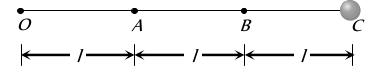
Three identical particles are joined together by a thread as shown in figure. All the three particles are moving in a horizontal plane. If the velocity of the outermost particle is $v$, then the ratio of tensions in the three sections of the string is
  • A
    $3: 5: 7$
  • B
    $3: 4: 5$
  • C
    $7: 11: 6$
  • $3: 5: 6$

Answer

Correct option: D.
$3: 5: 6$
(d) Let $\omega$ is the angular speed of revolution
$ T_3=m \omega^2 3 l  T_2-T_3=m \omega^2 2 l$
$\Rightarrow T_2=m \omega^2 5 l  T_1-T_2=m \omega^2 l$
$\Rightarrow T_1=m \omega^2 6 l$
$T_3: T_2: T_1=3: 5: 6$

Need a full question paper?

Generate a complete, print-ready paper with questions like this in minutes — across 16+ boards, with answer keys.

Start Generating Free

Similar questions

The rates of cooling of two different liquids put in exactly similar calorimeters and kept in identical surroundings are the same if
When a tuning fork vibrates, the waves produced in the fork are
Graph between velocity and displacement of a particle, executing S.H.M. is
The volume of an air bubble becomes three times as it rises from the bottom of a lake to its surface. Assuming atmospheric pressure to be $75 cm$ of $Hg$ and the density of water to be $1 / 10$ of the density of mercury, the depth of the lake is
Two planets move around the sun. The periodic times and the mean radii of the orbits are $T_1, T_2$ and $r_1, r_2$ respectively. The ratio $T_1 / T_2$ is equal to
In an experiment, the following observation's were recorded : $L=$ $2.820 m , M=3.00 kg , l =0.087 cm$, Diameter $D=0.041 cm$Taking $g=9.81 m / s ^2$ using the formula , $\gamma=\frac{4 M g L}{\pi D^2 l}$, the maximum permissible error in $Y$ is
A missile is launched with a velocity less than the escape velocity. The sum of its kinetic and potential energy is
Two lenses are placed in contact with each other and the focal length of combination is $80 \mathrm{~cm}$. If the focal length of one is $20 \mathrm{~cm}$, then the power of the other will be
A car travelling at a speed of $30 \mathrm{~km} /$ hour is brought to a halt in 8 $m$ by applying brakes. If the same car is travelling at $60 \mathrm{~km} / \mathrm{hour}$, it can be brought to a halt with the same braking force in
The efficiency of Carnot's engine operating between reservoirs, maintained at temperatures $27^{\circ} \mathrm{C}$ and $-123^{\circ} \mathrm{C}$, is