MCQ
Three infinitely long wires with linear charge density $\lambda$ are placed along the x -axis, y -axis and z axis respectively. Which of the following denotes an equipotential surface?
  • A
    $x y+y z+z x=$ constant
  • $(x+y)(y+z)(z+x)=$ constant
  • C
    $\left(x^{2}+y^{2}\right)\left(y^{2}+z^{2}\right)\left(z^{2}+x^{2}\right)=$ constant
  • D
    $x y z=$ constant

Answer

Correct option: B.
$(x+y)(y+z)(z+x)=$ constant
(B)
Sol. $\quad v=-\int \overrightarrow{\mathrm{E}} \cdot \mathrm{d} \overrightarrow{\mathrm{r}}=\int \frac{2 \mathrm{k} \lambda}{\mathrm{r}} \mathrm{dr}=2 \mathrm{k} \lambda \ln \mathrm{r}+\mathrm{c}$
Net potential due to all wire
$
\mathrm{v}=2 \mathrm{k} \lambda \ln \sqrt{\mathrm{x}^{2}+\mathrm{y}^{2}}+2 \mathrm{k} \lambda \ln \sqrt{\mathrm{y}^{2}+\mathrm{z}^{2}}+2 \mathrm{k} \lambda \ln \sqrt{\mathrm{z}^{2}+\mathrm{x}^{2}}+\mathrm{c}
$
for $v=c$
$\sqrt{\left(\mathrm{x}^{2}+\mathrm{y}^{2}\right)\left(\mathrm{y}^{2}+\mathrm{z}^{2}\right)\left(\mathrm{z}^{2}+\mathrm{x}^{2}\right)}=\mathrm{c}$
$\therefore\left(\mathrm{x}^{2}+\mathrm{y}^{2}\right)\left(\mathrm{y}^{2}+\mathrm{z}^{2}\right)\left(\mathrm{z}^{2}+\mathrm{x}^{2}\right)=\mathrm{c}$
where $\mathrm{c}=$ constant

Need a full question paper?

Generate a complete, print-ready paper with questions like this in minutes — across 16+ boards, with answer keys.

Start Generating Free

Similar questions

If mass of a body is $M$ on the earth surface, then the mass of the same body on the moon surface is
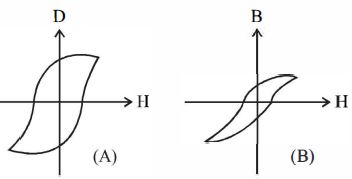
Hysteresis loops for two magnetic materials $A$ and $B$ are given below

These materials are used to make magnets for elecric generators, transformer core and electromagnet core. Then it is proper to use

A gas expands with temperature according to the relation $V = k{T^{2/3}}.$ What is the work done when the temperature changes by ${30^o}C$
The primary winding of transformer has $500$ turns whereas its secondary has $5000$ turns. The primary is connected to an $ac$ supply of $20\, V$, $50 \,Hz$. The secondary will have an output of
The first line in the Lyman series has wavelength $\lambda$. The wavelength of the first line in Balmer series is
A strap is passing over a wheel of radius $30\, cm.$ During the time the wheel moving with initial constant velocity of $2\, rev/sec.$ comes to rest the strap covers a distance of $25\, m.$ The deceleration of the wheel in $rad/s$$^2$ is
Two forces ${\vec F_1} = 5\hat i + 10\hat j - 20\hat k$ and ${\vec F_2} = 10\hat i - 5\hat j - 15\hat k$ act on a single point. The angle between ${\vec F_1}$ and ${\vec F_2}$ is nearly ....... $^o$
A physical quantity $y$ is represented by the formula $y=m^{2}\, r^{-4}\, g^{x}\,l^{-\frac{3}{2}}$. If the percentage error found in $y, m, r, l$ and $g$ are $18,1,0.5,4$ and $p$ respectively, then find the value of $x$ and $p$.
Two moles a monoatomic gas is mixed with six moles of a diatomic gas. The molar specific heat of the mixture at constant volume is:
A bar magnet of magnetic moment $1.5\,A \times m^2$ lies aligned with the direction of a uniform magnetic field of $2\,Tesla$. What is the amount of work required to turn the magnet so as to align itsmagnetic moment normal to the field direction....$J$