Questions

SECTION - A [PHYSICS MCQ]

🎯

Test yourself on this topic

20 questions · timed · auto-graded

Question 14 Marks
A Carnot engine (E) is working between two temperatures 473 K and 273 K . In a new system two engines - engine $E_{1}$ works between 473 K to 373 K and engine $\mathrm{E}_{2}$ works between 373 K to 273 K . If $\eta_{12}$, $\eta_{1}$ and $\eta_{2}$ are the efficiencies of the engines $E, E_{1}$ and $\mathrm{E}_{2}$, respectively, then
(1) $\eta_{12}<\eta_{1}+\eta_{2}$ (2) $\eta_{12}=\eta_{1} \eta_{2}$
(3) $\eta_{12}=\eta_{1}+\eta_{2}$ (4) $\eta_{12} \geq \eta_{1}+\eta_{2}$
Answer
(1)
Sol. $\quad \eta_{12}=1-\frac{273}{473}=\frac{200}{473}=0.423$
$\eta_{1}=1-\frac{373}{473}=\frac{100}{473}=0.211$
$\eta_{2}=1-\frac{273}{373}=\frac{100}{373}=0.268$
View full question & answer
MCQ 24 Marks
A thin prism $P_{1}$ with angle $4^{\circ}$ made of glass having refractive index 1.54 , is combined with another thin prism $\mathrm{P}_{2}$ made of glass having refractive index 1.72 to get dispersion without deviation. The angle of the prism $\mathrm{P}_{2}$ in degrees is
  • A
    4
  • 3
  • C
    $16 / 3$
  • D
    1.5
Answer
Correct option: B.
3
(B)
Sol. $\delta_{\text {net }}=0$
$\left(\mu_{1}-1\right) \mathrm{A}_{1}-\left(\mu_{2}-1\right) \mathrm{A}_{2}=0$
$(1.54-1) 4-(1.72-1) \mathrm{A}_{2}=0$
$\mathrm{A}_{2}=3^{\circ}$
View full question & answer
MCQ 34 Marks
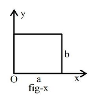
The centre of mass of a thin rectangular plate (fig x ) with sides of length a and b , whose mass per unit area $(\sigma)$ varies as $\sigma=\frac{\sigma_{0} \mathrm{x}}{\mathrm{ab}}$ (where $\sigma_{0}$ is a constant), would be $\qquad$
Image
  • $\left(\frac{2}{3} a, \frac{b}{2}\right)$
  • B
    $\left(\frac{2}{3} a, \frac{2}{3} b\right)$
  • C
    $\left(\frac{\mathrm{a}}{2}, \frac{\mathrm{~b}}{2}\right)$
  • D
    $\left(\frac{1}{3} a, \frac{b}{2}\right)$
Answer
Correct option: A.
$\left(\frac{2}{3} a, \frac{b}{2}\right)$
(A)
Sol. $\sigma$ is constant in $y$-direction
So, $y_{c m}=b / 2$
Image
$X_{c m}=\frac{\int_{0}^{a} x d m}{\int_{0}^{a} d m}$
$=\frac{\int_{0}^{a} x \sigma_{x} d A}{\int_{0}^{a} \sigma_{x} d A}$
$=\frac{\int_{0}^{a} x \frac{\sigma_{\circ} x}{a b} b d x}{\int_{0}^{a} \frac{\sigma_{\circ} x}{a b} b d x}$
$x_{c m}=\frac{\int_{0}^{a} x^{2} d x}{\int_{0}^{a} x d x}$
$=\frac{\left(\frac{x^{3}}{3}\right)_{0}^{a}}{\left(\frac{x^{2}}{2}\right)_{0}^{a}}=\frac{a^{3} / 3}{a^{2} / 2}$
$=\frac{2 \mathrm{a}}{3}$
View full question & answer
MCQ 44 Marks
A proton of mass ' $m_{p}$ ' has same energy as that of a photon of wavelength ' $\lambda$ '. If the proton is moving at non-relativistic speed, then ratio of its de Broglie wavelength to the wavelength of photon is.
  • A
    $\frac{1}{c} \sqrt{\frac{2 E}{m_{p}}}$
  • B
    $\frac{1}{c} \sqrt{\frac{E}{m_{p}}}$
  • $\frac{1}{c} \sqrt{\frac{E}{2 m_{p}}}$
  • D
    $\frac{1}{2 c} \sqrt{\frac{E}{m_{p}}}$
Answer
Correct option: C.
$\frac{1}{c} \sqrt{\frac{E}{2 m_{p}}}$
(C)
Sol. E is missing in the question but considering E as energy, the solution will be
$\mathrm{E}_{\text {photon }}=\frac{\mathrm{hc}}{\lambda}=\mathrm{E} ; \mathrm{E}_{\text {proton }}=\frac{1}{2} \mathrm{~m}_{\mathrm{p}} \mathrm{v}^{2}=\mathrm{E}$
$\frac{\lambda_{\text {proton }}}{\lambda_{\text {photon }}}=\frac{\mathrm{h} / \mathrm{p}}{\mathrm{hc} / \mathrm{E}}=\frac{\mathrm{h} / \sqrt{2 \mathrm{~m}_{\mathrm{p}} \mathrm{E}}}{\mathrm{hc} / \mathrm{E}}$
$=\frac{\mathrm{E}}{\mathrm{c} \sqrt{2 \mathrm{~m}_{\mathrm{p}} \mathrm{E}}}$
$\frac{\lambda_{\text {proton }}}{\lambda_{\text {photon }}}=\frac{1}{c} \sqrt{\frac{\mathrm{E}}{2 \mathrm{~m}_{\mathrm{p}}}}$

View full question & answer
MCQ 54 Marks
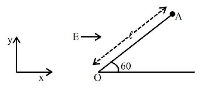
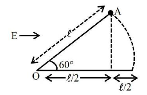
A particle of mass ' $m$ ' and charge ' $q$ ' is fastened to one end ' $A$ ' of a massless string having equilibrium length $\ell$, whose other end is fixed at point ' $O$ '. The whole system is placed on a frictionless horizontal plane and is initially at rest. If uniform electric field is switched on along the direction as shown in figure, then the speed of the particle when it crosses the x -axis is
Image
  • A
    $\sqrt{\frac{2 q E \ell}{m}}$
  • B
    $\sqrt{\frac{q E \ell}{4 m}}$
  • $\sqrt{\frac{q E \ell}{m}}$
  • D
    $\sqrt{\frac{q E \ell}{2 m}}$
Answer
Correct option: C.
$\sqrt{\frac{q E \ell}{m}}$
(C)
$\mathrm{W}_{\mathrm{all}}=\Delta \mathrm{k}$
$\mathrm{W}_{\mathrm{c}}=\mathrm{k}_{\mathrm{f}}-\mathrm{k}_{\mathrm{i}}$
$\mathrm{qE} \frac{\ell}{2}=\frac{1}{2} \mathrm{mv}^{2}-0$
$\mathrm{v}=\sqrt{\frac{\mathrm{qE} \ell}{\mathrm{m}}}$
Image

View full question & answer
MCQ 64 Marks
Due to presence of an em-wave whose electric component is given by $\mathrm{E}=100 \sin (\omega \mathrm{t}-\mathrm{kx}) \mathrm{NC}^{-1}$, a cylinder of length 200 cm holds certain amount of em-energy inside it. If another cylinder of same length but half diameter than previous one holds same amount of em-energy, the magnitude of the electric field of the corresponding em-wave should be modified as
  • A
    $25 \sin (\omega \mathrm{t}-\mathrm{kx}) \mathrm{NC}^{-1}$
  • $200 \sin (\omega t-k x) \mathrm{NC}^{-1}$
  • C
    $400 \sin (\omega t-k x) \mathrm{NC}^{-1}$
  • D
    $50 \sin (\omega \mathrm{t}-\mathrm{kx}) \mathrm{NC}^{-1}$
Answer
Correct option: B.
$200 \sin (\omega t-k x) \mathrm{NC}^{-1}$
(B)
Sol. Energy density $=\frac{1}{2} \in_{0} E^{2} \times c$
Energy $=\frac{1}{2} \in_{0} E^{2} \times \mathrm{c} \times$ volume
$(\text { Energy })_{1}=(\text { Energy })_{2} \quad($ Given $)$
$\frac{1}{2} \in_{0} \mathrm{E}_{1}^{2} \mathrm{c} \pi \mathrm{R}_{1}^{2} \times \mathrm{L}_{1}=\frac{1}{2} \in_{0} \mathrm{E}_{2}^{2} \mathrm{c} \pi \mathrm{R}_{2}^{2} \times \mathrm{L}_{2}$
$\mathrm{E}_{1}^{2} \mathrm{R}_{1}^{2}=\mathrm{E}_{2}^{2} \mathrm{R}_{2}^{2}$
$\mathrm{E}_{1} \mathrm{R}_{1}=\mathrm{E}_{2} \mathrm{R}_{2}$
$100 \times \mathrm{R}_{1}=\mathrm{E}_{2} \times \frac{\mathrm{R}_{1}}{2}$
$\mathrm{E}_{2}=200 \mathrm{~N} / \mathrm{C}$
View full question & answer
MCQ 74 Marks
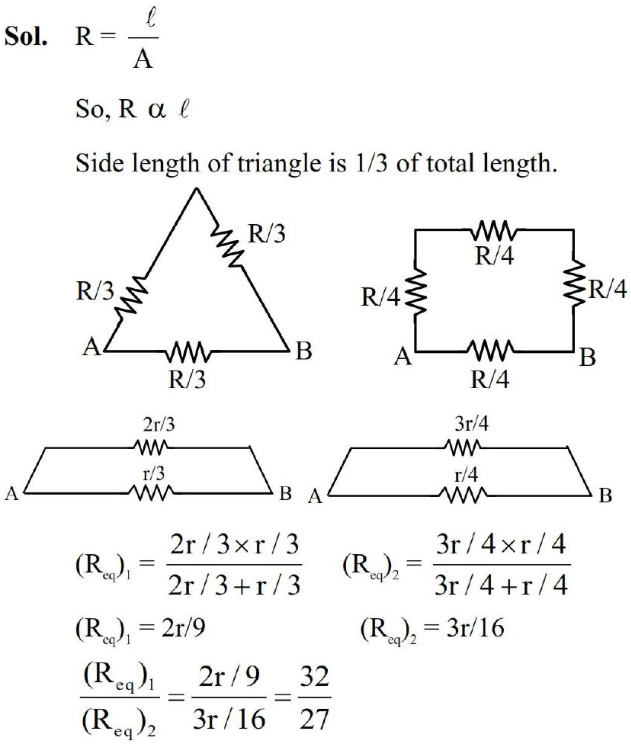
A wire of resistance $R$ is bent into an equilateral triangle and an identical wire is bent into a square. The ratio of resistance between the two end points of an edge of the triangle to that of the square is
  • A
    $9 / 8$
  • B
    $8 / 9$
  • C
    $27 / 32$
  • D
    $32 / 27$
Answer
View full question & answer
MCQ 84 Marks
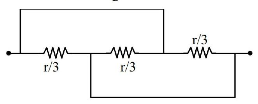
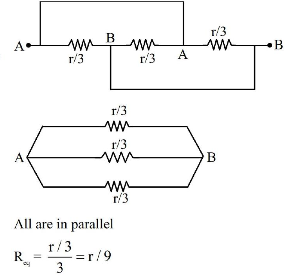
Find the equivalent resistance between two ends of the following circuit.
Image
  • A
    $r$
  • B
    $\frac{r}{6}$
  • $\frac{r}{9}$
  • D
    $\frac{r}{3}$
Answer
Correct option: C.
$\frac{r}{9}$
(C)
Image
View full question & answer
MCQ 94 Marks
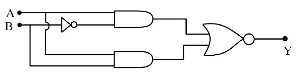
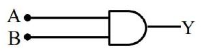
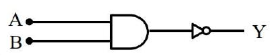
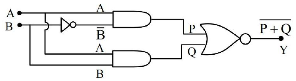
Which of the following circuits has the same output as that of the given circuit?
Image
  • Image
  • B
    Image
  • C
    Image
  • D
    Image
Answer
Correct option: A.
Image
(A)
Image
$\mathrm{P}=\mathrm{A} \cdot \overline{\mathrm{B}}$
$\mathrm{Q}=\mathrm{A} \cdot \mathrm{B}$
$\mathrm{Y}=\overline{\mathrm{P}+\mathrm{Q}}=\overline{\mathrm{A} \cdot \overline{\mathrm{B}}+\mathrm{A} \cdot \mathrm{B}}$
$=\overline{\mathrm{A} \cdot(\mathrm{B}+\overline{\mathrm{B}})}=\overline{\mathrm{A} \cdot \mathrm{I}}$
$Y=\overline{\mathrm{A}}$
View full question & answer
MCQ 104 Marks
Choose the correct nuclear process from the below options
[p: proton, n : neutron, $\mathrm{e}^{-}$: electron, $\mathrm{e}^{+}$: positron, $v$ : neutrino, $\bar{v}$ : antineutrino]
  • $n \rightarrow p+e^{-}+\bar{v}$
  • B
    $n \rightarrow p+e^{-}+v$
  • C
    $\mathrm{n} \rightarrow \mathrm{p}+\mathrm{e}^{+}+\bar{v}$
  • D
    $n \rightarrow p+e^{+}+v$
Answer
Correct option: A.
$n \rightarrow p+e^{-}+\bar{v}$
(A)
Sol. Theoretical equation for $\beta^{-1}$ decay
$\mathrm{n}_{0}^{1} \rightarrow \mathrm{p}_{1}^{1}+\mathrm{e}_{-1}^{-0}+\bar{v}$
View full question & answer
MCQ 114 Marks
Given below are two statements: one is labelled as Assertion A and the other is labelled as Reason $\mathbf{R}$
Assertion A: In a central force field, the work done is independent of the path chosen
Reason R: Every force encountered in mechanics does not have an associated potential energy.
In the light of the above statements, choose the most appropriate answer from the options given below
  • A
    $\mathbf{A}$ is true but $\mathbf{R}$ is false
  • Both $\mathbf{A}$ and $\mathbf{R}$ are true but $\mathbf{R}$ is NOT the correct explanation of $\mathbf{A}$
  • C
    Both $\mathbf{A}$ and $\mathbf{R}$ are true and $\mathbf{R}$ is the correct explanation of $\mathbf{A}$
  • D
    $\mathbf{A}$ is false but $\mathbf{R}$ is true
Answer
Correct option: B.
Both $\mathbf{A}$ and $\mathbf{R}$ are true but $\mathbf{R}$ is NOT the correct explanation of $\mathbf{A}$
(B)
Sol. Both statement are correct but Reason is not the correct explanation of Assertion.
View full question & answer
MCQ 124 Marks
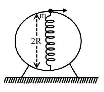
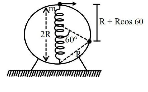
A bead of mass ' $m$ ' slides without friction on the wall of a vertical circular hoop of radius ' $R$ ' as shown in figure. The bead moves under the combined action of gravity and a massless spring (k) attached to the bottom of the hoop. The equilibrium length of the spring is ' $R$ '. If the bead is released from top of the hoop with (negligible) zero initial speed, velocity of bead, when the length of spring becomes ' $R$ ', would be (spring constant is ' $k$ ', $g$ is acceleration due to gravity)
Image
  • A
    $2 \sqrt{\mathrm{gR}+\frac{\mathrm{kR}{ }^{2}}{\mathrm{~m}}}$
  • B
    $\sqrt{2 \mathrm{Rg}+\frac{4 \mathrm{kR}^{2}}{\mathrm{~m}}}$
  • C
    $\sqrt{2 R g+\frac{\mathrm{kR}^{2}}{\mathrm{~m}}}$
  • $\sqrt{3 R g+\frac{k R^{2}}{m}}$
Answer
Correct option: D.
$\sqrt{3 R g+\frac{k R^{2}}{m}}$
(D)
Work energy theorem
$\operatorname{Mg}(\mathrm{R}+\mathrm{R} \cos 60)+\frac{1}{2} \mathrm{k}\left(\mathrm{R}^{2}-0^{2}\right)=\frac{1}{2} \mathrm{mv}^{2}$
$\mathrm{Mg} \frac{3 \mathrm{R}}{2}+\frac{\mathrm{KR}^{2}}{2}=\frac{1}{2} \mathrm{mv}^{2}$
$V=\sqrt{3 g R+\frac{K R^{2}}{m}}$
Image


View full question & answer
MCQ 134 Marks
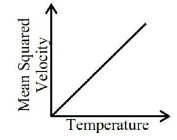
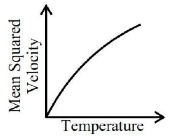
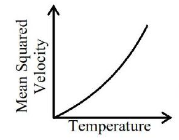
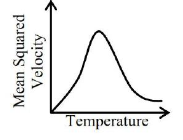
For a particular ideal gas which of the following graphs represents the variation of mean squared velocity of the gas molecules with temperature?
  • Image
  • B
    Image
  • C
    Image
  • D
    Image
Answer
Correct option: A.
Image
(A)
Sol. $\quad V_{\mathrm{rms}}=\sqrt{\frac{3 R T}{M}}$
$\mathrm{V}_{\mathrm{rms}}^{2}=3 \mathrm{RT} / \mathrm{M}$
Hence we can conclude that $\mathrm{V}_{\mathrm{rms}}^{2}$ is directly proportional to temperature
$y=m x$
$\Rightarrow$ Graph will be straight line
View full question & answer
MCQ 144 Marks
Given below are two statements: one is labelled as Assertion A and the other is labelled as Reason $\mathbf{R}$
Assertion A: A sound wave has higher speed in solids than gases.
Reason R: Gases have higher value of Bulk modulus than solids.
In the light of the above statements, choose the correct answer from the options given below
  • A
    Both $\mathbf{A}$ and $\mathbf{R}$ are true and $\mathbf{R}$ is the correct explanation of $\mathbf{A}$
  • B
    $\mathbf{A}$ is false but $\mathbf{R}$ is true
  • C
    Both $\mathbf{A}$ and $\mathbf{R}$ are true but $\mathbf{R}$ is NOT the correct explanation of $\mathbf{A}$
  • $\mathbf{A}$ is true but $\mathbf{R}$ is false.
Answer
Correct option: D.
$\mathbf{A}$ is true but $\mathbf{R}$ is false.
(D)
Sol. Solids have higher value of bulk modulus than gases.
View full question & answer
MCQ 154 Marks
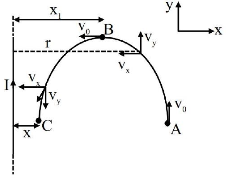
Consider a long thin conducting wire carrying a uniform current I. A particle having mass " M " and charge " q " is released at a distance " a " from the wire with a speed $v_{0}$ along the direction of current in the wire. The particle gets attracted to the wire due to magnetic force. The particle turns round when it is at distance $x$ from the wire. The value of x is [ $\mu_{0}$ is vacuum permeability]
  • A
    $a\left[1-\frac{m v_{o}}{2 q \mu_{o} I}\right]$
  • B
    $\frac{a}{2}$
  • C
    $\mathrm{a}\left[1-\frac{m v_{o}}{q \mu_{o} I}\right]$
  • D
    $\mathrm{ae}^{\frac{-4 \pi \mathrm{mv}_{0}}{\mathrm{qu}_{0} \mathrm{I}}}$
Answer
(D)
Image
$\mathrm{A} \rightarrow \mathrm{B}$
$\overrightarrow{\mathrm{V}}=-\mathrm{v}_{\mathrm{x}} \hat{\mathrm{i}}+\mathrm{v}_{\mathrm{y}} \hat{\mathrm{j}}$
$\overrightarrow{\mathrm{B}}=\frac{\mu_{0} \mathrm{I}}{2 \pi \mathrm{r}}(-\hat{\mathrm{k}})$
$\overrightarrow{\mathrm{F}}=\mathrm{q}(\overrightarrow{\mathrm{v}} \times \overrightarrow{\mathrm{B}})=\frac{\mu_{0} \operatorname{Iq}}{2 \pi \mathrm{r}}\left[-\mathrm{v}_{\mathrm{x}} \hat{\mathrm{j}}-\mathrm{v}_{\mathrm{y}} \hat{\mathrm{i}}\right]$
$\mathrm{a}_{\mathrm{x}}=-\frac{\mu_{0} \mathrm{Iq}}{2 \pi \mathrm{~m}} \cdot \frac{\mathrm{v}_{\mathrm{y}}}{\mathrm{r}}$
$\mathrm{a}_{\mathrm{y}}=-\frac{\mu_{0} \text { Iq }}{2 \pi \mathrm{~m}} \cdot \frac{\mathrm{v}_{\mathrm{x}}}{\mathrm{r}}$
$\frac{\mathrm{v}_{\mathrm{x}} \mathrm{dv}_{\mathrm{x}}}{\mathrm{dr}}=-\frac{\mu_{0} \mathrm{Iq}}{2 \pi \mathrm{~m}} \frac{\mathrm{v}_{\mathrm{y}}}{\mathrm{r}}$
$\frac{v_{x} \mathrm{dv}_{\mathrm{x}}}{\mathrm{v}_{\mathrm{y}}}=-\frac{\mu_{0} \mathrm{Iq}}{2 \pi \mathrm{~m}} \frac{\mathrm{dr}}{\mathrm{r}}$
$\int_{0}^{v_{0}} \frac{v_{x} d v_{x}}{\sqrt{v_{0}^{2}-v_{x}^{2}}}=-\frac{\mu_{0} I q^{2}}{2 \pi m_{a}} \int_{\mathrm{x}} \frac{d r}{r}$
Let, $z^{2}=v_{0}{ }^{2}-v_{x}^{2}$
$2 \mathrm{zd} \mathrm{z}=-2 \mathrm{v}_{\mathrm{x}} \mathrm{dv} \mathrm{v}_{\mathrm{x}}$
$\frac{\mathrm{v}_{\mathrm{x}} \mathrm{dv}_{\mathrm{x}}}{\sqrt{\mathrm{v}_{0}^{2}-\mathrm{v}_{\mathrm{x}}^{2}}}=\frac{-\mathrm{zdz}}{\mathrm{z}}=-\mathrm{dz}$
then integral becomes
$-\int_{\mathrm{v}_{0}}^{0} \mathrm{dz}=-\frac{\mu_{0} \mathrm{Iq}}{2 \pi \mathrm{~m}} \ln \frac{\mathrm{x}_{1}}{\mathrm{a}}$
$v_{0}=-\frac{\mu_{0} I q}{2 \pi m} \ln \frac{x_{1}}{a}$
$x_{1}=a e^{-\frac{2 \pi \mathrm{mv}_{0}}{\mu_{0} \mathrm{I}_{1}}}$
For B $\rightarrow$ C
$\overrightarrow{\mathrm{v}}=-\mathrm{v}_{\mathrm{x}} \hat{\mathrm{i}}-\mathrm{v}_{\mathrm{y}} \hat{\mathrm{j}}$
$\overrightarrow{\mathrm{B}}=\frac{\mu_{0} \mathrm{I}}{2 \pi \mathrm{r}}(-\hat{\mathrm{k}})$
$\vec{F}=q(\vec{v} \times \vec{B})=\frac{\mu_{0} I q}{2 \pi r}\left(-v_{x} \hat{j}+v_{y} \hat{i}\right)$
$\mathrm{a}_{\mathrm{x}}=+\frac{\mu_{0} \mathrm{Iq}}{2 \pi \mathrm{~m}} \frac{\mathrm{v}_{\mathrm{y}}}{\mathrm{r}}$
$a_{y}=-\frac{\mu_{0} I q}{2 \pi m} \cdot \frac{v_{x}}{r}$
$\frac{\mathrm{v}_{\mathrm{x}} \mathrm{dv}_{\mathrm{x}}}{\mathrm{dr}}=\frac{\mu_{0} \mathrm{Iq}}{2 \pi \mathrm{~m}} \frac{\mathrm{v}_{\mathrm{y}}}{\mathrm{r}}$
$\int_{v_{0}}^{0} \frac{v_{x} \mathrm{dv}_{\mathrm{x}}}{\sqrt{\mathrm{v}_{0}^{2}-\mathrm{v}_{\mathrm{x}}^{2}}}=\frac{\mu_{0} \mathrm{Iq}}{2 \pi \mathrm{~m}} \int_{\mathrm{x}_{1}}^{\mathrm{x}} \frac{\mathrm{dr}}{\mathrm{r}}$
$\frac{\mu_{0} \operatorname{Iq}}{2 \pi m} \ln \frac{x}{x_{1}}=-\int_{0}^{v_{0}} d z=-v_{0}$
$x=x_{1} e^{-\frac{2 \pi m v_{0}}{\mu_{0} \mathrm{Iq}^{2}}}$
From equation 1 and 2
$X=a e^{-\frac{4 \pi \mathrm{mv}_{0}}{\mu_{0} I_{q}}}$


View full question & answer
MCQ 164 Marks
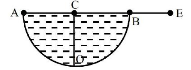
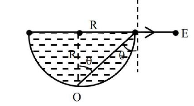
A hemispherical vessel is completely filled with a liquid of refractive index $\mu$. A small coin is kept at the lowest point $(\mathrm{O})$ of the vessel as shown in figure. The minimum value of the refractive index of the liquid so that a person can see the coin from point $E$ (at the level of the vessel) is _____________ .
Image
  • A
    $\sqrt{3}$
  • B
    $\frac{3}{2}$
  • C
    $\sqrt{2}$
  • D
    $\frac{\sqrt{3}}{2}$
View full question & answer
MCQ 174 Marks
Three infinitely long wires with linear charge density $\lambda$ are placed along the x -axis, y -axis and z axis respectively. Which of the following denotes an equipotential surface?
  • A
    $x y+y z+z x=$ constant
  • $(x+y)(y+z)(z+x)=$ constant
  • C
    $\left(x^{2}+y^{2}\right)\left(y^{2}+z^{2}\right)\left(z^{2}+x^{2}\right)=$ constant
  • D
    $x y z=$ constant
Answer
Correct option: B.
$(x+y)(y+z)(z+x)=$ constant
(B)
Sol. $\quad v=-\int \overrightarrow{\mathrm{E}} \cdot \mathrm{d} \overrightarrow{\mathrm{r}}=\int \frac{2 \mathrm{k} \lambda}{\mathrm{r}} \mathrm{dr}=2 \mathrm{k} \lambda \ln \mathrm{r}+\mathrm{c}$
Net potential due to all wire
$
\mathrm{v}=2 \mathrm{k} \lambda \ln \sqrt{\mathrm{x}^{2}+\mathrm{y}^{2}}+2 \mathrm{k} \lambda \ln \sqrt{\mathrm{y}^{2}+\mathrm{z}^{2}}+2 \mathrm{k} \lambda \ln \sqrt{\mathrm{z}^{2}+\mathrm{x}^{2}}+\mathrm{c}
$
for $v=c$
$\sqrt{\left(\mathrm{x}^{2}+\mathrm{y}^{2}\right)\left(\mathrm{y}^{2}+\mathrm{z}^{2}\right)\left(\mathrm{z}^{2}+\mathrm{x}^{2}\right)}=\mathrm{c}$
$\therefore\left(\mathrm{x}^{2}+\mathrm{y}^{2}\right)\left(\mathrm{y}^{2}+\mathrm{z}^{2}\right)\left(\mathrm{z}^{2}+\mathrm{x}^{2}\right)=\mathrm{c}$
where $\mathrm{c}=$ constant
View full question & answer
MCQ 184 Marks
Consider following statements:
A. Surface tension arises due to extra energy of the molecules at the interior as compared to the molecules at the surface, of a liquid.
B. As the temperature of liquid rises, the coefficient of viscosity increases.
C. As the temperature of gas increases, the coefficient of viscosity increases.
D. The onset of turbulence is determined by Reynold's number.
E. In a steady flow two stream lines never intersect.
Choose the correct answer from the options given below :
  • A
    A, D, E only
  • C, D, E only
  • C
    B, C, D only
  • D
    A, B, C only
Answer
Correct option: B.
C, D, E only
(B)
View full question & answer
MCQ 194 Marks
In the experiment for measurement of viscosity ' $\eta$ ' of given liquid with a ball having radius $R$, consider following statements.
A. Graph between terminal velocity V and R will be a parabola
B. The terminal velocities of different diameter balls are constant for a given liquid.
C. Measurement of terminal velocity is dependent on the temperature.
D. This experiment can be utilized to assess the density of a given liquid.
E. If balls are dropped with some initial speed, the value of $\eta$ will change.
Choose the correct answer from the options given below:
  • A
    B, D and E only
  • A, C and D only
  • C
    C, D and E only
  • D
    A, B and E only
Answer
Correct option: B.
A, C and D only
(B)
Sol. $\quad V_{T}=\frac{2}{9} R^{2} \frac{g}{\eta}(d-\rho)$
View full question & answer
MCQ 204 Marks
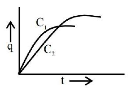
Two capacitors $\mathrm{C}_{1}$ and $\mathrm{C}_{2}$ are connected in parallel to a battery. Charge-time graph is shown below for the two capacitors. The energy stored with them are $U_{1}$ and $U_{2}$, respectively. Which of the given statements is true?
Image
  • A
    $\mathrm{C}_{1}>\mathrm{C}_{2}, \mathrm{U}_{1}>\mathrm{U}_{2}$
  • B
    $\mathrm{C}_{2}>\mathrm{C}_{1}, \mathrm{U}_{2}<\mathrm{U}_{1}$
  • C
    $\mathrm{C}_{1}>\mathrm{C}_{2}, \mathrm{U}_{1}<\mathrm{U}_{2}$
  • D
    $\mathrm{C}_{2}>\mathrm{C}_{1}, \mathrm{U}_{2}>\mathrm{U}_{1}$
Answer
Sol. potential difference,
$\mathrm{v} \rightarrow$ same
$\mathrm{U}=\frac{1}{2} \mathrm{cv}^{2}$
as $\mathrm{q}_{1}<\mathrm{q}_{2}$
$\therefore \mathrm{c}_{1}<\mathrm{c}_{2}$
$\& \mathrm{U}_{1}<\mathrm{U}_{2}$
View full question & answer