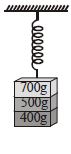
Three masses $700g, 500g$ and $400g$ are suspended at the end of a spring a shown and are in equilibrium. When the $700g$ mass is removed, the system oscillates with a period of $3\,seconds$, when the $500g$ mass is also removed, it will oscillate with a period of .... $s$
Medium


Download our appand get started for free
Experience the future of education. Simply download our apps or reach out to us for more information. Let's shape the future of learning together!No signup needed.*
Similar Questions
- 1A force of $6.4\ N$ stretches a vertical spring by $0.1\ m$. The mass that must be suspended from the spring so that it oscillates with a time period of $\pi/4\ second$ is .... $kg$View Solution
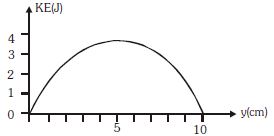
- 2A mass on a vertical spring begins its motion at rest at $y = 0\ cm$. It reaches a maximum height of $y = 10\ cm$. The two forces acting on the mass are gravity and the spring force. The graph of its kinetic energy ($KE$) versus position is given below. Net force on the mass varies with $y$ asView Solution
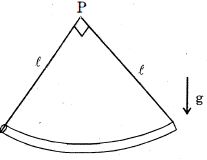
- 3A circular arc of mass $m$ is connected with the help of two massless strings as shown in the figuw in vertical plane. About point $P$, small oscillations are given in the plane of the arc. Time period of the oscillations of $SHM$ will beView Solution
- 4A particle executing simple harmonic motion with amplitude of $0.1 \,m$. At a certain instant when its displacement is $0.02 \,m$, its acceleration is $0.5 \,m/s^2$. The maximum velocity of the particle is (in $m/s$)View Solution
- 5The potential energy of a simple harmonic oscillator at mean position is $2\,joules$. If its mean $K.E.$ is $4\,joules$, its total energy will be .... $J$View Solution
- 6A particle which is simultaneously subjected to two perpendicular simple harmonic motions represented by; $x = {a_1}\,\cos \,\omega t$ and $y = {a_2}\,\cos \,2\,\omega t$ traces a curve given byView Solution
- 7The amplitude and the time period in a $S.H.M.$ is $0.5 \,cm$ and $0.4 \,sec$ respectively. If the initial phase is $\pi /2$ radian, then the equation of $S.H.M.$ will beView Solution
- 8A particle is executing simple harmonic motion with a period of $T$ seconds and amplitude a metre. The shortest time it takes to reach a point $\frac{a}{{\sqrt 2 }}\,m$ from its mean position in seconds isView Solution
- 9A particle executes $SHM$ of amplitude $25\, cm$ and time period $3\, s$. What is the minimum time required for the particle to move between two points $12.5\, cm$ on either side of the mean position ..... $\sec$View Solution
- 10View SolutionThe total energy of a particle executing simple harmonic motion is