Question
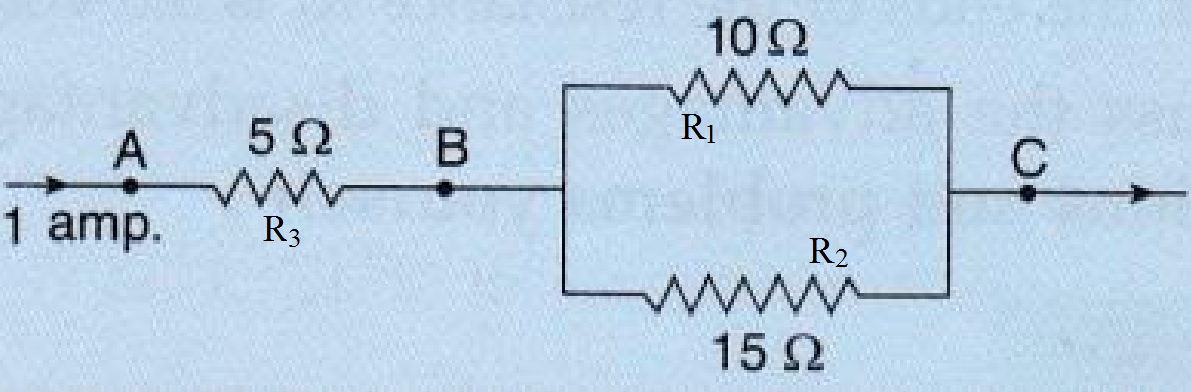
Three resistors are connected as shown in the diagram.
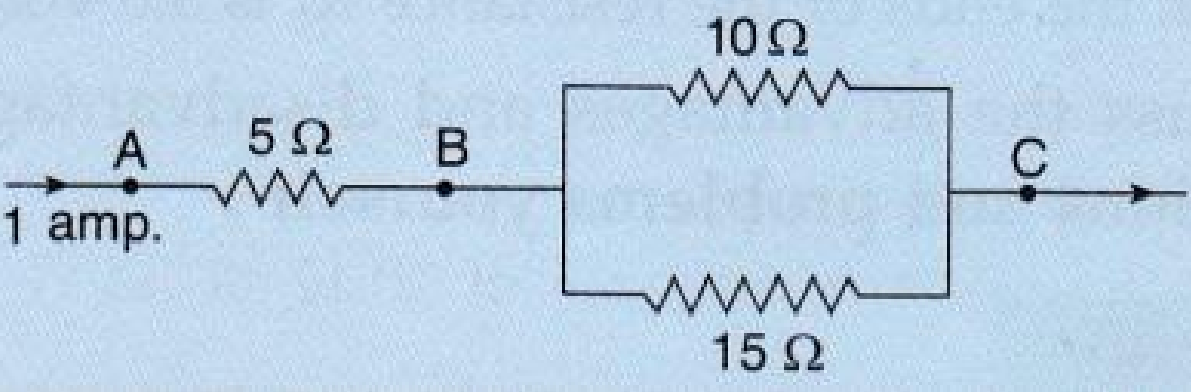
Through the resistor 5 ohm, a current of 1 ampere is flowing,
  1. What is the current through the other two resistors?
  2. What is the p.d. across AB and across AC?
  3. What is the total resistance?

Answer


According to the diagram
  1. Total current I = 1 amp is entering the parallel combination of R1 and R. Let I1 current flows through R1 and I2 current flows through R2
Then

$\text{I}_1=\frac{\text{IR}_2}{\text{R}_1+\text{R}_2}$

$=\frac{1\times15}{10+15}=0.6\text{A}$

$\text{I}_2=\frac{\text{IR}_2}{\text{R}_1+\text{R}_2}$

$=\frac{1\times10}{10+15}=0.4\text{A}$
  1. p.d. across AB = $IR_3 = 1 × 5 = 5V$
Equivalent resisyance between B and C is

$\frac{1}{\text{R}'}=\frac{1}{\text{R}_1}+\frac{1}{\text{R}_2}=\frac{1}{10}+\frac{1}{15}$

$\frac{1}{\text{R}'}=\frac{5}{30}$

R' = 6 ohm

Total resistance between A and C is R = 5 + 6 = 11 ohm

p.d. across AC = IR = 1 × 11 = 11V
  1. Total resistance $=R_3+R^{\prime}=5+6=11$ ohm.

Need a full question paper?

Generate a complete, print-ready paper with questions like this in minutes — across 16+ boards, with answer keys.

Start Generating Free

Similar questions

What substances are contained in pancreatic juice? What are their functions?
  1. List three distinguishing features between sexual and asexual types of reproduction.
  2. Explain why variations are observed in the off spring’s of sexually reproducing organisms?
Image
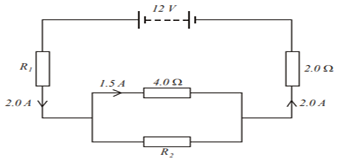
The above circuit is a part of an electrical device. Use the information given in the question to calculate the following.
$(i)$ Potential Difference across $R_2.$
$(ii)$ Value of the resistance $R_2.$
$(iii)$ Value of resistance $R_1$​​​​​​​
The flask-shaped organ A at the centre of a flower is surrounded by a number of little stalks B having swollen tops which lie just inside the ring of petals.
  1. Name A. What are the various parts of A?
  2. Which part of A contains gametes?
  3. Name B. What is the swollen top of B known as?
  4. What does the swollen top of b contain?
  5. Out of A and B, which one is (i) male part, and (ii) female part of the flower?
A student focussed the image of a candle flame on a white screen using a convex lens. He noted down the position of the candle screen and the lens as under,
Position of candle = 12.0cm
Position of convex lens = 50.0cm
Position of the screen = 88.0cm
  1. What is the focal length of the convex lens?
  2. Where will the image be formed if he shifts the candle towards the lens at a position of 31.0cm?
  3. What will be the nature of the image formed if he further shifts the candle towards the lens?
  4. Draw a ray diagram to show the formation of the image in case (iii) as said above.
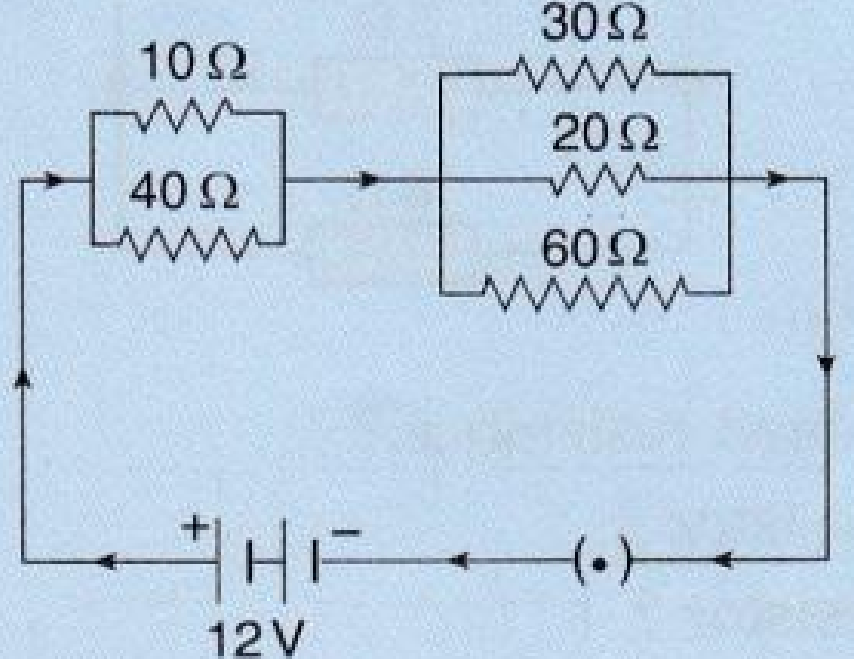
In the circuit diagram given below five resistances of $10 Ω, 40 Ω, 30 Ω, 20 Ω\ \text{and}\ 60 Ω$ are connected as shown to a 12V battery.
Calculate:
  1. Total resistance in the circuit.
  2. Total current flowing in the circuit.
How is double circulation different from single circulation?
Outline the functioning of kidney dialysis machine?
Make a list of conventional and non-conventional sources of energy. Give a brief description of harnessing one nonconventional source of energy.
Draw the diagram of alimentary canal of man and label the following parts.Mouth, Oesophagus, Stomach, Intestine.