Three resistors each of $4\,\Omega $ are connected together to form a network. The equivalent resistance of the network cannot be ............ $\Omega$
Medium
Download our app for free and get started
(b) If all are in series then ${R_{eq}} = 12\,\Omega $
If all are in parallel then ${R_{eq}} = \frac{4}{3}\Omega = 1.33\,\Omega $
If two are in series then parallel with third, ${R_{eq}} = \frac{8}{3} = 2.6\,\Omega $
If two are in parallel then series with third, ${R_{eq}} = 6\,\Omega $

Download our appand get started for free
Experience the future of education. Simply download our apps or reach out to us for more information. Let's shape the future of learning together!No signup needed.*
Similar Questions
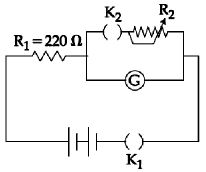
- 1The galvanometer deflection, when key $K_1$ is closed but $K_2$ is open, equals $\theta_0$ (see figure). On closing $K_2$ also and adjusting $R_2$ to $5\,\Omega $ , the deflection in galvanometer becomes $\frac{{\theta _0}}{5}$. The resistance of the galvanometer is, then, given by [Neglect the internal resistance of battery]: .................. $\Omega$View Solution
- 2Two $220\; V , 100 \;W$ bulbs are connected first in series and then in parallel. Each time the combination is connected to a $220 \;V \;AC$ supply line. The power drawn by the combination in each case respectively will beView Solution
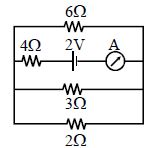
- 3The reading of the ammeter in the adjoining figure will be .............. $A$View Solution
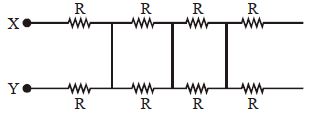
- 4Net resistance between $X$ and $Y$ isView Solution
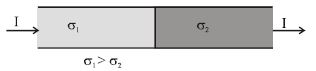
- 5Current $I$ is flowing through the two materials having electrical conductivities $\sigma_1$ and $\sigma_2$ respectively $(\sigma_1 > \sigma_2 )$ as shown in the figure. The total amount of charge at the junction of the materials isView Solution
- 6A ($100\, W$, $200\, V$) bulb is connected to a $160\, V$ power supply. The power consumption would be ............. $W$View Solution
- 7View SolutionA heater coil is cut into two equal parts and only one part is now used in the heater. The heat generated will now be
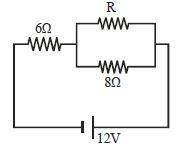
- 8In the circuit shown in figure, the power which is dissipated as heat in the $6\,\Omega $ resistor is $6\,W$. What is the value of resistance $R$ in the circuit? ................ $\Omega$View Solution
- 9If voltage across a bulb rated $220$ $volt-$ $100$ $watt$ drops by $2.5\%$ of its rated value, the percentage of the rated value by which the power would decrease is ............... $\%$View Solution
- 10Two circuits (shown below) are called ‘Circuit $A$ ’and ‘Circuit $B$’. The equivalent resistance of ‘Circuit $a$’ is $x$ and that of ‘Circuit $B$’ is $y$ between $1$ and $2.$View Solution
