MCQ
The angle made by the vector $A = \hat i + \hat j$ with $x-$ axis is ....... $^o$
  • A
    $90$
  • $45$
  • C
    $22.5$
  • D
    $30$

Answer

Correct option: B.
$45$
b
(b) $\vec A = \hat i + \hat j$ 

$⇒$ $|A| = \sqrt {{1^2} + {1^2}} = \sqrt 2 $

$\cos \alpha = \frac{{{A_x}}}{{|A|}} = \frac{1}{{\sqrt 2 }} = \cos 45^\circ $ 
$⇒$ $\alpha = 45^\circ $

Need a full question paper?

Generate a complete, print-ready paper with questions like this in minutes — across 16+ boards, with answer keys.

Start Generating Free

Similar questions

The gas which obeys Boyle's law for maximum range of temperature is
For a particle in a uniformly accelerated circular motion
A projectile is hurled into air from a point on the horizontal ground at an angle with the vertical.
If the air exerts a constant resistive force,
A solid cylinder of mass $2\ kg$ and radius $0.2\,m$ is rotating about its own axis without friction with angular velocity $3\,rad/s$. A particle of mass $0.5\ kg$ and moving with a velocity $5\ m/s$ strikes the cylinder and sticks to it as shown in figure. The angular momentum of the cylinder before collision will be ........ $J-s$
Velocity of a particle is in negative direction with constant acceleration in positive direction. Then, match the following columns.
Colum $I$ Colum $II$
$(A)$ Velocity-time graph $(p)$ Slope $\rightarrow$ negative
$(B)$ Acceleration-time graph $(q)$ Slope $\rightarrow$ positive
$(C)$ Displacement-time graph $(r)$ Slope $\rightarrow$ zero
  $(s)$ $\mid$ Slope $\mid \rightarrow$ increasing
  $(t)$ $\mid$ Slope $\mid$ $\rightarrow$ decreasing
  $(u)$ |Slope| $\rightarrow$ constant
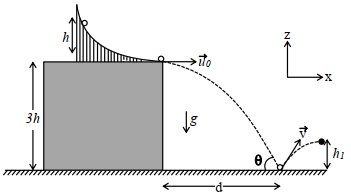
A slide with a frictionless curved surface, which becomes horizontal at its lower end,, is fixed on the terrace of a building of height $3 h$ from the ground, as shown in the figure. A spherical ball of mass $\mathrm{m}$ is released on the slide from rest at a height $h$ from the top of the terrace. The ball leaves the slide with a velocity $\vec{u}_0=u_0 \hat{x}$ and falls on the ground at a distance $d$ from the building making an angle $\theta$ with the horizontal. It bounces off with a velocity $\overrightarrow{\mathrm{v}}$ and reaches a maximum height $h_l$. The acceleration due to gravity is $g$ and the coefficient of restitution of the ground is $1 / \sqrt{3}$. Which of the following statement($s$) is(are) correct?

($AV$) $\vec{u}_0=\sqrt{2 g h} \hat{x}$ ($B$) $\vec{v}=\sqrt{2 g h}(\hat{x}-\hat{z})$  ($C$) $\theta=60^{\circ}$  ($D$) $d / h_1=2 \sqrt{3}$
The root mean square speed of molecules of a given mass of a gas at $27^{\circ} C$ and $1$ atmosphere pressure is $200\, ms ^{-1}$. The root mean square speed of molecules of the gas at $127^{\circ} C$ and $2$ atmosphere pressure is $\frac{ x }{\sqrt{3}}\, ms ^{-1} .$ The value of $x$ will be ......$ms ^{-1} .$
$Assertion :$ Two thin blankets put together are warmer than a single blanket of double the thickness.
$Reason :$ Thickness increases because of air layer enclosed between the two blankets.
The ratio of the speed of sound in nitrogen gas to that in helium gas, at $300 K$ is
A mixture of gases undergoing explosive chemical reaction: