Question
Through what potential difference should an electron be accelerated to give it a speed of: 
  1. 0.6c
  2. 0.9c
  3. 0.99c

Answer

  1. $\text{eV}-\text{m}_0\text{C}^2=\frac{\text{m}_0\text{C}^2}{2\sqrt{1-\frac{\text{V}^2}{\text{C}^2}}}$

$\Rightarrow\text{eV}-9.1\times10^{-31}\times9\times10^{16}$

$=-\frac{9.1\times9\times10^{-31}\times10^{16}}{2\sqrt{1-\frac{0.36\text{C}^2}{\text{C}^2}}}$

$\Rightarrow\text{eV}-9.1\times9\times10^{-15}$

$=\frac{9.1\times9\times10^{-15}}{2\times0.08}$

$\Rightarrow\text{ev}-9.1\times9\times10^{-15}$

$=\frac{9.1\times9\times10^{-15}}{1.6}$

$\Rightarrow\text{eV}=\Big(\frac{9.1\times9}{1.6}+9.1\times9\Big)\times10^{-15}$

$=\text{eV}\Big(\frac{81.9}{1.6}+81.9\Big)\times10^{-15}$

$=\text{eV}=133.0875\times10^{-15}$

$\Rightarrow\text{V}=83.179\times10^{4}=831\text{KV}$

  1. $\text{eV}=\text{m}_0\text{C}^2=\frac{\text{m}_0\text{C}^2}{2\sqrt{1-\frac{\text{V}^2}{\text{C}^2}}}$

$\Rightarrow\text{eV}-9.1\times9\times10^{-19}\times9\times10^{16}$

$=\frac{9.1\times9\times10^{-15}}{2\sqrt{1-\frac{0.81\text{C}^2}{\text{C}^2}}}$

$\Rightarrow\text{eV}-81.9\times10^{-15}=\frac{9.1\times9\times10^{-15}}{2\times0.435}$

$\Rightarrow\text{eV}=12.237\times10^{-15}$

$\Rightarrow\text{V}=\frac{12.237\times10^{-15}}{1.6\times10^{-19}}=76.48\text{kV}$

$\text{V}=0.99\text{C}=\text{ev}-\text{m}_0\text{C}^2=\frac{\text{m}_0\text{C}^2}{2\sqrt{1-\frac{\text{V}^2}{\text{C}^2}}}$

$\Rightarrow\text{eV}=\frac{\text{m}_0\text{C}^2}{2\sqrt{1-\frac{\text{V}^2}{\text{C}^2}}}+\text{m}_0\text{C}^2$

$=\frac{9.1\times10^{31}\times9\times10^{16}}{2\sqrt{1-(0.99)^2}} +9.1\times10^{-31}\times9\times10^{16}$

$\Rightarrow\text{eV}=372.18\times10^{-15}$

$\Rightarrow\text{V}=\frac{372.18\times20^{-15}}{1.6\times10^{-19}}=272.6\times10^{4}$

$\Rightarrow\text{V}=2.726\times10^{6}=2.7\text{MeV}$

Need a full question paper?

Generate a complete, print-ready paper with questions like this in minutes — across 16+ boards, with answer keys.
Start Generating Free

Similar questions

Find the change in the internal energy of 2kg of water as it is heated from 0°C to 4°C. The specific heat capacity of water is 4200Jkg-1 K-1 and its densities at 0°C and 4°C are 999.9kgm-3 and 1000kgm-3 respectively. Atmospheric pressure = 10-6Pa.
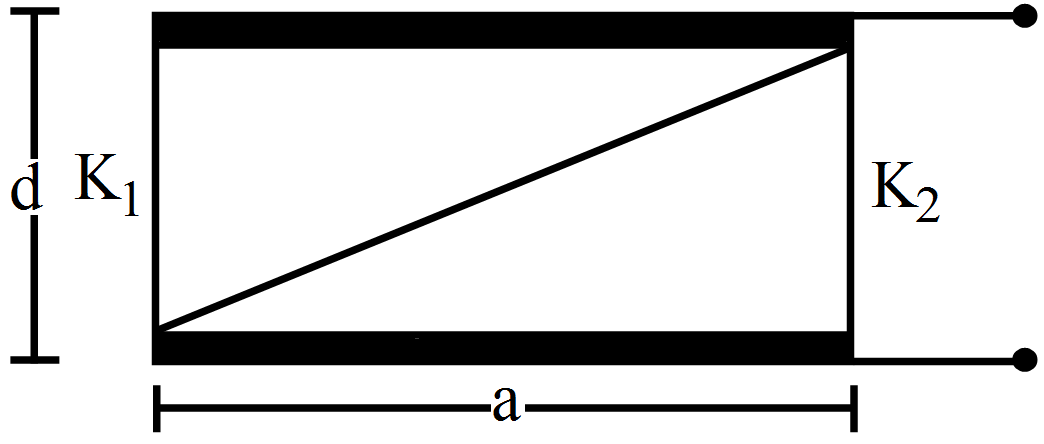
A capacitor is formed by two square metal-plates of edge a, separated by a distance d. Dielectrics of dielectric constants K1 and K2 are filled in the gap as shown in figure. Find the capacitance.

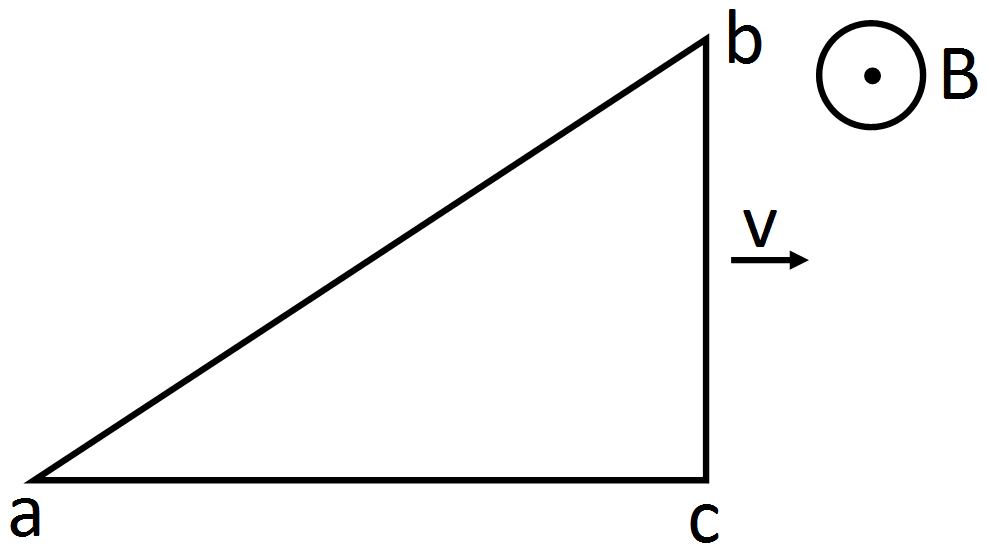
A right-angled triangle abc, made from a metallic wire, moves at a uniform speed v in its plane as shown in figure. A uniform magnetic field B exists in the perpendicular direction. Find the emf induced:
  1. In the loop abc.
  2. In the segment bc.
  3. In the segment ac.
  4. In the segment ab.

What is the difference between cathode rays and beta rays? When the two are travelling in space, can you make out which is the cathode ray and which is the beta ray?
An inductor of inductance 2.00H is joined in series with a resistor of resistance $200\Omega$ and a battery of emf 2.00V. At t = 10ms, find
  1. The current in the circuit.
  2. The power delivered by the battery.
  3. The power dissipated in heating the resistor.
  4. The rate at which energy is being stored in magnetic field.
A bucket full of water is placed in a room at 15°C with initial relative humidity 40%. The volume of the room is 50m3.
  1. How much water will evaporate?
  2. lf the room temperature is increased by 5°C, how much more water will evaporate? The saturation vapour pressure of water at 15°C and 20°C are 1.6kPa and 2.4kPa respectively.
Consider an excited hydrogen atom in state n moving with a velocity u(ν << c). It emits a photon in the direction of its motion and changes its state to a lower state m. Apply momentum and energy conservation principles to calculate the frequency ν of the emitted radiation. Compare this with the frequency ν0 emitted if the atom were at rest.
The magnetic field inside a long solenoid having 50 turns/cm is increased from 2·5 × 10.3T to 2.5T when an iron core of cross-sectional area 4cm2 is inserted into it. Find:
  1. The current in the solenoid.
  2. The magnetization I of the core.
  3. The pole strength developed in the core.
A current of 1.0A exists in a copper wire of cross-section 1.0mm2. Assuming one free electron per atom, calculate the drift speed of the free electrons in the wire. The density of copper is 9000kg/m-3.
A hot body placed in a surrounding of temperature $\theta_0$ obeys Newton's law of cooling $\frac{\text{d}\theta}{\text{dt}}=-\text{k}(\theta-\theta_0).$ Its temperature at t = 0 is $\theta_1.$ The specific heat capacity of the body is s and its mass is m. Find,
  1. The maximum heat that the body can lose.
  2. The time starting from t = 0 in which it will lose 90% of this maximum heat.