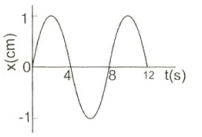
Time period of a simple pendulum is $T$. The time taken to complete $5 / 8$ oscillations starting from mean position is $\frac{\alpha}{\beta} T$. The value of $\alpha$ is ..... .
JEE MAIN 2021, Diffcult
Download our app for free and get started
$\frac{5}{8}$ th of oscillation $=\left(\frac{1}{2}+\frac{1}{8}\right)^{\text {th }}$ of oscillation
$\pi+\theta=\omega t$
$\pi+\frac{\pi}{6}=\left(\frac{2 \pi}{T}\right) t$
$\frac{7 \pi}{6}=\left(\frac{2 \pi}{T}\right) t$
$t=\frac{7 T}{12}$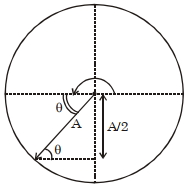

Download our appand get started for free
Experience the future of education. Simply download our apps or reach out to us for more information. Let's shape the future of learning together!No signup needed.*
Similar Questions
- 1View SolutionWhich of the following is a necessary and sufficient condition for S.H.M.
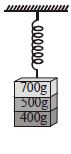
- 2Three masses $700g, 500g$ and $400g$ are suspended at the end of a spring a shown and are in equilibrium. When the $700g$ mass is removed, the system oscillates with a period of $3\,seconds$, when the $500g$ mass is also removed, it will oscillate with a period of .... $s$View Solution
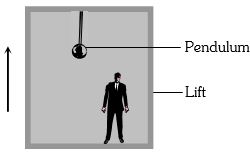
- 3A man measures the period of a simple pendulum inside a stationary lift and finds it to be $T$ sec. If the lift accelerates upwards with an acceleration $\frac{g}{4}$, then the period of the pendulum will beView Solution
- 4The displacement of a particle varies according to the relation $x$ = $3 sin100t + 8cos^2 50t$. Which of the following is $INCORRECT$ about this motionView Solution
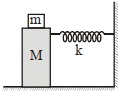
- 5In the given figure, a mass $M$ is attached to a horizontal spring which is fixed on one side to a rigid support. The spring constant of the spring is $k$. The mass oscillates on a frictionless surface with time period $T$ and amplitude $A$. When the mass is in equilibrium position, as shown in the figure, another mass $m$ is gently fixed upon it. The new amplitude of oscillation will beView Solution
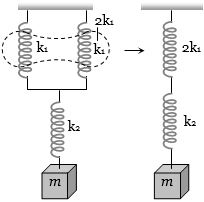
- 6View SolutionWhat will be the force constant of the spring system shown in the figure
- 7Two pendulums have time periods $T$ and $\frac{{5T}}{4}.$They start $S.H.M.$ at the same time from the mean position. What will be the phase difference between them after the bigger pendulum has complete one oscillation ..... $^o$View Solution
- 8There is a simple pendulum hanging from the ceiling of a lift. When the lift is stand still, the time period of the pendulum is $T$. If the resultant acceleration becomes $g/4,$ then the new time period of the pendulum isView Solution
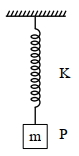
- 9In simple harmonic motion, the total mechanical energy of given system is E. If mass of oscillating particle $P$ is doubled then the new energy of the system for same amplitude is:View Solution
- 10The $x$-t graph of a particle undergoing simple harmonic motion is shown below. The acceleration of the particle at $t=4 / 3 \mathrm{~s}$ isView Solution