MCQ
To an astronaut in a spaceship, the sky appears
  • Black
  • B
    White
  • C
    Green
  • D
    Blue

Answer

Correct option: A.
Black
(a)

Need a full question paper?

Generate a complete, print-ready paper with questions like this in minutes — across 16+ boards, with answer keys.
Start Generating Free

Similar questions

If the amplitude of sound is doubled and the frequency reduced to one-fourth, the intensity of sound at the same point will be
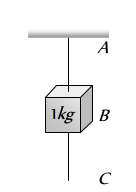
A mass of $1 kg$ is suspended by a string $A$. Another string $C$ is connected to its lower end (see figure). If asudden jerk is given to $C$, then

A quantity of heat required to change the unit mass of a solid substance, from solid state to liquid state, while the temperature remains constant, is known as
At a certain temperature for given wave length, the ratio of emissive power of a body to emissive power of black body in same circumstances is known as
In an electric heater $4 amp$ current passes for 1 minute at potential difference of $250 volt$, the power of heater and energy consumed will be respectively
A galvanometer coil of resistance $50 \Omega$, show full deflection of $100 \mu \mathrm{A}$. The shunt resistance to be added to the galvanometer, to work as an ammeter of range $10 \mathrm{~mA}$ is
A glass flask of volume one litre at $0^{\circ} \mathrm{C}$ is filled, level full of mercury at this temperature. The flask and mercury are now heated to $100^{\circ} \mathrm{C}$. How much mercury will spill out, if coefficient of volume expansion of mercury is $1.82 \times 10^{-4} /{ }^{\circ} \mathrm{C}$ and linear expansion of glass is $0.1 \times 10^{-4} /{ }^{\circ} \mathrm{C}$ respectively
A magnet is suspended in such a way that it oscillates in the horizontal plane. It makes $20$ oscillations per minute at a place where dip angle is $30$ and $15$ oscillations per minute at a place where dip angle is $60.$ The ratio of total earth's magnetic field at the two places is
A particle in S.H.M. is described by the displacement function $x(t)=a \cos (\omega t+\theta)$. If the initial $(t=0)$ position of the particle is $1 cm$ and its initial velocity is $\pi cm / s$. The angular frequency of the particle is $\pi rad / s$, then it's amplitude is
A heavy uniform chain lies on a horizontal table-top. If the coefficient of friction between the chain and table surface is 0.25 , then the maximum fraction of length of the chain, that can hang over one edge of the table is