MCQ
To avoid slipping while walking on ice, one should take smaller steps because of the
  • A
    Friction of ice is large
  • B
    Larger normal reaction
  • Friction of ice is small
  • D
    Smaller normal reaction

Answer

Correct option: C.
Friction of ice is small
c
(c) To avoid slipping one should take smaller steps because the frictional force of ice is small.

Smaller steps will give larger normal force and more the normal force more the friction.

Also the advantage of talking small steps is that lateral forces are decreased. When we put down are foot it will be pushing forwards on the concrete and at the end of the step it will be pushing backwards. Hence larger the step these forward and backward forces will be larger increasing the chances of slipping.

Need a full question paper?

Generate a complete, print-ready paper with questions like this in minutes — across 16+ boards, with answer keys.
Start Generating Free

Similar questions

A uniform circular disc of mass $50 \ kg$ and radius $0.4 \ m$ is rotating with an angular velocity of $10 \ rad / s ^{-1}$ about its own axis, which is vertical. Two uniform circular rings, each of mass $6.25 \ kg$ and radius $0.2 \ m$, are gently placed symmetrically on the disc in such a manner that they are touching each other along the axis of the disc and are horizontal. Assume that the friction is large enough such that the rings are at rest relative to the disc and the system rotates about the original axis. The new angular velocity (in $rad s ^{-1}$ ) of the system is :
A monkey is sitting on the pan of a spring balance which is placed on an elevator. The maximum reading of the spring balance will be when
A solid cylinder is placed on a rough surface of inclination $\theta $ , minimum value of coefficient of static friction between the cylinder and the surface so that the cylinder roll's without slipping is
At $127^o C$ radiates energy is $2.7 \times 10^{-3} J/s$. At ....... $K$ temperature radiated energy is $4.32 \times 10^6 J/s$
A whistle giving out $450 Hz$ approaches a stationary observer at a speed of $33 m/s.$ The frequency heard by the observer in $Hz$ is
Mechanical equivalent of heat is equal to the amount of:
A simple pendulum is hanging from a peg inserted in a vertical wall. Its bob is stretched in horizontal position from the wall and is left free to move. The bob hits on the wall the coefficient of restitution is $\frac{2}{{\sqrt 5 }}$. After how many collisions the amplitude of vibration will become less than $60°$
The distance covered by a particle moving with initial velocity and acceleration a in the $x ^{\text {th }}$ second will be :
A group of people watch a ice show which is held in closed area . Skaters perform a . music show whose level is $60\ db$ . Spectator can yell at $40.0 \ dB$ . Which one of the them represent approx combine sound level
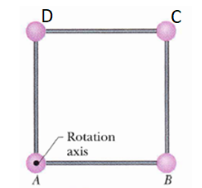
Four particles of equal masses are placed on the vertices of a square and are rotated with a uniform angular velocity about one of the edges (A) as shown in the figure. Which particle will have a larger angular momentum: