MCQ
A simple pendulum is hanging from a peg inserted in a vertical wall. Its bob is stretched in horizontal position from the wall and is left free to move. The bob hits on the wall the coefficient of restitution is $\frac{2}{{\sqrt 5 }}$. After how many collisions the amplitude of vibration will become less than $60°$
  • A
    $6$
  • $3$
  • C
    $5$
  • D
    $4$

Answer

Correct option: B.
$3$
b
(b) From the relation of restitution $\frac{{{h_n}}}{{{h_0}}} = {e^{2n}}$ and
${h_n} = {h_0}(1 - \cos 60^\circ )$

$⇒$ $\frac{{{h_n}}}{{{h_0}}} = 1 - \cos 60^\circ = {\left( {\frac{2}{{\sqrt 5 }}} \right)^{2n}}$
$⇒$ $1 - \frac{1}{2} = {\left( {\frac{4}{5}} \right)^n}$

$⇒$ $\frac{1}{2} = {\left( {\frac{4}{5}} \right)^n}$
Taking log of both sides we get
$\log 1 - \log 2 = n(\log 4 - \log 5)$
$0 - 0.3010 = n(0.6020 - 0.6990)$
$ - \,0.3010 = - n \times 0.097$

==> $n = \frac{{0.3010}}{{0.097}} = 3.1 \approx 3$

Need a full question paper?

Generate a complete, print-ready paper with questions like this in minutes — across 16+ boards, with answer keys.

Start Generating Free

Similar questions

A metre scale is moving with uniform velocity. This implies:
  1. The force acting on the scale is zero, but a torque about the centre of mass can act on the scale.
  2. The force acting on the scale is zero and the torque acting about centre of mass of the scale is also zero.
  3. The total force acting on it need not be zero but the torque on it is zero.
  4. Neither the force nor the torque need to be zero.
A block of mass $m$ moving with speed $v$ compresses a spring through distance $x$ before its speed is halved. What is the value of spring constant ?
A particle is projected horizontally from a tower with velocity $10\,m / s$. Taking $g=10\,m / s ^2$. Match the following two columns at time $t=1\,s$.
Column $I$ Column $II$
$(A)$ Horizontal component of velocity $(p)$ $5$ SI unit
$(B)$ Vertical component of velocity $(q)$ $10$ SI unit
$(C)$ Horizontal displacement $(r)$ $15$ SI unit
$(D)$ Vertical displacement $(s)$ $20$ SI unit
An object is moving with a uniform acceleration which is parallel to its instantaneous direction of motion. The displacement $(s) - $ velocity $(v)$ graph of this object is
Two different wires having lengths $L _{1}$ and $L _{2}$ and respective temperature coefficient of linear expansion $\alpha_{1}$ and $\alpha_{2},$ are joined end-to-end. Then the effective temperature coefficient of linear expansion is
Which of the following will change the time period as they are taken to moon?
  1. A simple pendulum.
  2. A physical pendulum.
  3. A torsional pendulum.
  4. A spring-mass system.
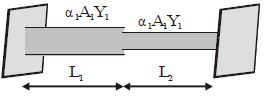
Two rods are joined between fixed supports as shown in the figure. Condition for no change in the lengths of individual rods with the increase of temperature will be

( ${\alpha _1},\,{\alpha _2},$ = linear expansion coefficient

$A_1, A_2$ = Area of rods

$Y_1, Y_2$ = Young modulus)

Coefficient of performance for heat pump is (when heat supplied by system is Q1):
The total work done on a particle is equal to the change in its kinetic energy. This is applicable
At $N.T.P.$ one mole of diatomic gas is compressed adiabatically to half of its volume $\gamma = 1.41$. The work done on gas will be ....... $J$