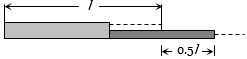
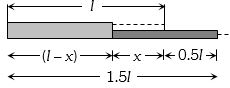
In order to quadruple the resistance of a uniform wire, a part of its length was uniformly stretched till the final length of the entire wire was $1.5$ times the original length, the part of the wire was fraction equal to
Diffcult


Download our appand get started for free
Experience the future of education. Simply download our apps or reach out to us for more information. Let's shape the future of learning together!No signup needed.*
Similar Questions
- 1A $10\, V$ storage battery of negligible internal resistance is connected across a $50\,\Omega $ resistor. How much heat energy is produced in the resistor in $1$ hour ............... $J$View Solution
- 2Two electric bulbs, rated at $(25\, W, 220\, V)$ and $(100\, W, 220\, V)$, are connected in series acroos a $220\, V$ voltage source. If the $25\, W$ and $100\, W$ bulbs draw powers $P_1$ and $P_2$ respectively, thenView Solution
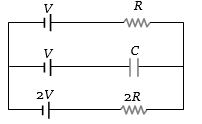
- 3View SolutionIn the given circuit, with steady current, the potential drop across the capacitor must be
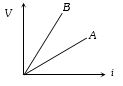
- 4$V-i$ graphs for parallel and series combination of two identical resistors are as shown in figure. Which graph represents parallel combinationView Solution
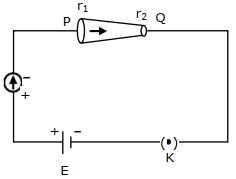
- 5In the given figure, a battery of emf $E$ is connnected across a conductor $P Q$ of length $'Y'$ and different area of cross-sections having radii $r_{1}$ and $r_{2}\left(r_{2}\,<\,r_{1}\right)$.View Solution
Choose the correct option as one moves from $P$ to $Q$ :
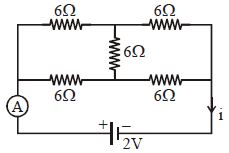
- 6View SolutionReading of ammeter in ampere for the following circuit is
- 7View SolutionThe specific resistance of all metals is most affected by
- 8There are $0.8 \times 10^{23}$ free electrons $/ cm^3$ in copper. If $0.2\, A $ current is flowing is copper wire, then the drift velocity of electrons will be, if the cross sectional area of wire is $0.01 \,cm^2$View Solution
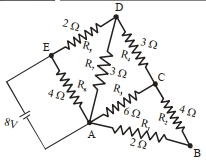
- 9The current flowing through $R _2$ is:View Solution
- 10A potentiometer wire of length $300\,cm$ is connected in series with a resistance $780\,\Omega$ and a standard cell of emf $4\,V$. A constant current flows through potentiometer wire. The length of the null point for cell of emf $20\,mV$ is found to be $60\,cm$. The resistance of the potentiometer wire is$...\Omega$View Solution