Question
Trace the rays which are passing through a convex lens and a concave lens.

Answer

Get the step-by-step solution for this question inside the Vidyadip app.

Get the answer in the app

Need a full question paper?

Generate a complete, print-ready paper with questions like this in minutes — across 16+ boards, with answer keys.
Start Generating Free

Similar questions

The weight of a body at the poles is greater than the weight at the equator. Is it the actual weight or the apparent weight we are talking about? Does your answer depend on whether only the earth's rotation is taken into account or the flattening of the earth at the poles is also taken into account?​​​​​
Half life of $^{238}\text{U}_{92}$against$\alpha$ decay is $4.5 \times 10^{9}$years. Calculate the activity of Ig sample of$^{238}\text{U}_{92}$? Given Avogadro's number $= 6 \times 10^{26}$atoms/kmol.
How are em waves produced by oscillating charges? Draw a sketch of linearly polarised em waves propagating in the Z-direction. Indicate the directions of the oscillating electric and magnetic fields.
A wire of length l carries a current i long the x-axis. A magnetic field exists, which is given $\overrightarrow{\text{B}}=\text{B}_0(\overrightarrow{\text{i}}+\overrightarrow{\text{j}}+\overrightarrow{\text{k}})\text{T}.$ Find the magnitude of the magnetic force acting on the wire.
Obtain the de Broglie wavelength associated with thermal neutrons at room temperature $(27^\circ C).$ Hence explain why a fast neutron beam needs to be thermalised with the environment before it can be used for neutron diffraction experiments.
$i$. Draw a plot showing the variation of potential energy of a pair of nucleons as a function of their separation. Mark the regions where the nuclear force is
$a$. attractive and
$b$. repulsive.
$ii$.  In the nuclear reaction ${ }_0 n^1+{ }_{92}^{235} U \rightarrow_{54}^a Xe +{ }_b^{94} Sr +2{ }_0 n^1$ determine the values of $a$ and $b$.
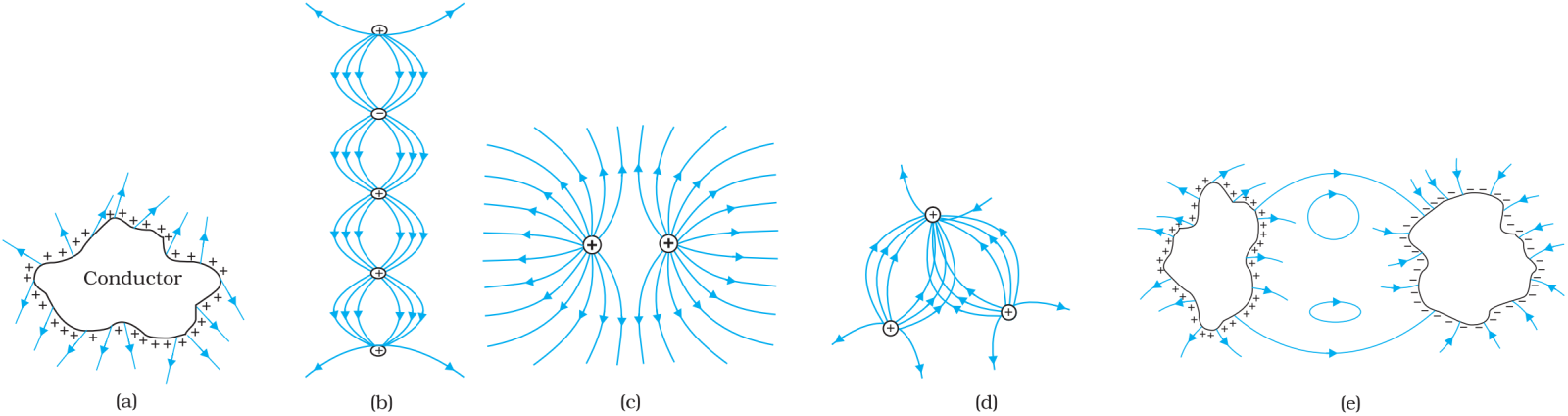
Which among the curves shown in figure cannot possibly represent electrostatic field lines?
Can we have magnetic hysteresis in paramagnetic or diamagnetic substances?
A charged particle having a charge of $-2.0 \times 10^{-6}C$ is placed close to a nonconducting plate having a surface charge density $4.0 \times 10^{-5}Cm^{-2}.$ Find the force of attraction between the particle and the plate.
Derive an expression for the electric field intensity at a point on the equatorial line of an electric dipole of dipole moment $\overrightarrow{\text{P}}$and length 2a. What is the direction of this field?