Question
Can we have magnetic hysteresis in paramagnetic or diamagnetic substances?

Answer

No, magnetic hysteresis is the lagging of intensity of magnetization (I) behind magnetising force (H). When diamagnetic and paramagnetic materials are placed in a magnetic field they get weekly magnetised. Also, they lose their magnetization as the magnetic field is removed (low retentively). Therefore, they do not form magnetic hysteresis curve.

Need a full question paper?

Generate a complete, print-ready paper with questions like this in minutes — across 16+ boards, with answer keys.
Start Generating Free

Similar questions

The earth’s surface has a negative surface charge density of $10^{-9} Cm^{-2}.$ The potential difference of $400 kV$ between the top of the atmosphere and the surface results $($due to the low conductivity of the lower atmosphere$)$ in a current of only $1800 A$ over the entire globe. If there were no mechanism of sustaining atmospheric electric field, how much time $($roughly$)$ would be required to neutralise the earth’s surface? $($This never happens in practice because there is a mechanism to replenish electric charges, namely the continual thunderstorms and lightning in different parts of the globe$). ($Radius of earth $= 6.37 \times 10^6 m.)$
Get the electric field due to a uniformly charged thin spherical shell.
A small telescope has an objective lens of focal length 140 cm and an eyepiece of focal length 5.0 cm. What is the magnifying power of the telescope for viewing distant objects when
(a) the telescope is in normal adjustment (i.e., when the final image is at infinity)?
(b) the final image is formed at the least distance of distinct vision (25 cm)?
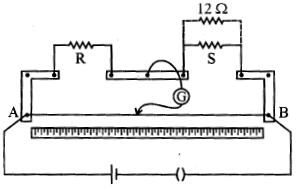
In a meter bridge, the null point is found at a distance of 40 cm from A. If a resistance of 12 Ω is connected in parallel with S, the null point occurs at 50.0 cm from. Determine the values of R and S.
A hydrogen atom in state n = 6 makes two successive transitions and reaches the ground state. In the first transition a photon of 1.13eV is emitted. (a) Find the energy of the photon emitted in the second transition (b) What is the value of n in the intermediate state?
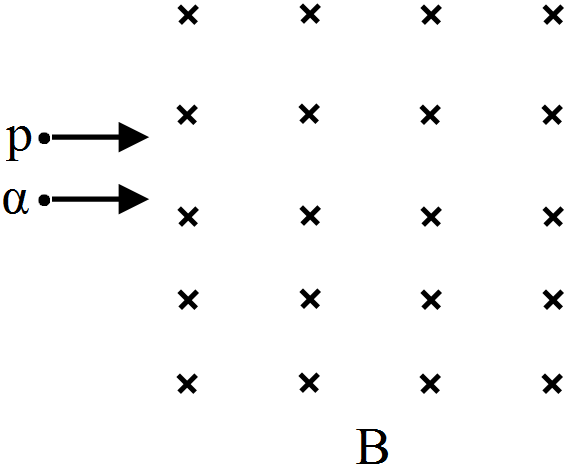
An $\alpha$-particle and a proton moving with the same speed enter the same magnetic field region at right angles to the direction of the field. Show the trajectories followed by the two particles in the region of the magnetic field. Find the ratio of the radii of the circular paths which the two particles may describe.
A proton and an α-particle move perpendicular to a magnetic field. Find the ratio of radii of the circular paths described by them when both (i) have equal momenta, and (ii) were accelerated through the same potential difference.
A wheel starting from rest is uniformly accelerated at $4 \text{ rad/-s}^2$ for $10$ seconds.It is allowed to rotate uniformly for the next $10$ seconds and is finally brought to rest in the next $10$ seconds. Find the total angle rotated by the wheel.
A metallic rod of length ‘l’ is rotated with a frequency v with one end hinged at the centre and the other end at the circumference of a circular metallic ring of radius r, about an axis passing through the centre and perpendicular to the plane of the rinig. A constant uniform magnetic field B parallel to the axis is present every where. Using Lorentz force, explain how emf is induced between the centre and the metallic ring and hence obtain the expression for it.
Answer the following question:
Two students are separated by a 7 m partition wall in a room 10 m high. If both light and sound waves can bend around obstacles, how is it that the students are unable to see each other even though they can converse easily.