Question
Transition metals can act as catalysts because these can change their oxidation state. How does Fe$(III)$ catalyze the reaction between iodide and persulphate ions?

Answer

Transition metals can act as catalysts because these can change their oxidation state.
The reaction between iodide and persulphate ions catalyzes by Fe is as follows:
$2 I^{-}+S_2 O_8^{2-} \xrightarrow{Fe(III)} I_2+2 SO_4^{2-}$
Role of $Fe ( IIII )$ ions:
$2 Fe^{3+}+2 I^{-} \longrightarrow 2 Fe^{2+}+I_2$
$2 Fe^{2+}+S_2 O_8^{2-} \longrightarrow 2 Fe^{3+}+2 SO_4^{2-}$

Need a full question paper?

Generate a complete, print-ready paper with questions like this in minutes — across 16+ boards, with answer keys.

Start Generating Free

Similar questions

(i) Name the product obtained when excess of ethanol is treated with ammonia in the presence of Alumina?
(ii) How is methyl amine prepared from the following compounds? Give the equation.
(a) $CH _3- MgCl$
(b) $CH _3 COCl$
Answer the following :
(a) Sulphurous acid is a reducing agent.
(b) Fluorine forms only one oxoacid.
(c) Boiling point of noble gases increases from He to Rn.
For the reaction
$2NO_{(g)} + Cl_{2(g)} \rightarrow 2 NOCl_{(g)}$
The following data were collected. All the measurements were taken at $263K:$
Experiment. No. Initial $[NO] (M)$ Initial $[Cl_2] (M)$ Initial rate of disappearance of $Cl_2(M/min)$
$1$ $0.15$ $0.15$ $0.60$
$2$ $0.15$ $0.30$ $1.20$
$3$ $0.30$ $0.15$ $2.40$
$4$ $0.25$ $0.25$ $?$
  1. Write the expression for rate law.
  2. Calculate the value of rate constant and specify its units.
  3. What is the initial rate of disappearance of $Cl_2$ in exp. $4?$
  1. Why are haloalkanes more reactive towards nucleophilic substitution reactions than haloarenes?
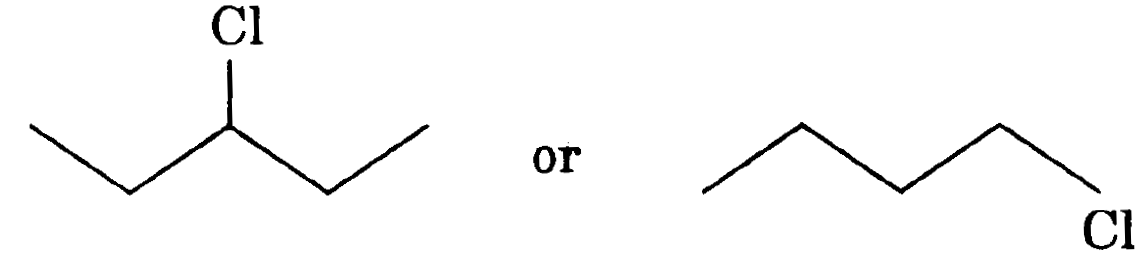
  2. Which one of the following two substances undergoes $S_N1$ reaction faster and why?
Classify carbohydrates.
a. Write the $\text{IUPAC}$ name of the following complex : $\ce{K[Cr(H_2O)_2(C_2O_4)_2]H_2O}$
b. Name the metal present in the complex compound of $(i)$ Haemoglobin $(ii)$ Vitamin $B-12$
Write common name and $\text{IUPAC}$ name of following alcohol compound. $\ce{CH_3-CH_2-CH_2-CH_2-OH}$
What do you mean by Primary Cell?
What are the characteristics of the transition elements and why are they called transition elements? Which of the d-block elements may not be regarded as the transition elements?