MCQ
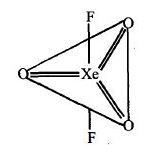
Trigonal bipyramidal geometry is shown by
- A$XeOF_2$
- ✓$XeO_3F_2$
- C$FXeOSO_2F$
- D$[XeF_8]^{2-}$
Generate a complete, print-ready paper with questions like this in minutes — across 16+ boards, with answer keys.
If the rate of formation of $B$ is set to be zero then the concentration of $B$ is given by :
$\mathrm{Sn}(\mathrm{s})\left|\mathrm{Sn}^{2+}(\mathrm{aq}, 1 \mathrm{M}) \| \mathrm{Pb}^{2+}(\mathrm{aq}, 1 \mathrm{M})\right| \mathrm{Pb}(\mathrm{s})$
the ratio $\frac{\left[\mathrm{Sn}^{2+}\right]}{\left[\mathrm{Pb}^{2+}\right]}$ when this cell attains equilibrium is
(Given $\mathrm{E}_{\mathrm{Sn}^{2+} / \mathrm{Sn}}^{0}=-0.14 \mathrm{\;V}$ $\left.\mathrm{E}_{\mathrm{Pb}^{+2}/{\mathrm{Pb}}}^{0}=-0.13 \;\mathrm{V}, \frac{2.303 \mathrm{RT}}{\mathrm{F}}=0.06\right)$
In the above reaction $A, B$ and $C $ are the following compounds
[At. no. of $Mn = 25 ]$