MCQ
True structure is predicted by:
  • A
    Valence bond approach
  • B
    Sidgwick approach
  • C
    Hybrid orbital formation
  • D
    None of the above

Answer

  1. Hybrid orbital formation

Explanation:

Hybrid formation was introduced to explain molecular structure when the other theories failed to correctly predict them.

Need a full question paper?

Generate a complete, print-ready paper with questions like this in minutes — across 16+ boards, with answer keys.

Start Generating Free

Similar questions

Assertion : Alkyl isocyanides in acidified water give alkyl formamides.
Reason : In isocyanides, carbon first acts as a nucleophile and then as an electrophile
Metal halide which is insoluble in water is
An optically active compound $C_6H_{12}O$ gives positive test with $2, 4$ - dinitrophenyl hydrazine, but negative with Tollens' reagent, what is the structure of  the compound ?
Half lives of first order and a zero order reaction are same. Assume that initial concentration of reactant is same for both reactions, then the ratio of initial rates of first order reaction to that of zero order reaction is
Contents of three bottles were found to react

$(i)$ Neither with Fehling's solution nor with Tollen's reagent

$(ii)$ Only with Tollen's reagent but not with Fehling's solution

$(iii)$ With both Tollen's reagent and Fehling's solution. If they contained either ethanal (acetaldehyde) or propanone (acetone) or benzal (benzaldehyde), which bottle contained which
The density of $2\, M\, MgBr_2$ solution is $1.2\, gm$ per $ml$. then molality of solution is ........ $m$.
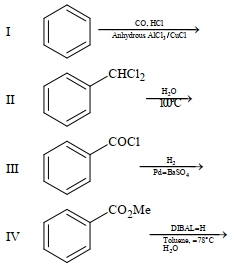
Among the following, the number of reaction$(s)$ that produce$(s)$ benzaldehyde is
$C{H_3} - C{H_2} - OH\xrightarrow{{PCC}}A\xrightarrow{{HCN}}B\xrightarrow[\Delta ]{{{H_3}\mathop O\limits^ +  }}C$ 

compound $'C'$ is

Electrolysis of dilute aqueous $\mathrm{NaCl}$ solution was carried out by passing $10$ milli ampere current. The time required to liberate $0.01 \mathrm{~mol}$ of $\mathrm{H}_2$ gas at the cathode is ( $1$ Faraday $=96500 \mathrm{C} \mathrm{mol}^{-1}$ )
Which of the following are non-reducing sugar.

$(I)$ Glucose             

$(II)$ Fructose

$(III)$ Maltose

$(IV)$ Sucrose

$(V)$ Galactose