Question
Two audio speakers are kept some distance apart and are driven by the same amplifier system. A person is sitting at a place 6.0m from one of the speakers and 6.4m from the other. If the sound signal is continuously varied from 500Hz to 5000Hz, what are the frequencies for which there is a destructive interference at the place of the listener? Speed of sound in air = 320m/s.
Answer

The path difference of the two sound waves is given by

$\triangle\text{L}=6.4-6.0=0.4\text{m}$

The wavelength of either wave = $\lambda=\frac{\text{V}}{\rho}=\frac{320}{\rho}(\text{m/s})$

For destructive interference $\triangle\text{L}=\frac{(2\text{n}+1)\lambda}{2}$ where n is an integers.

Or $0.4\text{m}=\frac{2\text{n}+1}{2}\times\frac{320}{\rho}$

$\Rightarrow\rho=\text{n}=\frac{320}{0.4}=800\frac{2\text{n}+1}{2}\text{Hz}=(2\text{n}+1)400\text{Hz}$

Thus the frequency within the specified range which cause destructive interference are 1200Hz, 2000Hz, 2800Hz, 3600Hz and 4400Hz.

Need a full question paper?

Generate a complete, print-ready paper with questions like this in minutes — across 16+ boards, with answer keys.

Start Generating Free

Similar questions

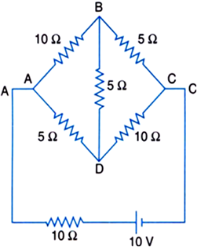
Determine the current in each branch of the network shown in Fig.:

Suppose all the electrons of 100g water are lumped together to form a negatively charged particle and all the nuclei are lumped together to form a positively charged particle. If these two particles are placed 10.0cm away from each other, find the force of attraction between them. Compare it with your weight.
Explain electric charge. Verify by experiment that there is repulsion between like charges and attraction between unlike charges.
Two charges -q each are separated by distance 2d. A third charge +q is kept at mid point O. Find potential energy of +q as a function of small distance x from O due to -q charges. Sketch P.E. v/s x and convince yourself that the charge at O is in an unstable equilibrium.
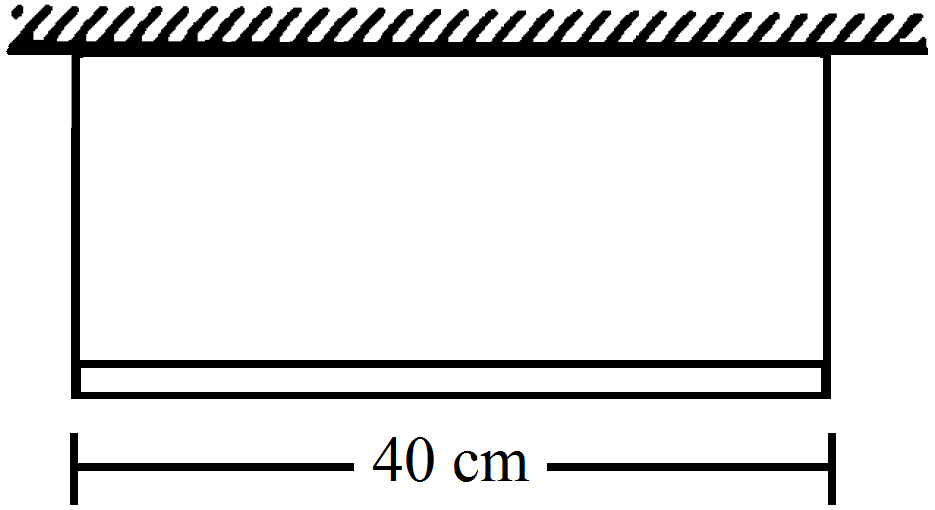
A uniform horizontal rod of length 40cm and mass 1.2kg is supported by two identical wires as shown in figure, Where should a mass of 4.8kg be placed on the rod so that the same tuning fork may excite the wire on left into its fundamental vibrations and that on right into its first overtone? Take g = 10m/s2.

A thin prism of angle $6.0^\circ,\omega=0.07$ and $\mu_\text{y}=1.50$ is combined with another thin prism having $\omega=0.08$ and $\mu_\text{y}=1.60.$ The combination produces no deviation in the mean ray.
  1. Find the angle of the second prism.
  2. Find the net angular dispersion produced by the combination when a beam of white light passes through it.
  3. If the prisms are similarly directed, what will be the deviation in the mean ray
  4. Find the angular dispersion in the situation described in (c).
Suppose the gravitational potential due to a small system is $\frac{\text{k}}{\text{r}^2}$ at a distance r from it. What will be the gravitational field? Can you think of any such system? What happens if there were negative masses?
A pendulum bob of mass 80mg and carrying a charge of 2 × 10-8C is at rest in a uniform, horizontal electric field of 20kVm-1. Find the tension in the thread.
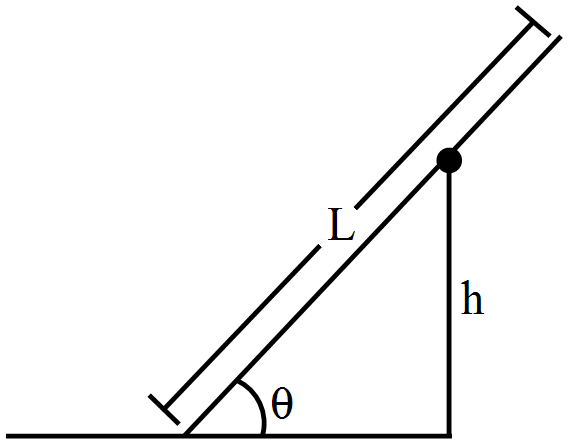
A uniform rod of length L rests against a smooth roller as shown in figure. Find the friction coefficient between the ground and the lower end if the minimum angle that the rod can make with the horizontal is $\theta.$

A 2kg block is placed over a 4kg block and both are placed on a smooth horizontal surface. The coefficient of friction between the blocks is 0.20. Find the acceleration of the two blocks if a horizontal force of 12N is applied to:
  1. The upper block.
  2. The lower block. Take g = 10m/s2.