MCQ
Two blocks $A$ and $B$ are joined together with a compressed spring. When the system is released, the two blocks appear to be moving with unequal speeds in opposite directions as shown in figure. Select the correct statement
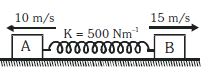
  • The centre of mass of the system will remain stationary
  • B
    Mass of block $A$ is equal to that of block $B$
  • C
    The centre of mass of the system will move towards right.
  • D
    It is an impossible physical situation

Answer

Correct option: A.
The centre of mass of the system will remain stationary
a
As net force on the system $= 0$ (after being released) So centre of mass of the system remains stationary

Need a full question paper?

Generate a complete, print-ready paper with questions like this in minutes — across 16+ boards, with answer keys.

Start Generating Free

Similar questions

The gravitational force between two stones of mass $1\, kg $ each separated by a distance of $1 \,metre$ in vacuum is
A beaker of radius $15\, cm$ is filled with a liquid of surface tension $0.075\, N/m.$ Force  across an imaginary diameter on the surface of the liquid is:-
In a steady state of thermal conduction, temperature of the ends $A$ and $B$ of a $20\, cm$ long rod are ${100^o}C$ and ${0^o}C$ respectively. What will be the temperature of the rod at a point at a distance of $6$ cm from the end $A$ of the rod....... $^oC$
The area of a rectangular field (in $m ^{2}$) of length $55.3\,m$ and breadth $25 \;m$ after rounding off the value for correct significant digits is
Assume the aerodynamic drag force on $a$ car is proportional to its speed. If the power output from the engine is doubled, then the maximum speed of the car.
A uniform bar of length $'6l'$ and mass $'8m'$ lies on a smooth horizontal table. Two point masses $m$ and $2m$ moving in the same horizontal plane with speed $2v$ and $v$ respectively, strike the bar (as shown in the fig.) and stick to the bar after collision. Total energy after collision (about the center of mass, $c$) will be :-
How many collision are possible between the blocks?
Assuming the earth to be a sphere of uniform mass density, a body weighed $300 \mathrm{~N}$ on the surface of earth. How much it would weigh at $R / 4$ depth under surface of earth?
The following are the quantities associated with a body performing SHM.
  1. The velocity of the body.
  2. The accelerating of the body.
  3. The accelerating force acting on the body.
Which of these quantities are exactly in phase with each other?
The equation of a wave travelling on a string is $y=4 \sin \left[\frac{\pi}{2}\left(8 t-\frac{x}{8}\right)\right]$ where $x , y$ are in cm and t in second. The velocity of the wave is