MCQ
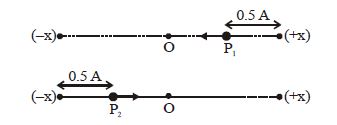
Two bodies performing $S.H.M.$ have same amplitude and frequency. Their phases at a certain instant are as shown in the figure. The phase difference between them is
  • A
    $\frac {11}{6}\pi $
  • $\pi $
  • C
    $\pi /3$
  • D
    $\frac {3}{5}\pi $

Answer

Correct option: B.
$\pi $
b
First particle is comming towards mean position

$\therefore \phi_{1}=\pi-\frac{\pi}{6}$

second particle is comming towards mean position but in negative side

$\therefore \phi_{2}=2 \pi-\frac{\pi}{6}$

$\therefore \phi_{2}-\phi_{1}=\left(2 \pi-\frac{\pi}{6}\right)-\left(\pi-\frac{\pi}{6}\right)=\pi$

Need a full question paper?

Generate a complete, print-ready paper with questions like this in minutes — across 16+ boards, with answer keys.
Start Generating Free

Similar questions

The position of a particle moving along $x$-axis is given by $x=10 t-2 t^2$. Then the time $(t)$ at which it will momently come to rest is .......... $s$
Two superimposing waves are represented by equation $y_1=2 \sin 2 \pi(10 t-0.4 x)$ and $y_2=4 \sin 2 \pi(20 t-0.8 x)$. The ratio of $I_{\max }$ to $I_{\min }$ is ........
A Carnot’s engine is made to work between $200°C$ and $0°C$ first and then between $0°C$ and $-200°C.$ The ratio of efficiencies of the engine in the two cases is
In which of the following gas the root mean square velocity will be minimum (at const. temperature)
A solid cylinder $(i)$ rolls down $(ii)$ slides down an inclined plane. The ratio of the accelerations in these conditions 
A car $P$ travelling at $20\,ms ^{-1}$ sounds its horn at a frequency of $400\,Hz$. Another car $Q$ is travelling behind the first car in the same direction with a velocity $40\,ms ^{-1}$. The frequency heard by the passenger of the car $Q$ is approximately $.......\,Hz$ [Take, velocity of sound $=360\,ms ^{-1}$ ]
An ideal gas undergoes change in its state from the initial state $I$ to the final state $F$ via two possible paths as shown below. Then,
Which of the following graphs correctly represents the variation of $\beta = - (dV/dP)/V$ with $P$ for an ideal gas at constant temperature
A body falling from a height of $10\,m$ rebounds from hard floor. If it loses $20\%$ energy on the impact, then coefficient of restitution is
In an elastic collision between disks $A$ and $B$ of equal mass but unequal radii, $A$ moves along the $x$ -axis and $B$ is stationary before impact. Which of the following is possible after impact?