Two bulbs of $100\, W$ and $200\, W$ working at $220$ $volt$ are joined in series with $220$ $volt$ supply. Total power consumed will be approximately ........... $watt$
Medium
Download our app for free and get started
(a) ${P_S} = \frac{{{P_1}{P_2}}}{{{P_1} + {P_2}}} = \frac{{100 \times 200}}{{100 + 200}} = \frac{{200}}{3} \approx 65\,watt$

Download our appand get started for free
Experience the future of education. Simply download our apps or reach out to us for more information. Let's shape the future of learning together!No signup needed.*
Similar Questions
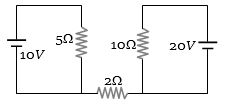
- 1Find out the value of current through $2\,\Omega$ resistance for the given circuit ............ $A$View Solution
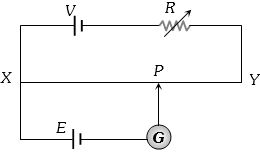
- 2A potentiometer circuit shown in the figure is set up to measure $e.m.f.$ of a cell $E$. As the point $P$ moves from $X$ to $Y$ the galvanometer $G$ shows deflection always in one direction, but the deflection decreases continuously until $Y$ is reached. In order to obtain balance point between $X$ and $Y$ it is necessary toView Solution
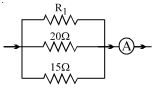
- 3In the given circuit the current flowing through the resisitance $20$ $\mathrm{ohms}$ is $0.3$ $\mathrm{ampere}$ while the ammeter reads $0.8$ $\mathrm{ampere}.$ What is the value of $R_1$? ................ $\mathrm{ohm}$View Solution
- 4The electric current through a wire varies with time as $I=I_0+\beta t$. where $I_0=20 \mathrm{~A}$ and $\beta=3 \mathrm{~A} / \mathrm{s}$. The amount of electric charge crossed through a section of the wire in $20 \mathrm{~s}$ is :View Solution
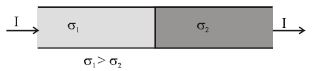
- 5Current $I$ is flowing through the two materials having electrical conductivities $\sigma_1$ and $\sigma_2$ respectively $(\sigma_1 > \sigma_2 )$ as shown in the figure. The total amount of charge at the junction of the materials isView Solution
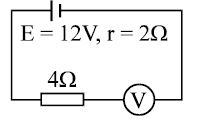
- 6By error, a student places moving-coil voltmeter $V$ (nearly ideal) in series with the resistance in a circuit in order to read the current, as shown. The voltmeter reading will be ............ $V$View Solution
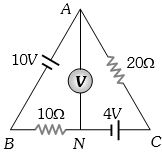
- 7The reading of the ideal voltmeter in the adjoining diagram will be ................. $V$View Solution
- 8$STATEMENT-1$ In a Meter Bridge experiment, null point for an unknown resistance is measured. Now, the unknown resistance is put inside an enclosure maintained at a higher temperature. The null point can be obtained at the same point as before by decreasing the value of the standard resistance. andView Solution
$STATEMENT-2$ Resistance of a metal increases with increase in temperature.
- 9The charge flowing through a resistance $R$ varies with time as $Q = 2t - 8t^2$. The total heat produced in the resistance is (for $0 \leq t \leq \frac{1}{8}$)View Solution
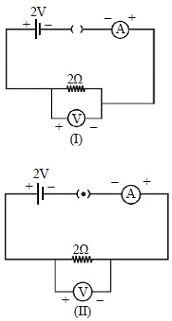
- 10For the circuits shown in figures $I$ and $II$, the voltmeter reading would beView Solution