Two bulbs of equal wattage, one having carbon filament and the other having a tungsten filament are connected in series to the mains, then
Easy


Download our appand get started for free
Experience the future of education. Simply download our apps or reach out to us for more information. Let's shape the future of learning together!No signup needed.*
Similar Questions
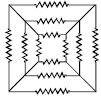
- 1Twelve resistors each of resistance $16 \,\Omega $ are connected in the circuit as shown. The net resistance between $AB$ (any two conjugate points of outer square) is ............... $\Omega$View Solution
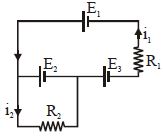
- 2The current $i_1$ and $i_2$ through the resistor $R_1 (= 10\,\Omega )$ and $R_2 (=30 \,\Omega )$ in the circuit diagram with $E_1 = 3\,V, E_2 = 3\,V$ and $E_3 = 2\,V$ are respectively:View Solution
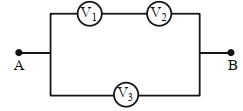
- 3Three voltmeters, all having different internal resistances are joined as shown in figure. When some potential difference is applied across $\mathrm{A}$ and $B$, their readings are $V_1, V_2$ and $V_3$. Choose the correct option.View Solution
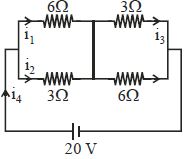
- 4View SolutionDiagram shows a circuit diagram choose incorrect statement
- 5The resistances of the platinum wire of a platinum resistance thermometer at the ice point and steam point are $8 \Omega$ and $10 \Omega$ respectively. After inserting in a hot bath of temperature $400^{\circ} \mathrm{C}$, the resistance of platinum wire is:View Solution
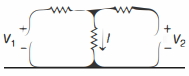
- 6Two batteries $V_1$ and $V_2$ are connected to three resistors as shown below. If $V_1=2 \,V$ and $V_2=0 \,V$, then the current $I=3 \,mA$. If $V_1=0 \,V$ and $V_2=4 \,V$, then the current $I=4 \,mA$. Now, if $V_1=10 \,V$ and $V_2=10 \,V$, then the current $I$ will be ............ $\,mA$View Solution
- 7For a metallic wire, the ratio $V/i$ ($V = $ the applied potential difference, $i$ = current flowing) isView Solution
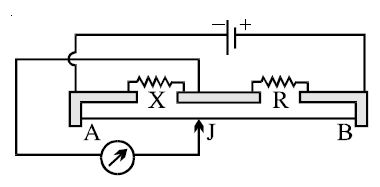
- 8The figure shows a meter-bridge circuit, with $AB = 100\, cm$,$ X = 12\,\Omega$ and $R = 18\,\Omega$ , and the jockey $J$ in the position of balance. If $R$ is now made $8\,\Omega$ , through what distance will $J$ have to be moved to obtain balance? .............. $cm$View Solution
- 9View SolutionKirchhoff's second law is based on the law of conservation of
- 10The resistance of a conductor is $5\, ohm$ at $50\,^oC$ and $6\, ohm$ at $100\,^oC$. Its resistance at $0\,^oC$ is ................ $ohm$View Solution