MCQ
Two capillary tubes of same diameter are put vertically one each in two liquids whose relative densities are $0.8$ and $0.6$ and surface tensions are $60$ and $50\, dyne/cm$ respectively Ratio of heights of liquids in the two tubes $\frac{h_1}{h_2}$ is
  • A
    $\frac{10}{9}$
  • B
    $\frac{3}{10}$
  • C
    $\frac{10}{3}$
  • $\frac{9}{10}$

Answer

Correct option: D.
$\frac{9}{10}$
d
Ascent formula $\mathrm{h}=\frac{2 \mathrm{T} \cos \theta}{\mathrm{rdg}}$

$\Rightarrow \frac{\mathrm{h}_{1}}{\mathrm{h}_{2}}=\frac{\mathrm{T}_{1}}{\mathrm{T}_{2}} \times \frac{\mathrm{d}_{2}}{\mathrm{d}_{1}} \quad[\mathrm{r}, \theta \text { and } \mathrm{g} \text { are constants }]$

$=\frac{60}{50} \times \frac{0.6}{0.8}=\frac{9}{10}$

Need a full question paper?

Generate a complete, print-ready paper with questions like this in minutes — across 16+ boards, with answer keys.

Start Generating Free

Similar questions

“Heat cannot by itself flow from a body at lower temperature to a body at higher temperature” is a statement or consequence of
From a stationary tank of mass $125000$ pound a small shell of mass $25$ pound is fired with a muzzle velocity of $1000\, ft/sec$. The tank recoils with a velocity of ............ $\mathrm{ft/sec}$
An electron and a proton are moving under the influence of mutual forces. In calculating the change in the kinetic energy of the system during motion, one ignores the magnetic force of one on another. This is because:
A rod of length is $3 \;m$ and its mass acting per unit length is directly proportional to distance $x$ from one of its end then its centre of gravity from that end will be at
Which of the following statements are correct.
A body falling under gravity covers two points $A$ and $B$ separated by $80 \mathrm{~m}$ in $2 \mathrm{~s}$. The distance of upper point A from the starting point is________ $\mathrm{m}$ (use $\mathrm{g}=10 \mathrm{~ms}^{-2}$ )
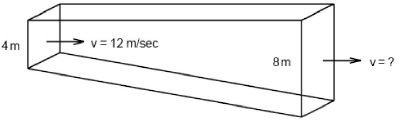
A river gradually deepens, from a depth of $4 \ m$ to a depth of $8\  m$ as shown. The width, $W$, of the river does not change. At the depth of $4 \ m$, the river's speed is $12\  m/sec.$ Its  elocity at the $8\  m$ depth is ......... $m/sec$
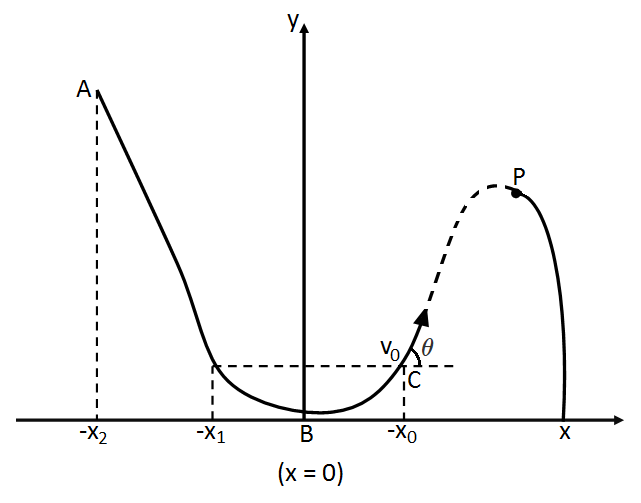
A particle slides down a frictionless parabolic $(y = x^2)$ track $(A – B – C)$ starting from rest at point $A.$ Point $B$ is at the vertex of parabola and point $C$ is at a height less than that of point $A$. After $C,$ the particle moves freely in air as a projectile. If the particle reaches highest point at $P,$ then
The rotation of earth about its axis is:
  1. Periodic motion.
  2. Simple harmonic motion.
  3. Periodic but not simple harmonic motion.
  4. Non$-$periodic motion.
The disturbance $y (x, t)$ of a wave propagating in the positive. $x-$ direction is given by $y = \frac{1}{{1 + {x^2}}}$ at time $t\,= 0$ and by $y = \frac{1}{{\left[ {1 + {{\left( {x - 1} \right)}^2}} \right]}}$ at $t\, = 2\, s$, where $x$ and $y$ are in meters. The shape of the wave disturbance does not change during the propagation. The velocity of wave in $m/s$ is