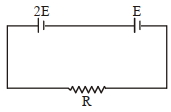
Two cells of emf $2\, E$ and $E$ with internal resistance $r _{1}$ and $r _{2}$ respectively are connected in series to an external resistor $R$ (see $figure$). The value of $R ,$ at which the potential difference across the terminals of the first cell becomes zero is
JEE MAIN 2021, Diffcult
Download our app for free and get started
$i =\frac{3 E }{ R + r _{1}+ r _{2}}$
$TPD =2 E - ir _{1}=0$
$2 E = ir _{1}$
$2 E =\frac{3 E \times r _{1}}{ R + r _{1}+ r _{2}}$
$2 R +2 r _{1}+2 r _{2}=3 r _{1}$
$R =\frac{ r _{1}}{2}- r _{2}$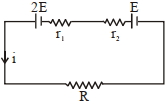

Download our appand get started for free
Experience the future of education. Simply download our apps or reach out to us for more information. Let's shape the future of learning together!No signup needed.*
Similar Questions
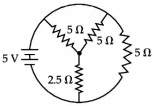
- 1The total current supplied to the circuit as shown in figure by the $5 V$ battery is $A$View Solution
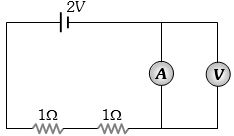
- 2In the circuit shown, $A$ and $V$ are ideal ammeter and voltmeter respectively. Reading of the voltmeter will be ............... $V$View Solution
- 3A torch battery consisting of two cells of $1.45\, volts$ and an internal resistance $0.15\,\Omega $, each cell sending currents through the filament of the lamps having resistance $1.5\,ohms$. The value of current will be ....... $A$View Solution
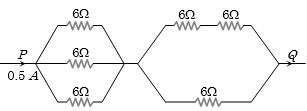
- 4Resistances of $6\, ohm$ each are connected in the manner shown in adjoining figure. With the current $0.5\,ampere$ as shown in figure, the potential difference ${V_P} - {V_Q}$ is .............. $V$View Solution
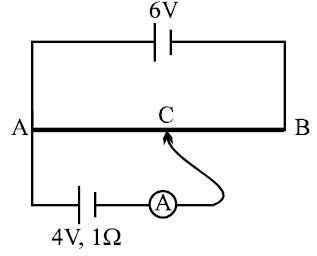
- 5$A \,6 \,V$ battery of negligible internal resistance is connected across a uniform wire of length $1\, m$. The positive terminal of another battery of emf $4\,V$ and internal resistance $1\, \Omega$ is joined to the point $A$ as shown in figure. The ammeter shows zero deflection when the jockey touches the wire at the point $C$. The $AC$ is equal toView Solution
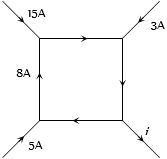
- 6The figure shows a network of currents. The magnitude of currents is shown here. The current $i$ will be ................. $A$View Solution
- 7This question contains statement$-1$ and statement$-2$. Of the four choices given after the statements, choose the one that best describes the two statements.View Solution
statement$-1$ : The temperature dependence of resistance is usually given as $R=R_{0}(1+\alpha \Delta t)$. The resistance of a wire changes from $100\; \Omega$ to $150\; \Omega$ when its temperature is increased from $27^{\circ} C$ to $227^{\circ} C$. This implies that $\alpha=2.5$ $\times 10^{-3} /{ }^{\circ} C$
statement$-2\;: R=R_{0}(1+\alpha \Delta t)$ is valid only when the change in the temperature $\Delta T$ is small and $\Delta R=\left(R-R_{0}\right) < < R_{0}$
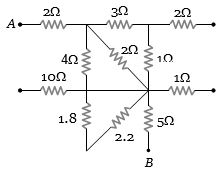
- 8What is the equivalent resistance between the points $A$ and $B$ of the network .................. $\Omega$View Solution
- 9A wire of length $100\, cm$ is connected to a cell of $emf$ $2\, V$ and negligible internal resistance. The resistance of the wire is $3\, \,\Omega$. The additional resistance required to produce a potential drop of $1$ milli volt per cm is ............... $\Omega $View Solution
- 10View SolutionConsider the combination of resistors as shown in figure and pick out the correct statement