MCQ
Two closed organ pipes, when sounded simultaneously gave $4$ beats per sec. If longer pipe has a length of $1m$. Then length of shorter pipe will be, ... $cm$ $(v = 300 m/s)$
  • A
    $185.5$
  • $94.9$
  • C
    $90$
  • D
    $80$

Answer

Correct option: B.
$94.9$
b
(b) For first pipe ${n_1} = \frac{v}{{4{l_1}}}$

and for second pipe ${n_2} = \frac{v}{{4{l_2}}}$

So, number of beats = ${n_2} - {n_1} = 4$ 

$ \Rightarrow $$4 = \frac{v}{4}\left( {\frac{1}{{{l_2}}} - \frac{1}{{{l_1}}}} \right)$

$ \Rightarrow $$16 = 300\left( {\frac{1}{{{l_2}}} - \frac{1}{1}} \right)$

$ \Rightarrow $${l_2} = 94.9$$cm$

Need a full question paper?

Generate a complete, print-ready paper with questions like this in minutes — across 16+ boards, with answer keys.
Start Generating Free

Similar questions

A hot metallic sphere of radius $r$ radiates heat. It's rate of cooling is
A faulty thermometer has its fixed points marked $5^o$ and $95^o$. This thermometer reads the temperature of a body as $59^o$. Then the correct temperature of the body on celsius scale is ........ $^o$
The amount of work, which can be obtained by supplying $200\, cal$ of heat, is
A particle moves with constant angular velocity in circular path of certain radius and is acted upon by a certain centripetal force $F$. if the angular velocity is kept same but the radius of the path is halved, the new force will be
A particle moves such that its acceleration $a$ is given by $a = - bx$, where $x$ is the displacement from equilibrium position and b is a constant. The period of oscillation is
What is the maximum acceleration of the particle doing the $SHM$ $y = 2\sin \left[ {\frac{{\pi t}}{2} + \phi } \right]$ where $2$ is in $cm$
The axis of rotation of a purely rotating body:
  1. Must pass through the centre of mass.
  2. May pass through the centre of mass.
  3. Must pass through a particle of the body.
  4. May pass through a particle of the body.
In an adiabatic process on a gas with $\gamma=1.4,$ the pressure is increased by 0.5%. The volume decreases by about:
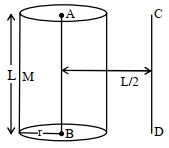
The solid cylinder of length $80\, {cm}$ and mass ${M}$ has a radius of $20\, {cm}$. Calculate the density of the material used if the moment of inertia of the cylinder about an axis $CD$ parallel to ${AB}$ as shown in figure is $2.7\, {kg} {m}^{2}$
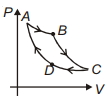
Carnot cycle is plotted in $P-V$ graph. Which portion represents an isothermal expansion?