Question
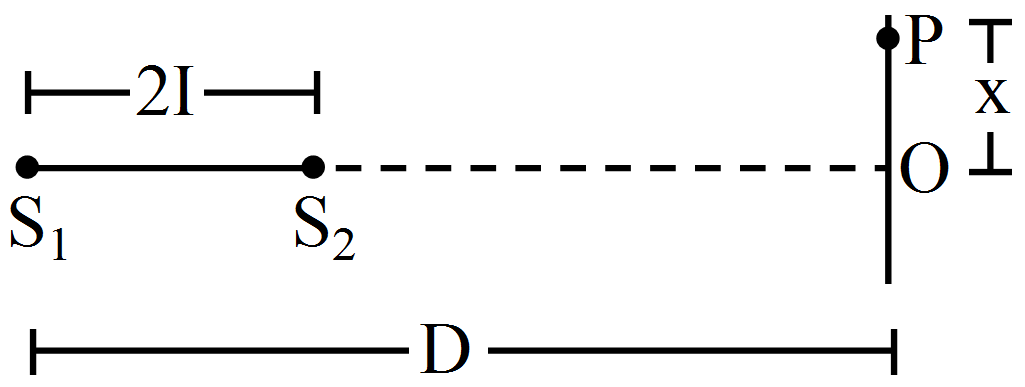
Two coherent narrow slits emitting sound of wavelength $\lambda$ in the same phase are placed parallel to each other at a small separation of $2\lambda.$ The sound is detected by moving a detector on the screen $\sum$ at a distance $\text{D}(>>\lambda)$ from the slit S1 as shown in figure. Find the distance x such that the intensity at P is equal to the intensity at 0.
Answer

Given:

S1 & S2 are in the same phase. At O, there will be maximum intensity.

There will be maximum intensity at P.

From the(in questions):

$\triangle\text{S}_1\text{PO}$ and $\triangle\text{S}_2\text{PO}$ are right-angled triangle

So, $(\text{S}_1\text{P})^2-(\text{S}_2\text{P})^2$

$=\big[\text{D}^2+\text{x}^2\big]-\Big[(\text{D}-2\lambda)^2+\text{x}^2\Big]^2$

$=4\lambda\text{D}+4\lambda^2=4\lambda\text{D}$

$\Big(\lambda^2$ is small and can be neglected$\Big)$

$\Rightarrow(\text{S}_1\text{P}+\text{S}_2\text{P})(\text{S}_1\text{P}-\text{S}_2\text{P})=4\lambda\text{D}$

$\Rightarrow(\text{S}_1\text{P}-\text{S}_2\text{P})=\frac{4\lambda\text{D}}{(\text{S}_1\text{P}+\text{S}_2\text{P})}$

$\Rightarrow\text{S}_1\text{P}-\text{S}_2\text{P}=\frac{4\lambda\text{D}}{2\sqrt{\text{x}^2+\text{D}^2}}$

For constructive interference, path difference $=\text{n}^\lambda$

So, $\text{S}_1\text{P}-\text{S}_2\text{P}=\frac{4\lambda\text{D}}{2\sqrt{\text{x}^2+\text{D}^2}}=\text{n}\lambda$

$\Rightarrow\frac{2\text{D}}{\sqrt{\text{x}^2+\text{D}^2}}=\text{n}$

$\Rightarrow\text{n}^2\big(\text{x}^2+\text{D}^2\big)=4\text{D}^2$

$\Rightarrow\text{n}^2\text{x}^2+\text{n}^2\text{D}^2=4\text{D}^2$

$\Rightarrow\text{n}^2\text{x}^2=4\text{D}^2-\text{n}^2\text{D}^2$

$\Rightarrow\text{n}^2\text{x}^2=\text{D}^2(4-\text{n}^2)$

$\Rightarrow\text{x}=\frac{\text{D}}{\text{n}}\sqrt{4-\text{n}^2}$

When n = 1,

$\text{x}=\sqrt{3}\text{D}$ (1st order).

When n = 2,

$\text{x}=0$ (2nd order).

So when $\text{x}=\sqrt{3}\text{D},$ the intensity at P is equal to the intensity at O.

Need a full question paper?

Generate a complete, print-ready paper with questions like this in minutes — across 16+ boards, with answer keys.

Start Generating Free

Similar questions

The shows a circular wire loop of radius a and carrying a current i, which is placed in a perpendicular magnetic field B.
  1. Consider a small part dl of the wire. Find the force on this part of the wire exerted by the magnetic field.
  2. Find the force of compression in the wire.

Find the equivalent capacitance of the network shown in the figure, when each capacitor is of $1\mu\text{F}$. When the ends X and Y are connected to a 6 V battery, find out (i) The charge and (ii) The energy stored in the network.
Find the range of frequency of light that is visible to an average human being $(400\text{nm}<\lambda<700\text{nm}).$
A laser beam has intensity 2.5 × 10¹⁴Wm-2. Find amplitudes of electric and magnetic fields in the beam.
Find the expression for the capacitance of a parallel plate capacitor of plate area A and plate separation d when (I) a dielectric slab of thickness t and (II) a metallic slab of thickness t, where (t < d) are introduced one by one between the plates of the capacitor. In which case would the capacitance be more and why?
You are given a circuit below. Write its truth table. Hence, identify the logic operation carried out by this circuit. Draw the logic symbol of the gate it corresponds to.

The radius of innertmost orbit of hydrogen atom is $5.3 \times 10^{-11} m$. What is the radius of second excited state?
Energy of electron in hydrogen atom expressed by the following formula :
$E _n=-\left(\frac{13.6 eV}{n^2}\right) ; \text { Where, } n=1,2,3, \ldots$
by using this formula, proved that :
(a) The energy of electron -6.8 eV cannot be in H -atom.
(b) The distance of attached lines in spectrum of hydrogen.
A positive point charge (+ q) is kept in the vicinity of an uncharged conducting plate. Sketch electric field lines originating from the point on to the surface of the plate.
Derive the expression for the electric field at the surface of a charged conductor.
Consider the situation of the previous problem. Suppose the production of the radioactive isotope starts at t = 0. Find the number of active nuclei at time t.