Question
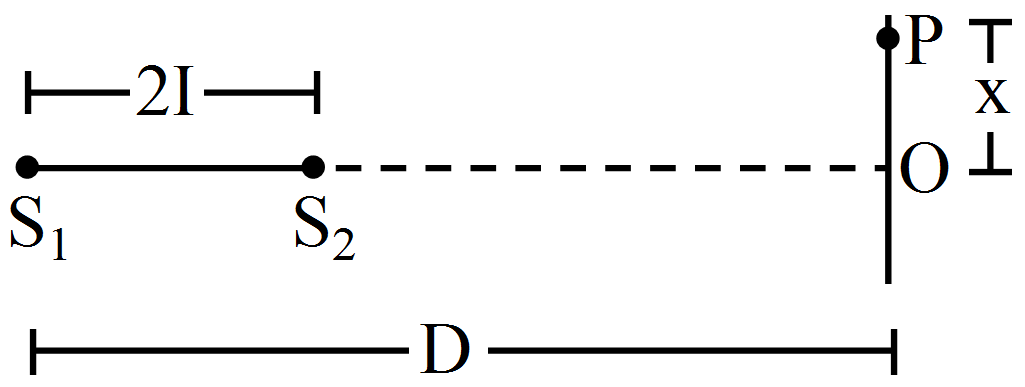
Two coherent narrow slits emitting sound of wavelength $\lambda$ in the same phase are placed parallel to each other at a small separation of $2\lambda.$ The sound is detected by moving a detector on the screen $\sum$ at a distance $\text{D}(>>\lambda)$ from the slit $S_1$ as shown in figure. Find the distance x such that the intensity at P is equal to the intensity at 0.
Answer

Given: $S_1\ \&\ S_2$ are in the same phase. At O, there will be maximum intensity. There will be maximum intensity at P. From the(in questions):$\triangle\text{S}_1\text{PO}$ and $\triangle\text{S}_2\text{PO}$ are right-angled triangle
So, $(\text{S}_1\text{P})^2-(\text{S}_2\text{P})^2$$=\big[\text{D}^2+\text{x}^2\big]-\Big[(\text{D}-2\lambda)^2+\text{x}^2\Big]^2$
$=4\lambda\text{D}+4\lambda^2=4\lambda\text{D}$
$\Big(\lambda^2$ is small and can be neglected$\Big)$
$\Rightarrow(\text{S}_1\text{P}+\text{S}_2\text{P})(\text{S}_1\text{P}-\text{S}_2\text{P})=4\lambda\text{D}$
$\Rightarrow(\text{S}_1\text{P}-\text{S}_2\text{P})=\frac{4\lambda\text{D}}{(\text{S}_1\text{P}+\text{S}_2\text{P})}$
$\Rightarrow\text{S}_1\text{P}-\text{S}_2\text{P}=\frac{4\lambda\text{D}}{2\sqrt{\text{x}^2+\text{D}^2}}$
For constructive interference, path difference $=\text{n}^\lambda$ So, $\text{S}_1\text{P}-\text{S}_2\text{P}=\frac{4\lambda\text{D}}{2\sqrt{\text{x}^2+\text{D}^2}}=\text{n}\lambda$$\Rightarrow\frac{2\text{D}}{\sqrt{\text{x}^2+\text{D}^2}}=\text{n}$
$\Rightarrow\text{n}^2\big(\text{x}^2+\text{D}^2\big)=4\text{D}^2$
$\Rightarrow\text{n}^2\text{x}^2+\text{n}^2\text{D}^2=4\text{D}^2$
$\Rightarrow\text{n}^2\text{x}^2=4\text{D}^2-\text{n}^2\text{D}^2$
$\Rightarrow\text{n}^2\text{x}^2=\text{D}^2(4-\text{n}^2)$
$\Rightarrow\text{x}=\frac{\text{D}}{\text{n}}\sqrt{4-\text{n}^2}$
When n = 1,$\text{x}=\sqrt{3}\text{D}$ $(1^{st}$ order$).$
When n = 2,$\text{x}=0$ $(2^{nd}$ order$).$
So when $\text{x}=\sqrt{3}\text{D},$ the intensity at P is equal to the intensity at O.

Need a full question paper?

Generate a complete, print-ready paper with questions like this in minutes — across 16+ boards, with answer keys.

Start Generating Free

Similar questions

The conductivity of a pure semiconductor is roughly proportional to $\text{T}^\frac{3}{2}\text{e}^{\frac{-\Delta\text{E}}{2\text{kT}}}$ where $\Delta\text{E}$ is the band gap. The band gap for germanium is 0.74eV at 4K and 0.67eV at 300K. By what factor does the conductivity of pure germanium increase as the temperature is raised from 4K to 300K?
  1. Write the expression for the speed of light in a material medium of relative permittivity $\varepsilon_\text{r}$ and relative magnetic permeability $\mu_\text{r}.$
  2. Write the wavelength range and name of the electromagnetic waves which are used in:
  1. Radar systems for aircraft navigation,
  2. Earth satellites to observe the growth of the crops.
Draw a plot showing the variation of photoelectric current with collector plate potential for two different frequencies, $ν_1 > ν_2,$ of incident radiation having the same intensity. In which case will the stopping potential be higher? Justify your answer.
A circular loop of radius 20cm carries a current of 10A. An electron crosses the plane of the loop with a speed of $2.0 \times 10^6m/s.$ The direction of motion makes an angle of 30° with the axis of the circle and passes through its centre. Find the magnitude of the magnetic force on the electron at the instant it crosses the plane.
In a Coolidge tube, electrons strike the target and stop inside it. Does the target get more and more negatively charged as time passes?
A difference of 2.3 eV separates two energy levels in an atom. What is the frequency of radiation emitted when the atom make a transition from the upper level to the lower level?
An electric bulb of volume 250cc was sealed during manufacturing at a pressure of $10^{-3}mm$ of mercury at $27^\circ C.$ Compute the number of air molecules contained in the bulb. Avogadro constant $= 6 \times 10^{23}mol^{-1}$, density of mercury $= 13600kg/ m^{-3} and g = 10ms^{-2}.$
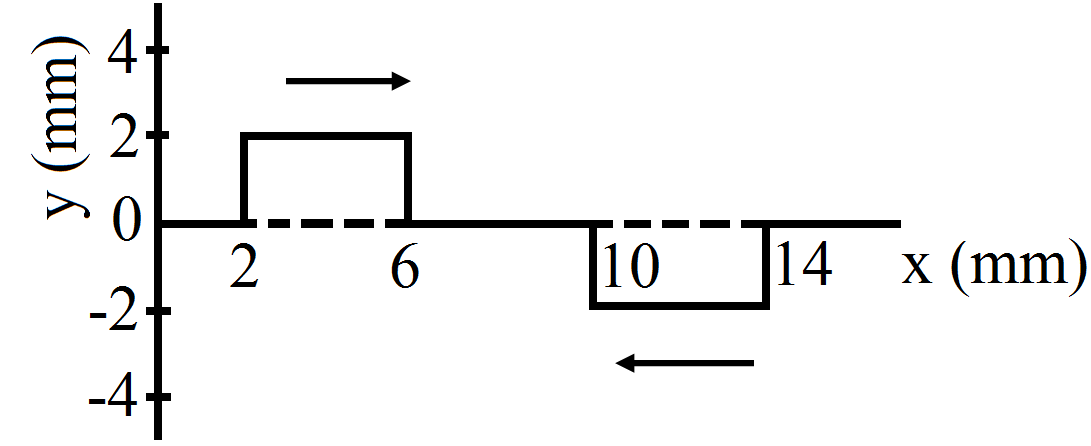
Figure shows two wave pulses at t = 0 travelling on a string in opposite directions with the same

wave speed 50cm/s. Sketch the shape of the string at t = 4ms, 6ms, 8ms, and 12ms.
What is reverse bias? Explain the change occuring in the junction under the effect of reverse bias.
A laser beam has intensity $2.5 \times 10^{14}Wm^{-2}$. Find amplitudes of electric and magnetic fields in the beam.