MCQ
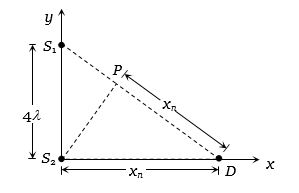
Two coherent sources $S_1$ and $S_2$ are separated by a distance four times the wavelength $\lambda$ of the source. The sources lie along y axis whereas a detector moves along $+ x$ axis. Leaving the origin and far off points the number of points where maxima are observed is
  • A
    $2$
  • $3$
  • C
    $4$
  • D
    $5$

Answer

Correct option: B.
$3$
b
(b) From $\Delta {S_1}{S_2}D,$
${({S_1}D)^2} = {({S_1}{S_2})^2} + {({S_2}D)^2}$
${({S_1}P + PD)^2} = {({S_1}{S_2})^2} + {({S_2}D)^2}$
Here ${S_1}P$ is the path difference $ = n\lambda $ for maximum intensity.
$\therefore {(n\lambda + {x_n})^2} = {(4\lambda )^2} + {({x_n})^2}$
or ${x_n} = \frac{{16{\lambda ^2} - {n^2}{\lambda ^2}}}{{2n\lambda }}$
Then ${x_1} = \frac{{16{\lambda ^2} - {\lambda ^2}}}{{2\lambda }} = 7.5\,\lambda $
${x_2} = \frac{{16{\lambda ^2} - 4{\lambda ^2}}}{{4\lambda }} = 3\lambda $
${x_3} = \frac{{16{\lambda ^2} - 9{\lambda ^2}}}{{6\lambda }} = \frac{7}{6}\lambda $
${x_4} = 0$.
$\therefore $Number of points for maxima becomes $ 3$.

Need a full question paper?

Generate a complete, print-ready paper with questions like this in minutes — across 16+ boards, with answer keys.

Start Generating Free

Similar questions

$A$ block of mass $m$ moving with a velocity $v_0$ on a smooth horizontal surface strikes and compresses a spring of stiffness $k$ till mass comes to rest as shown in the figure. This phenomenon is observed by two observers:

$A$: standing on the horizontal surface

$B$: standing on the block 

To an observer $A,$ the net work done on the block is

In $Y.D.S.E$ how many maxima can be obtained on the screen if wave length of light used is $200\,nm$ and $d = 700\,nm$
Regarding a semiconductor which one of the following is wrong
An electric fan and a heater are marked as $100\, watt$, $220\, volt$ and $1000\, watt$, $220\, volt$ respectively. The resistance of the heater is
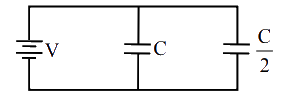
Two condensers, one of capacity $C$ and other of capacity $C/2$ are connected to a $V-$ volt battery, as shown in the figure. The work done in charging fully both the condensers is
The focal length of objective and eye lens of a astronomical telescope are respectively $2 \,m$ and $5\, cm$. Final image is formed at

$(i)$ least distance of distinct vision

$(ii)$ infinity. The magnifying power in both cases will be


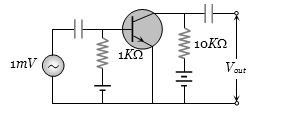
In the following common emitter configuration an $NPN $ transistor with current gain $\beta$ $= 100$ is used. The output voltage of the amplifier will be
A telegraph line of length $100 \,km$ has a capacity of $0.01\,\mu F / km$ and it carries an alternating current at $0.5 \,kilo \,cycle \,per \,second$. If minimum impedance is required, then the value of the inductance that needs to be introduced in series is__________ $m H$. $\text { (if } \pi=\sqrt{10})$
Dispersion of light is due to
If $'f^{\prime}$ denotes the ratio of the number of nuclei decayed $\left(N_{d}\right)$ to the number of nuclei at $t=0$ $\left({N}_{0}\right)$ then for a collection of radioactive nuclei, the rate of change of $'f'$ with respect to time is given as:

$[\lambda$ is the radioactive decay constant]