Two coils require $20$ minutes and $60$ minutes respectively to produce same amount of heat energy when connected separately to the same source. If they are connected in parallel arrangement to the same source; the time required to produce same amount of heat by the combination of coils, will be________ $min$
JEE MAIN 2022, Diffcult
Download our app for free and get started
$\frac{d Q}{d t}=i^{2} R=\frac{V^{2}}{R}$ (we know)
$\Rightarrow \text { In 't' time , } \Delta Q =\left(\frac{ V ^{2}}{ R }\right) t$
Given that, (for same source, $v=$ same)
$Q _{0}=\frac{ v ^{2}}{ R _{1}} \times 20=\frac{ V ^{2}}{ R _{2}} \times 60 \ldots$ $(i)$
$\Rightarrow R _{2}=3 R _{1} \ldots.$ $(ii)$
If they are connected in parallel then
$\operatorname{Req}=\frac{ R _{2} R _{1}}{ R _{1}+ R _{2}}=\frac{3 R _{1} \cdot R _{1}}{3 R _{1}+ R _{1}}=\left(\frac{3 R _{1}}{4}\right)$
To produce same heat, using equation ...$(i)$
$Q _{0}=\frac{ V ^{2}}{ R _{1}} \times 20=\frac{ v ^{2}}{\left(\frac{3 R _{1}}{4}\right)} \times t$
$t =\frac{3 \times 20}{4}=15 \,min$

Download our appand get started for free
Experience the future of education. Simply download our apps or reach out to us for more information. Let's shape the future of learning together!No signup needed.*
Similar Questions
- 1In a region $10^{19}$ $\alpha -$ particels and $10^{19}$ protons per second move to the left, while $10^{19}$ electrons moves to the right per second. The current isView Solution
- 2What equal length of an iron wire and a copper-nickel alloy wire, each of $2 \; {mm}$ diameter connected parallel to give an equivalent resistance of $3 \Omega ?$View Solution
(Given resistivities of iron and copper-nickel alloy wire are $12 \;\mu \Omega {cm}$ and $51\; \mu \Omega {cm}$ respectively) (in ${m}$)
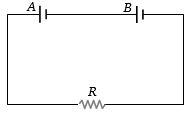
- 3Two batteries $A$ and $B$ each of $e.m.f.$ $2\, V$ are connected in series to an external resistance $R = 1 \,ohm$. If the internal resistance of battery $A$ is $1.9\, ohms$ and that of $B$ is $0.9\, ohm$, what is the potential difference between the terminals of battery $A$ ............. $V$View Solution
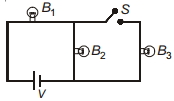
- 4Three identical bulbs $B_1, B_2$ and $B_3$ are connected to the mains as shown in figure. If $B_3$ is disconnected from the circuit by opening switch $S$, then incandescence of bulb $B_1$ willView Solution
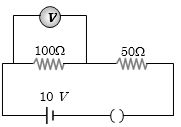
- 5In the given circuit, the voltmeter records $5\, volts$. The resistance of the voltmeter in $ohms$ isView Solution
- 6This question has Statement $1$ and Statement $2.$ Of the four choices given after the Statements, choose the one that best describes the two Statements.View Solution
Statement $1 :$ The possibility of an electric bulb fusing is higher at the time of switching $ON.$
Statement $2:$ Resistance of an electric bulb when it is not lit up is much smaller than when it is lit up.
- 7Two wires each of radius of cross section $r$ but of different materials are connected together end to end (in series). If the densities of charge carriers in the two wires are in the ratio $1 : 4$, the drift velocity of electrons in the two wires will be in the ratio:View Solution
- 8A source of $e.m.f.$ $E = 15\,V$ and having negligible internal resistance is connected to a variable resistance so that the current in the circuit increases with time as $i = 1.2 t + 3$. Then, the total charge that will flow in first five second will be ............... $C$View Solution
- 9In a meter bridge experiment null point is obtained at $20\, cm$ from one end of the wire when resistance $X$ is balanced against another resistance $Y$. If $X < Y$, then where will be the new position of the null point from the same end, if one decides to balance a resistance of $4X$ against $Y$ ........... $cm$View Solution
- 10Consider the circuit shown in the figure. The current $I_3$ is equal toView Solution