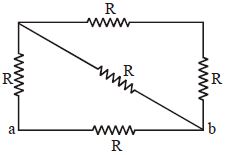
In a meter bridge experiment null point is obtained at $20\, cm$ from one end of the wire when resistance $X$ is balanced against another resistance $Y$. If $X < Y$, then where will be the new position of the null point from the same end, if one decides to balance a resistance of $4X$ against $Y$ ........... $cm$
AIEEE 2004, Medium
Download our app for free and get started
(a) In balancing condition, $\frac{{{R_1}}}{{{R_2}}} = \frac{{{l_1}}}{{{l_2}}} = \frac{{{l_1}}}{{100 - {l_1}}}$
$ \Rightarrow $ $\frac{X}{Y} = \frac{{20}}{{80}} = \frac{1}{4}$.....$(i)$
and $\frac{{4X}}{Y} = \frac{l}{{100 - l}}$.....$(ii)$
$ \Rightarrow $ $\frac{4}{4} = \frac{l}{{100 - l}}$$ \Rightarrow $ $l = 50\,cm$
$ \Rightarrow $ $\frac{X}{Y} = \frac{{20}}{{80}} = \frac{1}{4}$.....$(i)$
and $\frac{{4X}}{Y} = \frac{l}{{100 - l}}$.....$(ii)$
$ \Rightarrow $ $\frac{4}{4} = \frac{l}{{100 - l}}$$ \Rightarrow $ $l = 50\,cm$

Download our appand get started for free
Experience the future of education. Simply download our apps or reach out to us for more information. Let's shape the future of learning together!No signup needed.*
Similar Questions
- 1There is a current of $40$ ampere in a wire of ${10^{ - 6}}\,{m^2}$ area of cross-section. If the number of free electron per ${m^3}$ is ${10^{29}}$, then the drift velocity will beView Solution
- 2Forty electric bulbs are connected in series across a $220\, V$ supply. After one bulb is fused, the remaining $39$ are connected again in series across the same supply. The illumination will beView Solution
- 3View SolutionA steady current flows in a metallic conductor of non-uniform cross-section. The quantity/quantities constant along the length of the conductor is/are
- 4On interchanging the resistances, the balance point of a meter bridge shifts to the left by $10\ cm$. The resistance of their series combination is $1\ k\Omega$. How much was the resistance on the left slot before interchanging the resistances? .................. $\Omega$View Solution
- 5A cell of negligible resistance and $e.m.f.$ $2$ $volts$ is connected to series combination of $2$, $3$ and $5\, ohm$. The potential difference in volts between the terminals of $3\, ohm$ resistance will beView Solution
- 6There is a current of $20$ amperes in a copper wire of ${10^{ - 6}}$ square meter area of cross-section. If the number of free electrons per cubic meter is ${10^{29}}$, then the drift velocity isView Solution
- 7$A$ constant voltage is applied between the two ends of a uniform metallic wire. Some heat is developed in it. The heat developed is doubled ifView Solution
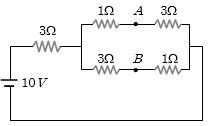
- 8A battery of $e.m.f.$ $10\, V$ is connected to resistance as shown in figure. The potential difference ${V_A} - {V_B}$ between the points $A$ and $B$ is .................... $V$View Solution
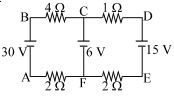
- 9View SolutionThe figure shows a network of four resistances and three batteries Which of the battery is getting charged.
- 10Find out the equivalent resistance between the points $a$ and $b$View Solution