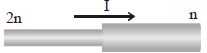
Two cylindrical rods of uniform crosssection area $A$ and $2A$, having free electrons per unit volume $2n$ and $n$ respectively are joined in series. A current $I$ flows through them in steady state. Then the ratio of drift velocity of free electron in left rod to drift velocity of electron in the right rod is $\left( {\frac{{{v_L}}}{{{v_R}}}} \right)$
Medium
Download our app for free and get started
Since current ${\rm{I}} = neA{v_d}$ through both rods
is same $2(\mathrm{n})$ e $\mathrm{A} \mathrm{v}_{\mathrm{L}}=\mathrm{n}$ e $(2 \mathrm{A}) \mathrm{v}_{\mathrm{R}} \Rightarrow \frac{\mathrm{v}_{\mathrm{L}}}{\mathrm{v}_{\mathrm{R}}}=1$

Download our appand get started for free
Experience the future of education. Simply download our apps or reach out to us for more information. Let's shape the future of learning together!No signup needed.*
Similar Questions
- 1Eight copper wire of length $l$ and diameter $d$ are joined in parallel to form a single composite conductor of resistance $R$. If a single copper wire of length $2\,l$ have the same resistance $(R)$ then its diameter will be $.....d$.View Solution
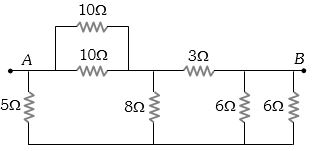
- 2Seven resistances are connected as shown in the figure. The equivalent resistance between $A$ and $B$ is ............... $\Omega$View Solution
- 3A current of $2\,A$ flows through a wire of crosssectional area $25.0\,mm ^2$. The number of free electrons in a cubic meter are $2.0 \times 10^{28}$. The drift velocity of the electrons is $...............\times 10^{-6}\,ms ^{-1}$ (given, charge on electron $=1.6 \times 10^{-19}\,C$ )View Solution
- 4$50\,\Omega $ and $100\,\Omega $ resistors are connected in series. This connection is connected with a battery of $2.4\, volts$. When a voltmeter of $100\,\Omega $ resistance is connected across $100\,\Omega $ resistor, then the reading of the voltmeter will be ............. $V$View Solution
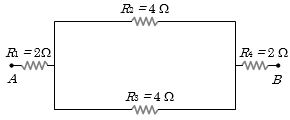
- 5In the given figure, the equivalent resistance between the points $A$ and $B$ is ............ $\Omega$View Solution
- 6View SolutionThe material of fuse wire should have
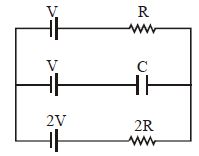
- 7View SolutionIn the given circuit, with steady current, the potential drop across the capacitor must be
- 8A piece of fuse wire melts when a current of $15\, ampere$ flows through it. With this current, if it dissipates $22.5\, W$, the resistance of fuse wire will be .............. $\Omega$View Solution
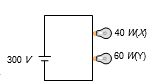
- 9Two bulbs $X$ and $Y$ having same voltage rating and of power $40\, watt$ and $60\, watt$ respectively are connected in series across a potential difference of $300\, volt$, thenView Solution
- 10View SolutionA conductor behaves as a superconductor