A current of $2\,A$ flows through a wire of crosssectional area $25.0\,mm ^2$. The number of free electrons in a cubic meter are $2.0 \times 10^{28}$. The drift velocity of the electrons is $...............\times 10^{-6}\,ms ^{-1}$ (given, charge on electron $=1.6 \times 10^{-19}\,C$ )
JEE MAIN 2023, Easy


Download our appand get started for free
Experience the future of education. Simply download our apps or reach out to us for more information. Let's shape the future of learning together!No signup needed.*
Similar Questions
- 1In a potentiometer wire experiment the $\mathrm{emf}$ of a battery in the primary circuit is $20\,V$ and its internal resistance is $5\,\Omega$ . There is a resistance box in series with the battery and the potentiometer wire, whose resistance can be varied from $120\,\Omega$ to $170\,\Omega$ . Resistance of the potentiometer wire is $75\,\Omega$ . The following potential differences can be measured using this potentiometer.View Solution
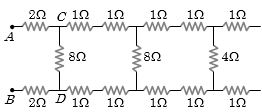
- 2In the figure shown, the total resistance between $A$ and $B$ is ............. $\Omega$View Solution
- 3The resistance of the filament of a lamp increases with the increase in temperature. A lamp rated $100\, W, 220\, V$ is connected across $220\, V$ power supply. If the voltage drops by $10\%$ then the power of lamp will beView Solution
- 4Two electric bulbs marked $40\,W,$ $220\,V$ and $60\,W,\,\,220\,V$ when connected in series across same voltage supply of $220\,V,$ the effective power is $P_1$ and when connected in parallel, the effective power is $P_2.$ Then $\frac {P_1}{P_2}$ isView Solution
- 5View SolutionWhen cells are connected in parallel, then
- 6$1.6\, mA$ current is flowing in conducting wire then the number of electrons flowing per second isView Solution
- 7The electric current through a wire varies with time as $I=I_0+\beta t$. where $I_0=20 \mathrm{~A}$ and $\beta=3 \mathrm{~A} / \mathrm{s}$. The amount of electric charge crossed through a section of the wire in $20 \mathrm{~s}$ is :View Solution
- 8A resistance wire connected in the left gap of a meter bridge balances a $10\, \Omega$ resistance in the right gap at a point which divides the bridge wire in the ratio $3: 2 .$ If the length of the resistance wire is $1.5 m ,$ then the length of $1\, \Omega$ of the resistance wire is $....... \times 10^{-2}\;m$View Solution
- 9The length of a potentiometer wire is $\ell $. A cell of emf $E$ is balanced at a length $\ell /3$ from the positive end of the wire. If the length of the wire is increased by $\ell /2$ at what distance will the same cell give a balanced pointView Solution
- 10To measure the temperature coefficient of resistivity $\alpha$ of a semiconductor, an electrical arrangement shown in the figure is prepared. The arm BC is made up of the semiconductor. The experiment is being conducted at $25^{\circ} \mathrm{C}$ and resistance of the semiconductor arm is $3 \mathrm{~m} \Omega$. Arm BC is cooled at a constant rate of $2^{\circ} \mathrm{C} / \mathrm{s}$. If the galvanometer $\mathrm{G}$ shows no deflection after $10 \mathrm{~s}$, then $\alpha$ is :View Solution