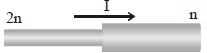
Two cylindrical rods of uniform crosssection area $A$ and $2A$, having free electrons per unit volume $2n$ and $n$ respectively are joined in series. A current $I$ flows through them in steady state. Then the ratio of drift velocity of free electron in left rod to drift velocity of electron in the right rod is $\left( {\frac{{{v_L}}}{{{v_R}}}} \right)$
Medium


Download our appand get started for free
Experience the future of education. Simply download our apps or reach out to us for more information. Let's shape the future of learning together!No signup needed.*
Similar Questions
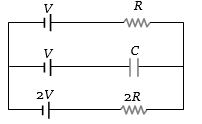
- 1View SolutionIn the given circuit, with steady current, the potential drop across the capacitor must be
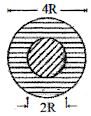
- 2A wire of circular cross section has inner portion of radius $R$ made of material of resisitivity $\rho$ and is surrounded by an outer portion of thickness $R$ made of a material of double resisitivity. Find the resistance of length $l$ of such wireView Solution
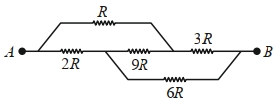
- 3The equivalent resistance between $A$ and $B$ of the network shown in figureView Solution
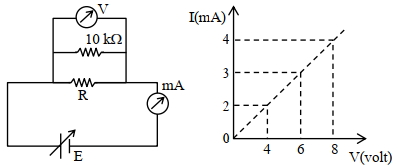
- 4To determine the resistance ($R$) of a wire, a circuit is designed below, The $V-I$ characteristic curve for this circuit is plotted for the voltmeter and the ammeter readings as shown in figure. The value of $\mathrm{R}$ is . . . . . . .$\Omega$View Solution
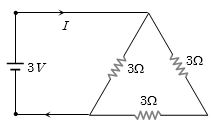
- 5A $3\, volt$ battery with negligible internal resistance is connected in a circuit as shown in the figure. The current $I$, in the circuit will be ............. $A$View Solution
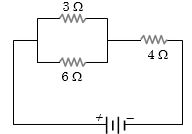
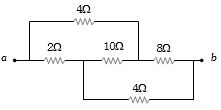
- 6Find the equivalent resistance between the points $a$ and $b$ .......... $\Omega$View Solution
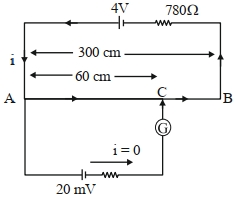
- 7A potentiometer wire of length $300\,cm$ is connected in series with a resistance $780\,\Omega$ and a standard cell of emf $4\,V$. A constant current flows through potentiometer wire. The length of the null point for cell of emf $20\,mV$ is found to be $60\,cm$. The resistance of the potentiometer wire is$...\Omega$View Solution
- 8Three resistances of magnitude $2$, $3$ and $5$ $ohm$ are connected in parallel to a battery of $10\, volts$ and of negligible resistance. The potential difference across $3\,\Omega $ resistance will be ............... $volts$View Solution
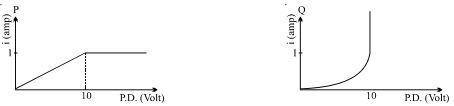
- 9Two current elements $P$ and $Q$ have current voltage characteristics as shown below :View Solution
Which of the graphs given below represents current voltage characteristics when $P$ and $Q$ are in series.
- 10In the figure, current through the $3\,\Omega $ resistor is $0.8\, ampere$, then potential drop through $4\,\Omega $ resistor is ........... $V$View Solution