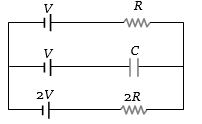
In the given circuit, with steady current, the potential drop across the capacitor must be
IIT 2001, Diffcult
Download our app for free and get started
(c) Moving anticlockwise from $A$
$ - \,iR - V + 2V - 2iR = 0$
or $3iR = V$ or $i = \frac{V}{{3R}}$
${V_A} - {V_B} = iR + V - V = iR$
$==>$ Potential drop across $C$ =$\frac{V}{3}$
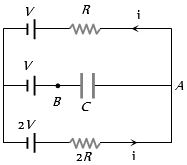
$ - \,iR - V + 2V - 2iR = 0$
or $3iR = V$ or $i = \frac{V}{{3R}}$
${V_A} - {V_B} = iR + V - V = iR$
$==>$ Potential drop across $C$ =$\frac{V}{3}$

Download our appand get started for free
Experience the future of education. Simply download our apps or reach out to us for more information. Let's shape the future of learning together!No signup needed.*
Similar Questions
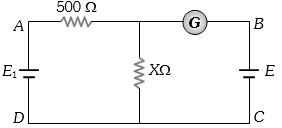
- 1In the adjoining circuit, the battery ${E_1}$ has an $e.m.f.$ of $12\,volt$ and zero internal resistance while the battery $E$ has an $e.m.f.$ of $2\,volt$. If the galvanometer $G$ reads zero, then the value of the resistance $X$ in $ohm$ isView Solution
- 2View SolutionConsider the circuit shown in the figure
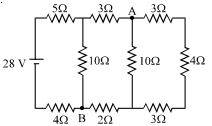
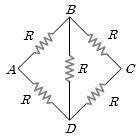
- 3Five equal resistances each of value $R$ are connected in a form shown alongside. The equivalent resistance of the networkView Solution
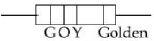
- 4View SolutionA carbon resistance has a following colour code. What is the value of the resistance?
- 5If the resistance of a conductor is $5\,\Omega\,\,$ at $\,50\,^oC$ and $7\, \Omega\,$ at $\,100\,^oC$ then the mean temperature coefficient of resistance of the material is ............... $^oC$View Solution
- 6A wire of resistance $160\,\Omega$ is melted and drawn in wire of one-fourth of its length. The new resistance of the wire will be $......\Omega$View Solution
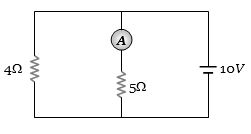
- 7if the internal resistance of the battery is $1\, ohm$, then what is the reading of ammeterView Solution
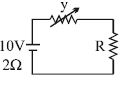
- 8In the figure shown the power generated in $y$ is maximum when $y = 5\,\Omega $. Then $R$ isView Solution
- 9When a resistor of $11 \,\Omega$ is connected in series with an electric cell, the current flowing in it is $0.5\, A$. Instead, when a resistor of $5 \,\Omega$ is connected to the same electric cell in series, the current increases by $0.4\, A$. The internal resistance of the cell is ................ $\Omega$View Solution
- 10The $H$ amount of thermal energy is developed by a resistor in $10\,s$ when a current of $4\,A$ is passed through it. If the current is increased to $16\,A$, the thermal energy developed by the resistor in $10\,s$ will be $........\,H$View Solution