MCQ
Two elements whose electronegativities are $1.2$ and $3.0$ the bond formed between them would be
  • Ionic
  • B
    Covalent
  • C
    Coordinate
  • D
    Metallic

Answer

Correct option: A.
Ionic
a
(a) If electronegativity difference is greater than $1.7$ bond is ionic, if less than $1.7$, the bond is covalent.

Need a full question paper?

Generate a complete, print-ready paper with questions like this in minutes — across 16+ boards, with answer keys.

Start Generating Free

Similar questions

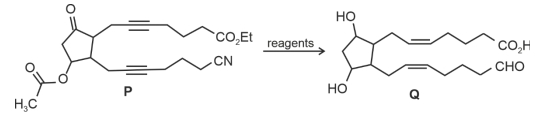
The option($s$) with correct sequence of reagents for the conversion of $P$ to $Q$ is(are)

$(A) i)$ Lindlar's catalyst, $H _2$; $ii$) $SnCl _2 / HCl$; iii) $NaBH _4$; iv) $H _3 O ^{+}$

$(B) i)$ Lindlar's catalyst, $H _2$; $ii$) $H _3 O ^{+}; iii)$ $SnCl _2 / HCl$; iv) $NaBH _4$

$(C) i)$ $NaBH _4; ii)$ $SnCl _2 / HCl; $iii$)$ $H _3 O ^{+}; iv)$ Lindlar's catalyst, $H _2$

$(D) i)$ Lindlar's catalyst, $H _2$; $ii$) $NaBH _4; iii)$ $SnCl _2 / HCl; iv)$ $H _3 O ^{+}$
If for a given substance melting point is ${T_B}$ and freezing point is ${T_A}$, then correct variation shown by graph between entropy change and temperature is
Which of the following statement is correct for paper chromatography ?
The element having atomic number 33 is present in which group of periodic table?
If the value of equilibrium constant for a particular reaction is $1.6 \times 10^{12}$ then at equilibrium the system will contain
Consider the elements: Cs, Ne, I and F. Identify the element(s) which exhibits neither the negative nor does the positive oxidation state.
Which of the following statements is correct?
A compound ' $X$ ' is a weak acid and it exhibits colour change at $pH$ close to the equivalence point during neutralization of $NaOH$ with $CH _{3} COOH$. Compound ' $X$ ' exists in ionized form in basic medium. The compound '$X$' is.
The solubility product of $CuS,\,\,A{g_2}S,\,\,HgS$ are ${10^{ - 31}},\,\,{10^{ - 44}},\,\,{10^{ - 54}}$ respectively. The solubilities of these sulphides are in the order
The correct statement regarding oxide of $'X'$