Question
Two ends of a conductor are at different temperatures the electromotive force generated between two ends is(a) Seebeck electro motive force (e.m.f.)(b) Peltier electro motive force (e.m.f.)(c) Thomson electro motive force (e.m.f.)(d) None of these


Answer

(c) Thomson electro motive force (e.m.f.)

Need a full question paper?

Generate a complete, print-ready paper with questions like this in minutes — across 16+ boards, with answer keys.

Start Generating Free

Similar questions

In the circuit shown in Fig. initially key $K_1$ is closed and key $K_2$ is open. Then $K_1$ is opened and $K_2$ is closed $($order is important$). [$Take $Q_1' $and $Q_2'$ as charges on $C_1$ and $C_2$ and $V_1$ and $V_2$ as voltage respectively.$]$ Then
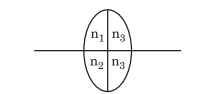
How many images are formed by the lens shown in adjacent figure if an object is kept on its axis ?
Image
The emitter-base junction of a transistor is …… biased while the collector-base junction is ……. biased(a) Reverse, forward(b) Reverse, reverse(c) Forward, forward (d) Forward, reverse
       
Electric charge is measured in:
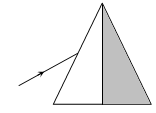
A light ray is incident upon a prism in minimum deviation position and suffers a deviation of $34^\circ .$ If the shaded half of the prism is knocked off, the ray will
The binding energy of a H-atom, considering an electron moving around a fixed nuclei (proton), is $\text{B}=-\frac{\text{me}^4}{8\text{n}^2\epsilon_0^2\text{h}^2}$. (m = electron mass).
If one decides to work in a frame of reference where the electron is at rest, the proton would be moving arround it. By similar arguments, the binding energy would be,
$\text{B}=-\frac{\text{me}^4}{8\text{n}^2\epsilon_0^2\text{h}^2}$ (M = proton mass)
This last expression is not correct because:
Monica wanted to take photographs of a monument. But since the surrounding is filled with smoke, she is not able to take good photos. Which one of the following electromagnetic waves can be used in this situation to help Monica?
The mass equivalent of $931\ \text{MeV}$ energy is
$\text{E.C.E.}$ of $Cu$ and $Ag$ are $7 \times 10^{-6}$ and $1.2 \times 10^{-6}$ A certain current deposits $14\ gm$ of $Cu.$ Amount of $Ag$ deposited is
A graph is plotted between the potential difference (applied across the ends of a conductor) and the current (following through the conductor). The graph is a straight line