MCQ
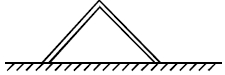
Two equal rods joined at one end are kept on a smooth surface as shown and released. Trajectory of centre of mass of both rods is 
  • A
    parabola
  • straight vertical line
  • C
    straight inclined line
  • D
    straight horizontal line

Answer

Correct option: B.
straight vertical line
b

Need a full question paper?

Generate a complete, print-ready paper with questions like this in minutes — across 16+ boards, with answer keys.
Start Generating Free

Similar questions

A cricketer can throw a ball to a maximum horizontal distance of $100\, m$. The speed with which he throws the ball is   ......... $ms^{-1}$ (to the nearest integer)
In a region, electric field varies as $E = 2x^2 -4$ where $x$ is the distance in metre from origin along $x-$ axis. A positive charge of $1\,\mu C$ is released with minimum velocity from infinity for crossing the origin, then
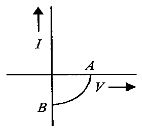
The given graph represents $V-I$ characteristic for a semiconductor device. Which of the following statement is correct? 
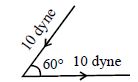
Two forces each numerically equal to $10$ $dynes$ are acting as shown in the adjoining figure, then the magnitude of resultant is.........$dyne$
An ideal gas expands in such a manner that its pressure and volume can be related by equation $P{V^2} = $ constant. During this process, the gas is
The $rms$ speeds of the molecules of Hydrogen, Oxygen and Carbondioxide at the same temperature are ${V}_{{H}}, {V}_{0}$ and ${V}_{{C}}$ respectively then
Water of mass $m$ gram is slowly heated to increase the temperature from $T_1$ to $T_2$. The change in entropy of the water, given specific heat of water is $1 Jkg ^{-1} K^{-1}$, is :
The half life of $^{131}I$ is $8\, days$. Given a sample of $^{131}I$ at time $t = 0,$ we can assert that
Consider two masses with $m_1 > m_2$ connected by a light inextensible string that passes over a pulley of radius $R$ and moment of inertia $I$ about its axis of rotation. The string does not slip on the pulley and  the pulley turns without friction. The two masses are released from rest separated by a vertical distance $2 h$. When the two masses pass each other, the speed of the masses is proportional to
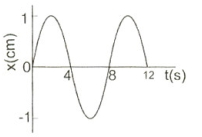
The $x$-t graph of a particle undergoing simple harmonic motion is shown below. The acceleration of the particle at $t=4 / 3 \mathrm{~s}$ is