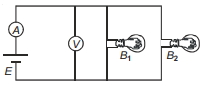
Two identical bulbs are connected in parallel across an ideal source of emf $E$. The ammeter $A$ and voltmeter $V$ are ideal. If bulb $B_2$ gets fused, then
Medium
Download our app for free and get started
(c)
If $B_2$ gets fused, $R_{\text {net }}$ increases, $i$ decreases, but reading of $V$ remains same.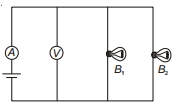

Download our appand get started for free
Experience the future of education. Simply download our apps or reach out to us for more information. Let's shape the future of learning together!No signup needed.*
Similar Questions
- 1A heater $A$ gives out $300\, W$ of heat when connected to a $200\, V$ $d.c.$ supply. Asecond heater $B$ gives out $600\, W$ when connected to a $200\,v$ $d.c$. supply. If a series combination of the two heaters is connected to a $200\, V$ $d.c$. supply the heat output will be ................. $W$View Solution
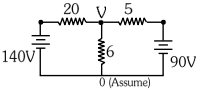
- 2The value of current in the $6 \,\Omega$ resistance is $....\,A$View Solution
- 3A potentiometer wire has length $10\, m$ and resistance $20\,\Omega $. A $2. 5\, V$ battery of negligible internal resistance is connected across the wire with an $80\,\Omega $ series resistance. The potential gradient on the wire will beView Solution
- 4The series combination of two batteries, both of the same emf $10 \mathrm{\;V},$ but different internal resistance of $20\; \Omega$ and $5\; \Omega,$ is connected to the parallel combination of two resistors $30\; \Omega$ and $\mathrm{R}\; \Omega .$ The voltage difference across the battery of internal resistance $20\; \Omega$ is zero, the value of $\mathrm{R}(\text { in } \Omega)$ isView Solution
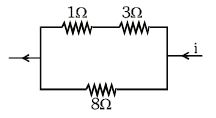
- 5Power dissipated across the $8\,\Omega $ resistor in the circuit shown here is $2\, watt$. The power dissipated in watt units across the $3\,\Omega $ resistor isView Solution
- 6A current of $1.6\, A$ is flowing through a wire having cross-sectional area $1\, mm^2$. If density of free electrons in the material of the wire is $10^{29}\, per\, m^3$, the drift velocity of electrons will beView Solution
- 7The effective resistance of a parallel connection that consists of four wires of equal length, equal area of cross-section and same material is $0.25\, \Omega$. What will be the effective resistance if they are connected in series ? (In $\Omega$)View Solution
- 8View SolutionThere are three resistance coils of equal resistance. The maximum number of resistances you can obtain by connecting them in any manner you choose, being free to use any number of the coils in any way is
- 9In a meter bridge experiment null point is obtained at $20\, cm$ from one end of the wire when resistance $X$ is balanced against another resistance $Y$. If $X < Y$, then where will be the new position of the null point from the same end, if one decides to balance a resistance of $4X$ against $Y$ ........... $cm$View Solution
- 10A source of $e.m.f.$ $E = 15\,V$ and having negligible internal resistance is connected to a variable resistance so that the current in the circuit increases with time as $i = 1.2 t + 3$. Then, the total charge that will flow in first five second will be ............... $C$View Solution