MCQ
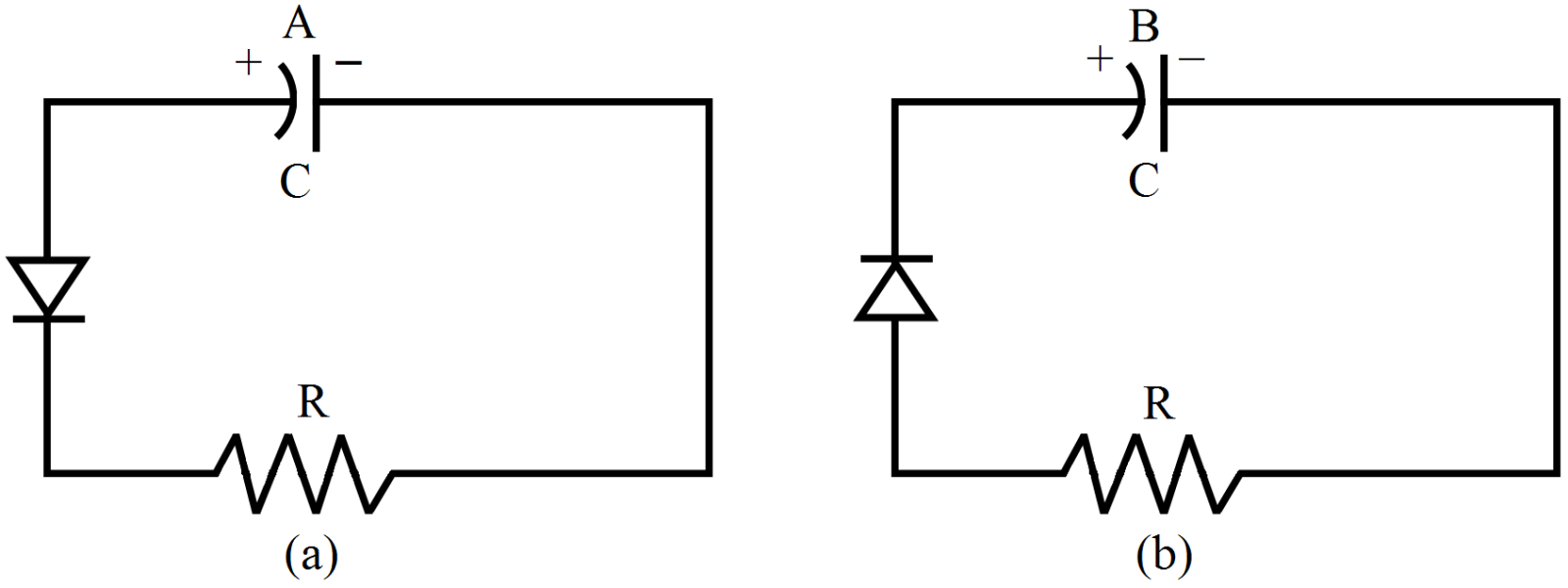
Two identical capacitors A and B are charged to the same potential V and are connected in two circuits at t = 0 as shown in figure. The charges on the capahltors at a time t = CR are, respectively:
  • A
    $\text{VC}, \text{VC}$
  • $\frac{\text{VC}}{\text{e}}, \text{VC}$
  • C
    $\text{VC}, \frac{\text{VC}}{\text{e}}$
  • D
    $\frac{\text{VC}}{\text{e}}, \frac{\text{VC}}{\text{e}}$
Answer

Correct option: B.
$\frac{\text{VC}}{\text{e}}, \text{VC}$
In circuit (a), the diode is forward biassed. So, it offers negligible resistance to the flow of current and can thus be replaced by a short circuit. Now, the capacitor charge will leak through the resistance and decay exponentially with time.
Capacitor charge $=\frac{\text{VC}}{\text{e}}$
In circuit (b), the diode is reverse biassed. So, it offers infinite resistance to the current flow and can thus be replaced by an open circuit. As the circuit is open now, no current can flow across the resistance. So, the charge in the capacitor cannot leak through the resistor.
Capacitor charge = VC

Need a full question paper?

Generate a complete, print-ready paper with questions like this in minutes — across 16+ boards, with answer keys.

Start Generating Free

Similar questions

The fundamental frequency of a sonometer wire of length $l$ is $n_0$ . A bridge is now introduced at a distance of $\Delta l ( < < l)$ from the centre of the wire. The lengths of wire on the two sides of the bridge are now vibrated in their fundamental modes. Then, the beat frequency nearly is
Velocity of transverse wave in stretched string doesn't depend on:
A particle is revolving in a circular path of radius $25 \,m$ with constant angular speed $12 \,rev/min$. Then the angular acceleration of particle is .......... $rad / s ^2$
Excess pressure inside a soap bubble is three times that of the other bubble, then the ratio of their volumes will be
A uniform rod of density $\rho $ is placed in a wide tank containing a liquid of density ${\rho _0}({\rho _0} > \rho )$. The depth of liquid in the tank is half the length of the rod. The rod is in equilibrium, with its lower end resting on the bottom of the tank. In this position the rod makes an angle $\theta $ with the horizontal
A block of mass m is placed on a smooth inclined plane of inclination 0 with the horizontal. The force exerted by the plane on the block has a magnitude:
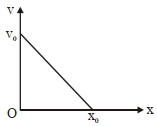
The velocity-displacement graph of a particle is shown in the figure.

The acceleration-displacement graph of the same particle is represented by :

There are two identical chambers, completely thermally insulated from surroundings. Both chambers have a partition wall dividing the chambers in two compartments. Compartment $1$ is filled with an ideal gas and Compartment $3$ is filled with a real gas. Compartments $2$ and $4$ are vacuum . A small hole (orifice) is made in the partition walls and the gases are allowed to expand in vacuum

Statement $-1$ : No change in the temperature of the gas takes place when ideal gas expands in vacuum. However, the temperature of real gas goes down (cooling) when it expands in vacuum

Statement $-2$ : The internal energy of an ideal gas is only kinetic. The internal energy of a real gas is kinetic as well as potential

A body of mass $10\,kg$ is moving with an initial speed of $20\,m / s$. The body stops after $5\,s$ due to friction between body and the floor. The value of the coefficient of friction is (Take acceleration due to gravity $g =10\; ms ^{-2}$)
Weight of a body of mass $m$ decreases by $1\%$ when it is raised to height $h$ above  the Earth's surface. If the body is taken to a depth $h$ in a mine, then its weight will