Question
Two identical capacitors are joined in parallel, charged to potential $V$, separated and then, connected in series, $i.e.$, the positive plate of one is connected to the negative plate of the other. Then

Answer

Both capacitors are charged to the same potential, so they acquire the same charge. When connected in series, the charges on free plates neutralise each other.

Need a full question paper?

Generate a complete, print-ready paper with questions like this in minutes — across 16+ boards, with answer keys.
Start Generating Free

Similar questions

A body starts from the origin and moves along the $X-$axis such that the velocity at any instant is given by $(4{t^3} - 2t)$, where $t$ is in sec and velocity in$m/s$. What is the acceleration of the particle, when it is $2\, m$ from the origin..........$m/{s^2}$
A transistor is used in common emitter mode as an amplifier. Then
The resistivity of alloys $ = {R_{{\rm{alloy}}}}$; the resistivity of constituent metals ${R_{{\rm{metal}}}}$. Then, usually
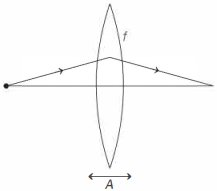
A point object is placed $20 \,cm$ left of a convex lens of focal length $f=5 \,cm$ (see in the below figure). The lens is made to oscillate with small amplitude $A$ along the horizontal axis. The image of the object will also oscillate along the axis with
A train starts from rest from a station with acceleration $0.2 \,m / s ^2$ on a straight track and then comes to rest after attaining maximum speed on another station due to retardation $0.4 \,m / s ^2$. If total time spent is half an hour, then distance between two stations is [Neglect length of train]
A body of mass $M$ at rest explodes into three pieces, two of which of mass $M/4$ each are thrown off in perpendicular directions with velocities of $3\, m/s$ and $4\, m/s$ respectively. The third piece will be thrown off with a velocity of .......... $m/s$
An object of mass $80 \,kg$ moving with velocity $2 \,ms ^{-1}$ hit by collides with another object of mass $20 \,kg$ moving with velocity $4 \,ms ^{-1}$. Find the loss of energy assuming a perfectly inelastic collision ........... $J$
A cylinder of height $ 20\; m$  is completely filled with water. The velocity of efflux of water (in $ m/s$) through a small hole on the side wall of the cylinder near its bottom is ....... $m/s$
A black body, at a temperature of $227\,^oC$ radiates heat at a rate of $7\,cal\,cm^{-2}\, s^{-1}$ . At a temperature of $727\,^oC$ , the rate of heat radiated in the same units will be
A small block slides down on a smooth inclined plane, starting from rest at time $t=0 .$ Let $S_{n}$ be the distance travelled by the block in the interval $\mathrm{t}=\mathrm{n}-1$ to $\mathrm{t}=\mathrm{n} .$ Then, the ratio $\frac{\mathrm{S}_{\mathrm{n}}}{\mathrm{S}_{\mathrm{n}+1}}$ is