- A$\oint\text{B.dl}=\pm2\mu_0\text{I}.$
- BThe value of $\oint\text{B.dl}$ is independent of sense of C.
- CThere may be a point on C where B and dl are perpendicular.
- DB vanishes every where on C.
Solution:
Key concept: Ampere’s law gives another method to calculate the magnetic field due to a given current distribution.
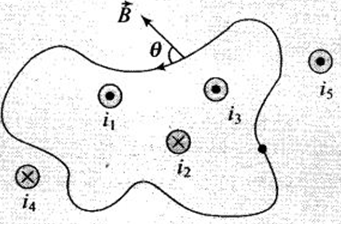
Line integral of the magnetic field $\vec{\text{B}}$ around any closed curve is equal to $\mu_0$ times the net current i threading through the area enclosed by the curve, i.e.,
$\oint\vec{\text{B}}.\vec{\text{dI}}=\mu_0\sum\text{i}=\mu_0(\text{i}_1+\text{i}_3-\text{i}_2)$
Total current crossing the above area is (i1 + i3 - i2). Any current outside the area is not included in net current. $(\text{Outward}\ \circledcirc\rightarrow\ +\text{ve},\text{ Inward}\ \otimes\ \rightarrow\ -\text{ve})$
Applying the Ampere's circuital law, we have
$\oint\ \text{B.dl}=\text{i}_0(\text{I}-\text{I})=0$ (because current is in opposite sense.)
Also, there may be a point on C where B and dl are perpendiclular and hence,
$\oint\limits_\text{c}\text{B.dI}=0.$
Generate a complete, print-ready paper with questions like this in minutes — across 16+ boards, with answer keys.
A parallel beam of light is incident on a converging lens parallel to its principal axis. As one moves away from the lens on the other side on its principal axis, the intensity of light:
The wavelength of the most energetic X–ray emitted when a metal target is bombarded by 100 KeV electrons is approximately
| (a) 12 Å | (b) 4 Å |
(c) 0.31 Å |
(d) 0.124 Å |
In nuclear fission, the fission reactions proceeds with a projectile. Which of the following suits the best
|
(a) Slow proton |
(b) Fast neutron |
(c) Slow neutron |
(d) None of these |
The wavelength 21 cm emitted by atomic hydrogen in interstellar space belongs to
|
(a) Radio waves |
(b) Infrared waves |
(c) Microwaves |
(d) g-rays |
The critical angle between an equilateral prism and air is 45°. If the incident ray is perpendicular to the refracting surface, then
|
(a) After deviation it will emerge from the second refracting surface |
|
(b) It is totally reflected on the second surface and emerges out perpendicularly from third surface in air |
|
(c) It is totally reflected from the second and third refracting surfaces and finally emerges out from the first surface |
|
(d) It is totally reflected from all the three sides of prism and never emerges out |
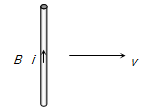
A conducting wire is moving towards right in a magnetic field B. The direction of induced current in the wire is shown in the figure. The direction of magnetic field will be

|
(a) In the plane of paper pointing towards right |
|
(b) In the plane of paper pointing towards left |
|
(c) Perpendicular to the plane of paper and down‑wards |
|
(d) Perpendicular to the plane of paper and upwards |
The optical path of a monochromatic light is same if it goes through 4.0 cm of glass or 4.5 cm of water. If the refractive index of glass is 1.53, the refractive index of the water is
|
(a) 1.30 |
(b) 1.36 |
(c) 1.42 |
(d) 1.46 |