Question
Two identical heavy spheres are separated by a distance 10 times their radius. Will an object placed at the mid point of the line joining their centres be in stable equilibrium or unstable equilibrium? Give reason for your answer.

Answer

$\text{m}_1=\text{m}_2=\text{M }\text{r}=10\text{R}$

Let mass m is placed at the mid point P of line joining the centres of A and B sphere
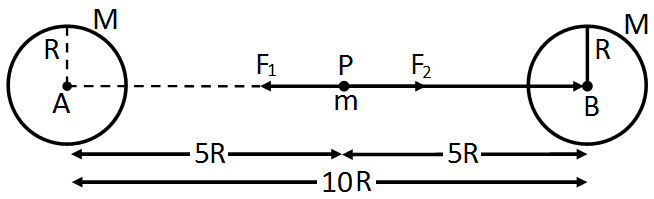
$|\text{F}_2|=|\text{F}_1|=\frac{\text{GMm}}{(5\text{R})^2}$

$|\text{F}_1|=|\text{F}_2|=\frac{\text{GMm}}{(25\text{R})^2}$

As the direction of force F1 and F2 are opposite (equal and opposite forces acting on m at P). The net force F1 + F2 = 0, (F1 = -F2). m will be in equilibrium.

If now m is displaced by x slightly from P to A then PA = (5R - x) and PB = (5R + x)

$\text{F}_1=\frac{\text{GMm}}{(5\text{R}-\text{x})^2}$ and $\text{F}_2=\frac{\text{GMm}}{(5\text{R}+\text{x})^2}$

$\therefore\ \text{F}_2<\text{F}_1$

Hence the resultant force acting on P is towards A, resulting in an unstable equilibrium.

Need a full question paper?

Generate a complete, print-ready paper with questions like this in minutes — across 16+ boards, with answer keys.
Start Generating Free

Similar questions

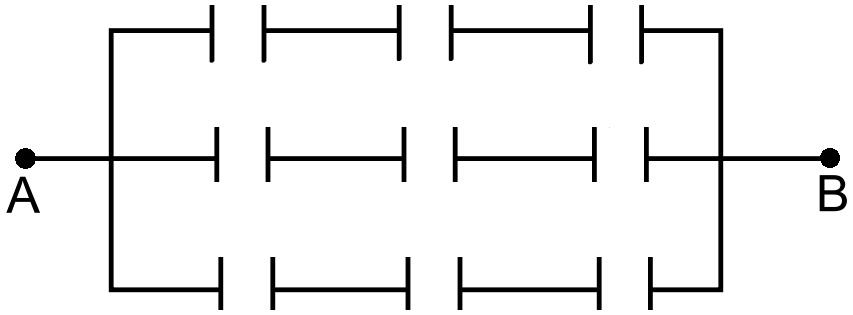
Each of the capacitors shown in figure has a capacitance of $2\mu\text{F}.$ Find the equivalent capacitance of the assembly between the points A and B. Suppose, a battery of emf 60 volts is connected between A and B. Find the potential difference appearing on the individual capacitors.

  1. Define SHM. What are its characteristics? At what distance from the mean position in SHM of amplitude r the energy is half kinetic and half potential?
  2. A spring having a force constant K is divided into three equal parts. What would be force constant for each individual parts?
Three vessels of equal capacity have gases at the same temperature and pressure. The first vessel contains neon (monatomic), the second contains chlorine (diatomic), and the third contains uranium hexafluoride (polyatomic). Do the vessels contain equal number of respective molecules? Is the root mean square speed of molecules the same in the three cases? If not, in which case is vrms the largest?
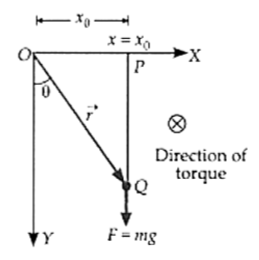
A particle of mass $m$ is released from point P at $x = x _0$ on the X -axis from origin O and falls vertically along the Y-axis, as shown in Fig.
Image

i. Find the torque $t$ acting on the particle at a time $t$ when it is at point Q with respect to O .
ii. Find the angular momentum L of the particle about O at this time t .
iii. Show that $\tau=\frac{d L}{d t}$ in this example.
An elastic spring of force constant K is compressed by an amount x. Show that its potential energy is $\frac{1}{2}\text{Kr}^2.$
Establish the following vector inequalities geometrically or otherwise:

$|\text{a}-\text{b}|\ge||\text{a}|-|\text{b}||$

When does the equality sign above apply?

The driver of a three-wheeler moving with a speed of 36km/h sees a child standing in the middle of the road and brings his vehicle to rest in 4.0s just in time to save the child. What is the average retarding force on the vehicle ? The mass of the three-wheeler is 400kg and the mass of the driver is 65kg.
Two pendulums with identical bobs and lengths are suspended from a common support such that in rest position the two bobs are in contact. One of the bobs is released after being displaced by 10° so that it collides elastically head-on with the other bob.

  1. Describe the motion of two bobs.
  2. Draw a graph showing variation in energy of either pendulum with time, for  where T is the period of each pendulum.
Give the postulates of kinetic theory of gases. Derive the expression for pressure exerted by gas molecules in a container. Use it to relate kinetic energy with pressure.
A uniform field of 2.0NC-1 exists in space in x-direction.
  1. Taking the potential at the origin to be zero, write an expression for the potential at a general point (x, y, z).
  2. At which points, the potential is 25V?
  3. If the potential at the origin is taken to be 100V, what will be the expression for the potential at a general point?
  4. What will be the potential at the origin if the potential at infinity is taken to be zero? Is it practical to choose the potential at infinity to be zero?