Question
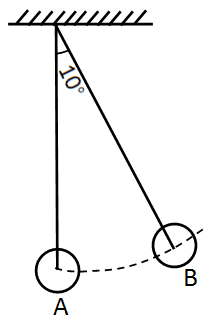
Two pendulums with identical bobs and lengths are suspended from a common support such that in rest position the two bobs are in contact. One of the bobs is released after being displaced by 10° so that it collides elastically head-on with the other bob.

  1. Describe the motion of two bobs.
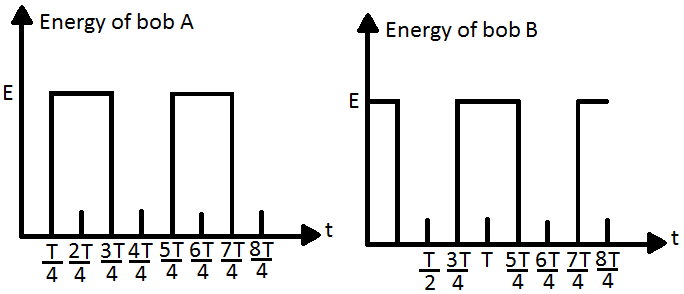
  2. Draw a graph showing variation in energy of either pendulum with time, for  where T is the period of each pendulum.

Answer

  1. Let at t = 0 A is at lowest position and B is at its height position at 10°

PEA = 0, PEB = E, KEA = KEB = 0

K.E. of both are zero. Now bob is released.

 reaches to A and collide elastically as both bobs are identical then,

KEA = 0, KEB = E, PEA = 0

PEB = 0

AT  reaches at it’s maximum height and B remains at it’s lowest position.

KEA = 0, KEB = E, PEA = E, PEB = 0

At  Bob A hits the bob B which was at rest elastically and ball A becomes at rest, B moves upward.

KEA = 0, KEB = E, PEA = E, PEB = 0

EA = 0, EB = E

At  Bob B is at its maximum height and A is at lower height.

So, KEA = 0, KEB = 0, PEA = 0, PEB = E

  1. The entire process is repeated.
Time t KEA PEA EA KEB PEB EB
0 0 0 0 0 E E
0 0 E 0 0 0
0 0 0 0 E E
E 0 E 0 0 0
0 0 0 0 E E

Need a full question paper?

Generate a complete, print-ready paper with questions like this in minutes — across 16+ boards, with answer keys.

Start Generating Free

Similar questions

Two ideal gas thermometers A and B use oxygen and hydrogen respectively. The following observations are made:
Temperature
Pressure thermometer A
Pressure thermometer B
Triple-point of water
1.250 × 10⁵Pa
0.200 × 10⁵Pa
Normal melting point of sulphur
1.797 × 10⁵Pa
0.287 × 10⁵Pa

What is the absolute temperature of normal melting point of sulphur as read by thermometers A and B?

What do you think is the reason behind the slight difference in answers of thermometers A and B? (The thermometers are not faulty). What further procedure is needed in the experiment to reduce the discrepancy between the two readings?

A glass tube, sealed at both ends, is 100cm long. It lies horizontally with the middle 10cm containing mercury. The two ends of the tube contain air at 27°C and at a pressure 76cm of mercury. The air column on one side is maintained at 0°C and the other side is maintained at 127°C. Calculate the length of the air column on the cooler side. Neglect the changes in the volume of mercury and of the glass.
The intensity of the sunlight reaching Earth is 1380Wm-2. Assume this light to be a plane, monochromatic wave. Find the amplitudes of electric and magnetic fields in this wave.
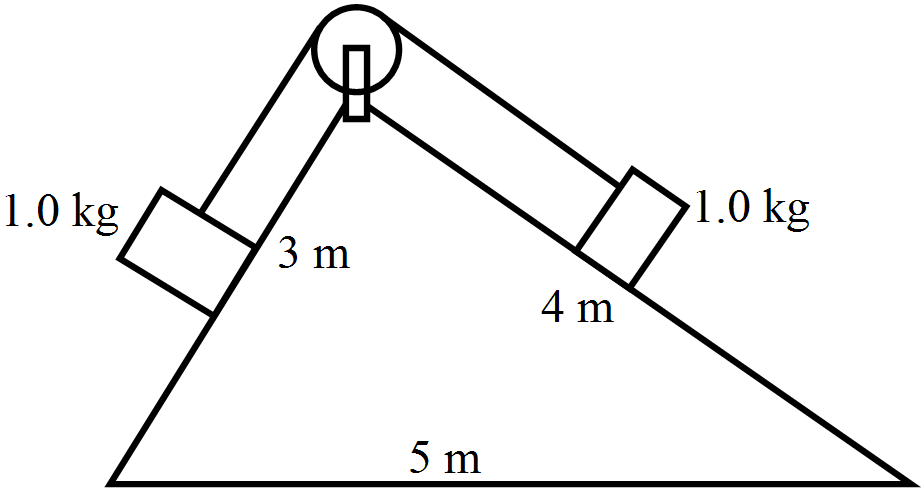
Consider the situation shown in figure. All the surfaces are frictionless and the string and the pulley are light. Find the magnitude of the acceleration of the two blocks.

State, for each of the following physical quantities, if it is a scalar or a vector : volume, mass, speed, acceleration, density, number of moles, velocity, angular frequency, displacement, angular velocity.
The bob of a pendulum at rest is given a sharp hit to impart a horizontal velocity $\sqrt{10\text{gl}},$ where l is the length of the pendulum. Find the tension in the string when,
  1. The string is horizontal.
  2. The bob is at its highest point.
  3. The string makes an angle of 60° with the upward vertical.
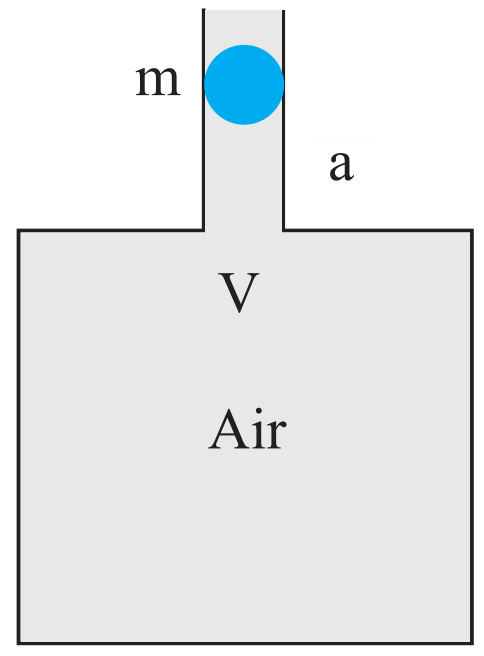
An air chamber of volume V has a neck area of cross section a into which a ball of mass m just fits and can move up and down without any friction (Fig.). Show that when the ball is pressed down a little and released , it executes SHM. Obtain an expression for the time period of oscillations assuming pressure-volume variations of air to be isothermal [see Fig.].

Separation of Motion of a system of particles into motion of the centre of mass and motion about the centre of mass:
Show $\text{p}=\text{p}'_\text{i}+\text{m}_\text{i}\text{V}$ where pi is the momentum of the ith particle (of mass mi ) and p′i = miv′i.
Note: v′i is the velocity of the ith particle relative to the centre of mass. Also, prove using the definition of the centre of mass.
Use the formula $\text{v}=\sqrt{\frac{\gamma\text{P}}{\rho}}$ to explain why the speed of sound in air:
Increases with humidity.
A bird is at a point P whose coordinates are $(4 m,-1 m, 5 m)$. The bird observes two points $P _1$ and $P _2$ having coordinates $(-1 m, 2 m, 0 m)$ and $(1 m, 1 m, 4 m)$ respectively. At time $t =0$, it starts flying in a plane of three positions, with a constant speed of $5 ms^{-1}$ in a direction perpendicular to the straight line $P _1 P _2$ till it sees $P _1$ and $P _2$ collinear at time $t$. Calculate $t$.